What are Hard Metric Connectors?
Meet the Connector: Hard Metric Connectors
Hard metric connectors are a highly standardized, high-density solution for high-speed data and power transmission.
The term “hard metric” refers to the exclusive use of standard metric measurements, as opposed to “soft metric” components that use metric dimensions converted from inch measurements. The highly standardized hard metric connectors are used primarily in backplane systems for high-density, high-speed data, and power transmission. Their 2 mm pitch supports applications that require high contact density and reliability. They provide excellent signal integrity and minimal crosstalk. Robust shielding and grounding options prevent EMI interference.
The hard metric dimensions allow for a flexible, modular design that supports various configurations for signal and power, as well as for fiber optic or coaxial connections.

Millipacs from Amphenol Communications Solutions is a 2.00 mm modular board-to-board or cable-to-board interconnection system in hard metric configuration designed in accordance with IEC 917 and IEC 61076-4-101 and Telcordia GR-1217-CORE standards.
Design Notes
Standards: IEC 61076-4-101 standardization ensures these connectors are compatible with products from different manufacturers.
Mounting types: Through-hole, press-fit or press-in, SMT, panel mount, cable mount/ free-hanging
Mating: The vertical mating style between a daughtercard (vertical PCB) and a backplane (horizontal PCB) allows for easy, hot-swappable component upgrades and maintenance without soldering.
Coding: According to the standard, 2 mm hard metric connectors have a coding system to prevent mismating of printed circuit boards (PCBs) using mechanical keys that can be inserted into a multi-functional area of the male and female connectors. Different colors correspond to specific applications.

TE Connectivity’s (TE) Z-PACK 2mm HM (Hard Metric) product series is an industry standard high density backplane interconnection system.
Contacts:
Pins – Various pin positions arranged in a consistent 2.0 mm pitch grid allow for scalability and standardization in backplane systems.
Pitch – 2.0 mm
Contact resistance – 20 mΩ (milliohms) max. Some high-performance variations may achieve lower resistance, around 10 mΩ or less.
Termination – Press-fit termination technology is often used for reliable mounting to PCBs without thermal shock from soldering.
Material specifications: Generally high-performance polymers for the insulator housing and copper alloys with gold plating for the contacts.
Physical properties:
Insulation – Glass-filled polybutylene terephthalate (PBT) or liquid crystal polymer (LCP)
Shielding – Metal shielding often with a metal housing or shell
Locking mechanism – Latch locking mechanism, often integrated into the side walls of the connector housing
Environmental properties:
IP rating/Sealing mechanism – hard metric connectors used in harsh environments may have IP ratings, such as IP67, IP68, or IP69K, depending on the application requirements.
Ruggedization – Ruggedized to withstand shock, vibration, environmental stress with features like secure locking mechanisms, robust housing materials (like die-cast metal or reinforced thermoplastics), durable contacts, and integrated sealing to protect against moisture and dust.
Temperature range – Typically -55 °C to +125 °C; some may extend down to -65 °C and up to 105 °C or 175 °C
Electrical properties:
Voltage AC/DC – Commonly 750 V r.m.s.
Current (Amps) – Typically rated for 1.5 A (at 20 °C) to 1.0 A (at 70 °C) per signal contact. High-power versions are available with ratings up to 20 A per contact.
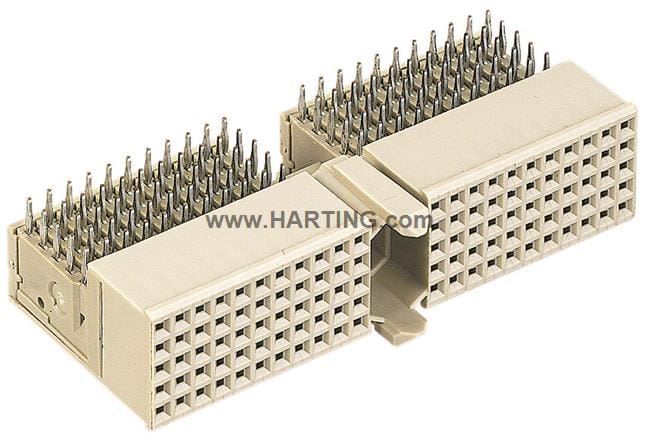
HARTING har-bus motherboard to daughterboard connection
Markets and Applications
Datacom/Telecom, Medical, Industrial, Test & Measurement, Mil/Aero
Network systems, CompactPCI, medical devices, Industrial computers (IPC), semiconductor testing, scientific labs, aerospace & defense
Suppliers
ept, Amphenol Communications Solutions, HARTING, TE Connectivity, DigiKey, Farnell Global, Conexion, Oupiin, and more.
Related products
Like this article? Check out our other Meet the Connector and Connector Basics articles, our Datacom/Telecom Market Page, and our 2025 Article Archives.
Subscribe to our weekly e-newsletters, follow us on LinkedIn, Twitter, and Facebook, and check out our eBook archives for more applicable, expert-informed connectivity content.

- Custom Cable Assemblies: A Value-Add Solution - October 13, 2026
- Fiber Optics Product Roundup - October 13, 2026
- October 2026 Connector Industry News - October 13, 2026