What is Automotive Composite Wire (ACW)?
Automotive composite wire (ACW) is a dual-wall, single-core wire used in vehicle wire harnesses for engine compartments and other high-temperature zones. Its insulation combines a radiation cross-linked polyolefin inner layer with a radiation cross-linked fluoropolymer outer layer. The two layers are chemically bonded rather than co-extruded in a thin-wall package. It is a cost-effective alternative to pure ETFE wire.
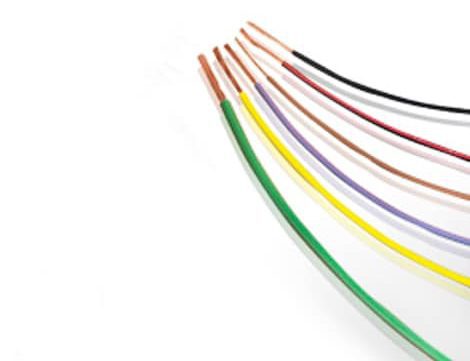
ACW was developed by Raychem Corporation in the 1990s to address the needs of the automotive market. During this era, engine compartment electrification was accelerating and integrating sensors, control modules, and increasing amounts of wiring. The high-heat wire options available at the time were either expensive (ETFE/Tefzel) or mechanically inadequate for unprotected harness routing (polyethylene). Standard dual-wall wire has unbonded layers that can allow fluids to wick between the insulation layers to connector cavities, causing electrical faults.
Raychem’s solution was to bond the two insulation layers during the radiation cross-linking manufacturing process, creating a composite that behaved as a single robust insulation layer. Tyco Electronics acquired Raychem in 1999, and TE Connectivity subsequently inherited the product line. ACW gained broad OEM approval and is considered a de facto global standard for engine harness primary wire.
Connectorization
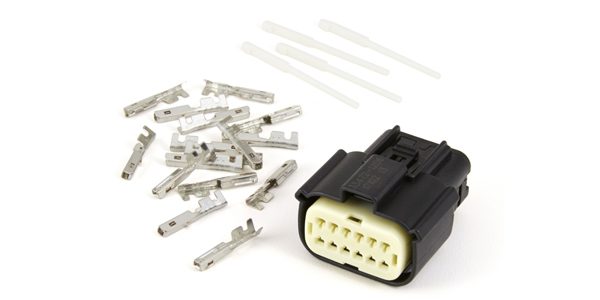
ACW is a general-purpose primary wire and is not limited to a specific connector series. Connector selection is driven by circuit requirements, environment, and OEM specifications. Common connector families used with ACW include TE Connectivity MCP and AMP Superseal, Molex MX-150, Delphi/Aptiv Metri-Pack (150, 280, 480, 630 series; available from Waytek), Deutsch DT and DTM, and equivalent sealed connector systems from Yazaki, Sumitomo, and JST used by OEM harness programs.
Termination Methods
ACW is terminated exclusively by crimp. The bonded dual-wall insulation strips cleanly using standard automated wire-processing equipment, making ACW well-suited to high-speed automated harness production. No special tooling or preparation steps are required beyond selecting the correct crimp contact for the wire’s cross-sectional area. Ultrasonic welding of conductors is also compatible with ACW.
System Considerations
ACW’s thin-wall Class D construction reduces overall harness diameter and weight relative to thicker-wall alternatives, which affects connector cavity sizing and grommet selection. Harness designers should verify that the wire’s outer diameter (OD) at each gauge falls within the connector manufacturer’s wire range for the chosen contact and cavity seal.
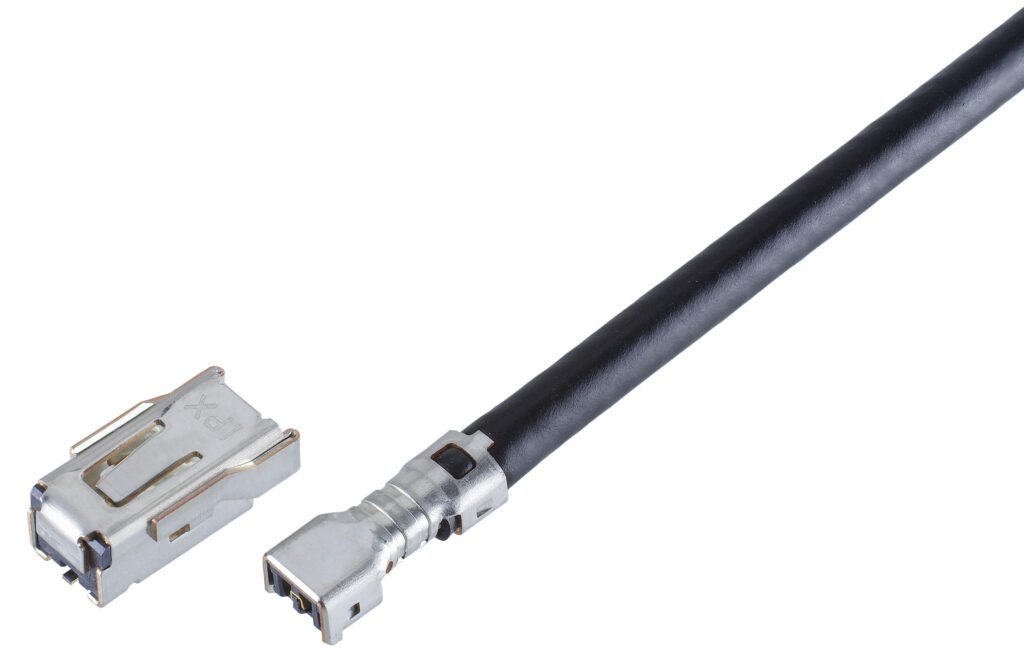
I-PEX MHF-TI is an RF connector engineered with high retention force to meet the harsh operating conditions of modern automotive systems. Suitable for ACW assembly.
Environmental & Chemical Resistance
The fluoropolymer outer layer provides a barrier to engine-bay fluids including engine oil (ASTM 1), battery acid, automatic transmission fluid, antifreeze, brake fluid, and windshield washer solution.
ACW’s thermal life rating of 3,000 hours at 150 °C satisfies the ISO 6722 Class D / T4 requirement. Heat shock performance exceeds 240 hours at 175 °C without cracking. These margins allow ACW to be routed directly through high-temperature zones — near exhaust manifolds, turbochargers, and other heat sources — without conduit or heat shielding in many applications, reducing harness cost and weight.
Technical Specifications
(Data reflects TE Connectivity ACW0219 series. Data for equivalent products from other manufacturers should be verified.)
| IDENTIFICATION | |
| Product / Series Name | Automotive Composite Wire (ACW); ACW0219 indicates dual-wall bonded insulation, 19-strand conductor |
| Manufacturer(s) | TE Connectivity (Raychem brand); equivalent products available from Siechem, R R Kabel, and others |
| Industry Category | Single-core, low-voltage automotive primary wire |
| Relevant Standards | ISO 6722 (Class D, 150 °C); Ford S97 GG 14401 AA; BMW GS.95; VW 60306; Fiat 9 91107; Tyco Electronics Raychem WSD 1223 |
| CONSTRUCTION | |
| Cable Configuration | Single conductor; also available in twisted pairs and triples (ACW0229) |
| Conductor Count | 1 (standard); 2 or 3 for twisted configurations |
| Conductor Size (mm²) | 0.35; 0.50; 0.75; 1.00; 1.50; 2.50; 4.00; 6.00; 10.00 mm² |
| Conductor Material | Bare or tinned annealed copper |
| Stranding | Multi-strand |
| Insulation System | Dual-wall, co-bonded: radiation cross-linked polyolefin inner layer bonded to radiation cross-linked fluoropolymer (PVF/PVDF) outer layer |
| Insulation Wall Thickness | Thin-wall Class D per ISO 6722; e.g., nominal 0.30 mm wall at 0.50 mm² |
| Jacket Color(s) | Full automotive color range; single or dual co-extruded longitudinal stripes available (stripe min. 10% circumference, max. 30% coverage) |
| Overall Diameter (nominal) | e.g., 1.50 mm OD at 0.50 mm²; 2.85 mm OD at 2.50 mm² |
| ELECTRICAL | |
| Voltage Rating (working) | 50 V DC |
| Current Rating | Per conductor at max. conductor temperature 80 °C and 40 °C ambient |
| Conductor DC Resistance | Per ISO 6722 and IEC 60228; e.g., ≤39.0 Ω/km at 0.50 mm² |
| ENVIRONMENTAL | |
| Operating Temperature Range | −40 °C to +150 °C continuous |
| Thermal Life (T4 rating) | 3,000 hours at 150 °C (ISO 6722 Class D / T4) |
| Fluid / Chemical Resistance | Excellent resistance to engine oil (ASTM 1), battery acid, automatic transmission fluid (Dexron III), antifreeze, brake fluid, windshield washer fluid; no wicking between insulation layers due to bonded construction |
| Flame Rating | Self-extinguishing; passes ISO 6722 flammability |
| COMPLIANCE & CERTIFICATIONS | |
| Primary Standard | ISO 6722 Class D (150 °C, thin-wall) |
| OEM Approvals | Ford S97 GG 14401 AA; BMW GS.95; VW 60306; Fiat 9 91107 |
| RoHS / REACH | Compliant (verify with current manufacturer certificate) |
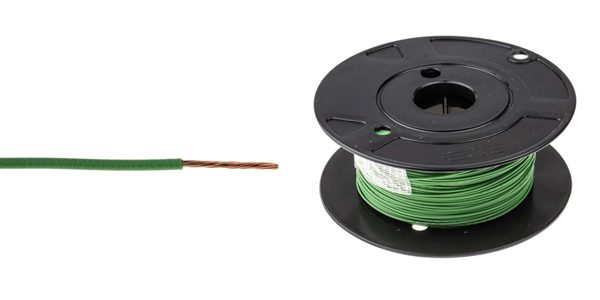
TE’s ACW 0219 wire reel
Markets & Applications
Automotive, Transportation
ACW is used almost exclusively in automotive and light commercial vehicle applications. It is specified wherever a 150 °C Class D wire is required within the vehicle, primarily in powertrain and engine management harnesses, although it has been adopted for some sensor and powertrain wiring applications.
Suppliers
TE Connectivity (Raychem brand), Waytek, Siechem Technologies, R R Kabel Limited, Dhoot Transmission (thin-wall Class D automotive cable with equivalent performance)
Related Products
ISO 6722 Class B/C Primary Wire (lower-temperature-rated alternatives (85 °C–125 °C)
ETFE/Tefzel Automotive Wire (higher-cost pure fluoropolymer alternative)
Anticapillary/Fluid-Blocked Wire (used where the connector interface rather than the insulation is the sealing concern)
To learn more about the companies mentioned in this article, visit the Preferred Supplier pages for Molex, TE Connectivity, and Waytek.
Like this article? Check out our other Meet the Connector and Connector Basics articles, our Automotive Market Page, and our 2026 Article Archives.
Subscribe to our weekly e-newsletters, follow us on LinkedIn, Twitter, and Facebook, and check out our eBook archives for more applicable, expert-informed connectivity content.

- Connectivity Is Reshaping Police and Security Vehicle Fleets - September 8, 2026
- Thermal Management Strategies with Liquid Cooling Connectors - August 11, 2026
- Rodent-Resistant Electronics - July 28, 2026