What are EDSFF Connectors?
What are EDSFF Connectors?
EDSFF connectors are a family of form factors used by Enterprise and Datacenter SSD Form Factor (EDSFF) drives. This high-speed, high-power, enterprise-grade PCIe/NVMe SSD connector standard was developed by the SNIA (Storage Networking Industry Association) to meet the needs of modern data center design with scalability, density, and thermal performance.
This interface is optimized for PCIe/NVMe in servers and provides many advantages, including front-access serviceability and improved signal integrity at PCIe Gen5/6. EDSFF is part of a broader architectural shift in server storage design and is replacing older data center SSD form factors like 2.5” U.2 and M.2.
The EDSFF specification was developed by the Small Form Factor Technology Affiliate technical work group under the stewardship of the Storage Networking Industry Association. EDSFF drives commonly use connectors based on the SFF-TA-1002 specification (sometimes referred to as the “Gen-Z style” connector, though primarily used for PCIe/NVMe).
The EDSFF family of specifications comes in four form factors, All use similar high-speed card-edge style connectors but differ in mechanical envelope and power delivery.
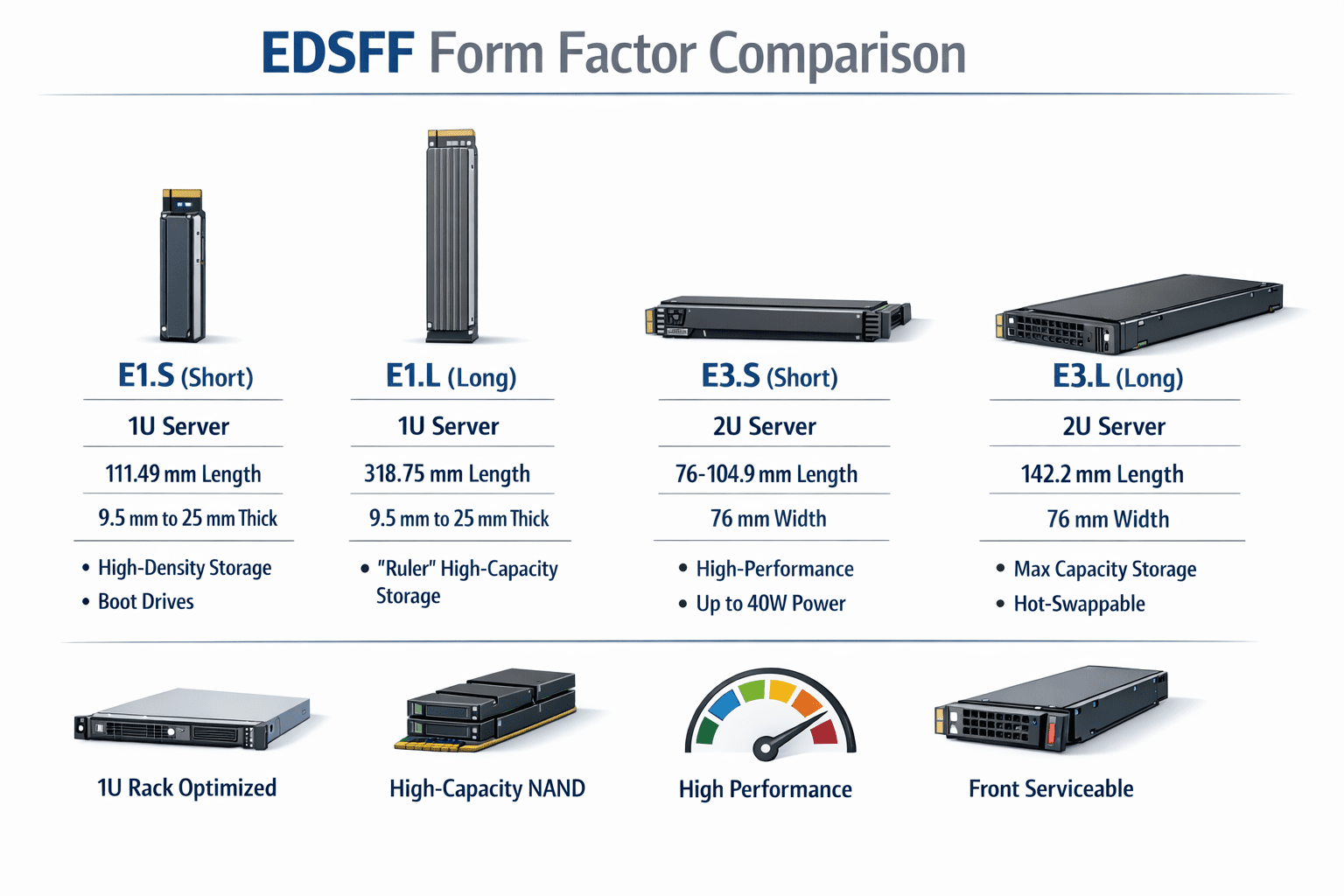
EDSFF (Enterprise & Datacenter SSD Form Factor) comparison showing four main variants optimized for different server configurations and performance requirements. Image adapted from SNIA EDSFF reference materials
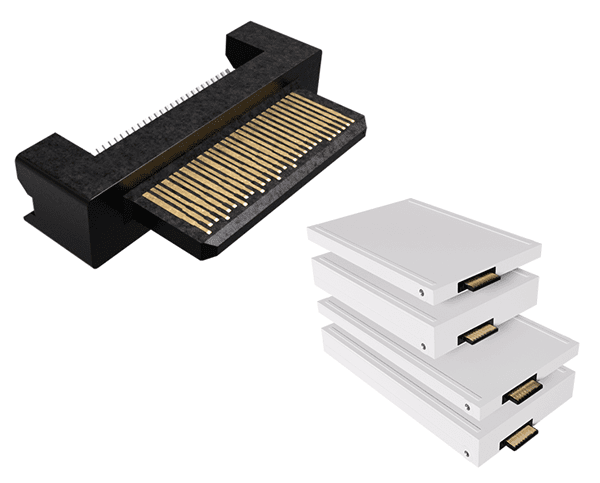
Amphenol Mini Cool Edge Plug : 0.60mm pitch adapter for EDSFF E1/E2/E3 and CXL drives
Automotive variant
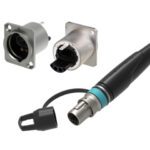
A new EDSFF specification for automotive applications is currently in development. This ruggedized variant features an automotive-grade EDSFF connector with receptacle connector and adaptor install on SSD device side. The connector interface has the same contact pin and gold finger pattern as SNIA-TA-1002. Both board attached connector and cable attached connector feature additional enhanced mechanical features to meet the harsh environment needs of automotive applications
EDSFF System Design Advantages
EDSFF delivers superior signal integrity and airflow compared to traditional
backplane designs, as demonstrated in this SNIA presentation:
~40% signal loss reduction, 75% airflow improvement.
- Signal Integrity: Direct connection reduces backplane
routing signal loss by ~40% - Airflow: 75% front opening increase, 20% CFM improvement
Design Notes
Standards: EDSFF stands for Enterprise and Datacenter Standard Form Factor. The family of specifications were developed by a group of 15 companies to address the concerns of data center storage, and are now maintained by SNIA as part of the SFF Technology Affiliate Technical Work Group (SFF TA TWG).
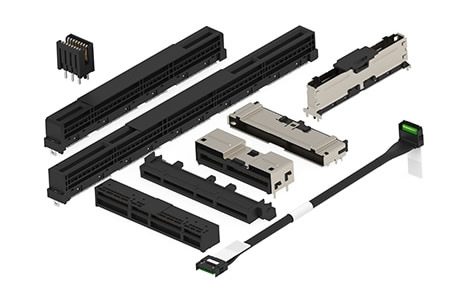
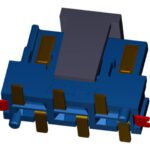
TE Connectivity SFF-TA-1002 sliver interconnects for standard: 0.6mm pitch card-edge connectors supporting EDSFF, PECFF, OCP NIC, and DC-XPI datacenter standards
Pins: 0.60 mm contact pitch with multiple pin-count variants supporting x4, x8, and x16 PCIe lane configurations
Technical Specifications
| Specification | Attributes |
|---|---|
| Contact Positions: | 56, 84, or 140 per SFF-TA-1002 |
| Lane Widths: | x4, x8, x16 (implementation dependent) |
| Signaling: | Differential high-speed pairs |
| PCIe Compatibility: | Backward compatible across PCIe generations |
| Motherboard Termination: | MCIO connectors (common method) |
| Width: | 31.5 mm (5.9 mm and 8.01 mm E1.S variants) or 33.75 mm (other E1.S variants) |
| Thickness Options: | 5.9 mm, 8.01 mm, 9.5 mm, 15 mm, 25 mm |
| Signal Rate: | 32 GT/s (PCIe Gen5) · 64 GT/s (PCIe Gen6 PAM4) |
| Mis-insertion Prevention: | Chassis-level alignment — bay/carrier mechanics, not pin-field keying |
| Competing Standard: | Samsung NGSFF (M.3 / NF1) — not compatible with EDSFF interface |
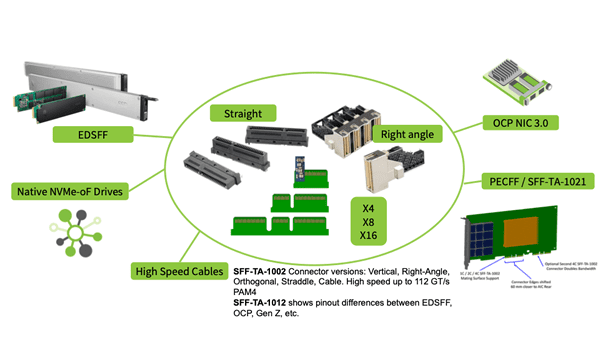
SFF-TA-1002 Connector Ecosystem: Applications include EDSFF storage, OCP NIC 3.0 network cards, and PECFF carriers. Available in vertical, right-angle, orthogonal, straddle, and cable variants supporting X4/X8/X16 PCIe lanes up to 112 GT/s. Source: SNIA
Markets and Applications
Datacom, Automotive
The rapid build-out of facilities to meet the demands of AI hyperscale data centers (e.g., Meta, Microsoft Azure) advanced the adoption of the EDSFF interface and accelerated the retirement of U.2-based architectures.
A new EDSFF specification for automotive applications is expected in 2026.
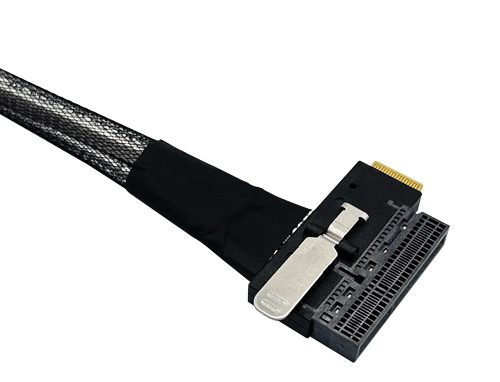
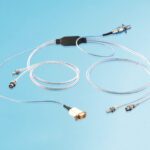
JPC’s EDSFF E3 high-speed cable assembly enables the transmission of power and high-speed signals through a cable that connects directly to the main PC board, supporting EDSFF E3 SSDs and CXL or other modules. This 2-piece EDSFF cable solution supports PCIe 5.0 data rates of up to 32 Gb/s. JPC EDSFF E3 High-Speed Cable Assembly – Direct motherboard connection for EDSFF E3 SSDs and CXL modules with PCIe 5.0 support (up to 32 Gb/s)
Suppliers
EDSFF connectors and assemblies are available from Amphenol Communications Solutions, BizLink, JPC Connectivity, Molex, Samtec Inc., and TE Connectivity.
Related products
SNIA-TA-1002
2.5″ U.2, M.2 connectors
PCIe Base Specification (PCI-SIG)
NVMe specification
Like this article? Check out our other Meet the Connector and Connector Basics articles, our Datacom/Telecom Market Page, and our 2025 and 2026 Article Archive.
Subscribe to our weekly e-newsletters, follow us on LinkedIn, Twitter, and Facebook, and check out our eBook archives for more applicable, expert-informed connectivity content.

- Connectivity Is Reshaping Police and Security Vehicle Fleets - September 8, 2026
- Thermal Management Strategies with Liquid Cooling Connectors - August 11, 2026
- Rodent-Resistant Electronics - July 28, 2026