Selecting RF Interconnects for Quantum Computers
Quantum engineers must consider the complex needs of today’s computing systems as well as plan for future needs as performance expectations inevitably scale up. Three areas of consideration help guide component selection.

Article contributed by SV Microwave
The field of quantum computing is undergoing a rapid evolution with the arrival of new material innovations, software developments, and expanding hardware options for designing quantum computing systems. Quantum computers leverage quantum mechanics by replacing traditional binary bit circuits with quantum particles called quantum bits, or qubits. A range of components support these complex machines.
Quantum processing units (QPUs), essentially the central processing unit of a quantum computer, execute quantum algorithms and perform calculations on quantum bits or qubits. Control electronics, which include high-frequency microwave generators, amplifiers, and attenuators, and subsystems such as cryogenic refrigeration systems, magnetic shielding, and vibration isolation systems, used to maintain the fragile quantum states of the qubits, support these complex computing operations.
Quantum systems grow in complexity as the number of qubits increases, and the number of interconnects in these systems also increases. The challenge is to maintain optimal function across a large and intricate network of connections. Quantum engineers face critical decisions to specify the right components and materials. Factors such as the number of control channels, signal frequency, and bandwidth requirements influence selections, while at the same time contributing to the efforts to minimize heat and interference.
To maintain qubit coherence, components on the quantum processing layer must be non-magnetic. They also need to be high-density, to connect multiple qubits in a small space.
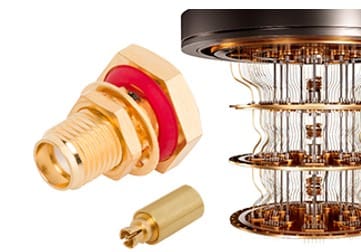
Engineers can make several choices to mitigate against qubit decoherence. Qubits, quantum computing’s basic unit of information, are fragile. Decoherence leads to quantum information loss in qubits, making it impossible to perform accurate computations. Selecting the right interconnects for the unique demands of quantum computing is the difference between robust and reliable quantum computations or facing error-prone and unusable results.
Here’s what designers need to consider when specifying RF interconnects for quantum systems:
- How many control channels are in your plan?
As quantum technology develops, engineers need to pack more and more components into smaller spaces. At the same time, research is focusing on how to scale up for more widespread use. More control channels allow for more complex computations. Alongside this, interconnect designs capable of handling complex control signals all need to scale effectively to accommodate a growing number of qubits. One solution is ganged connectors. These connectors allow for multiple connections in a compact area, offering much more efficient use of space compared to the traditional approach of one connecter for each control channel.
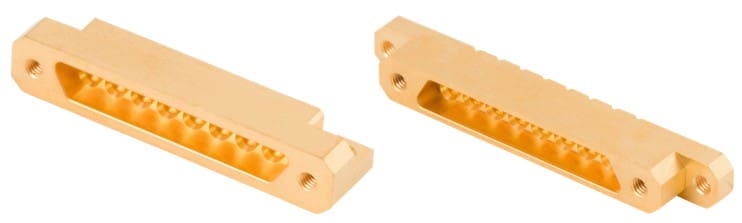
Edge Launch and surface mount ganged connectors
- What are the signal frequency and bandwidth requirements?
It’s essential to match the interconnect’s capabilities to the specific signal characteristics used in the system and keep any signal attenuation to an absolute minimum. Minimizing signal loss is crucial. Look for interconnects with low insertion loss and return loss to ensure strong signal integrity.
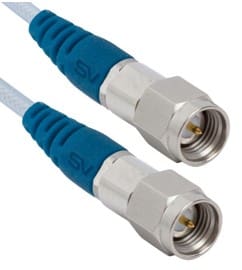
Bandwidth is another important factor. Limited bandwidth causes problems with scalability and slow computational time. New interconnect technologies with higher inherent bandwidth capabilities can help overcome limitations in data transfer rates.
- What is the operating temperature range?
Quantum computing requires cryogenic operating temperatures, typically close to absolute zero. When designing for these exceptionally cold environments, it is essential to specify harsh environment components that can function optimally and maintain their electrical properties under challenging conditions. Choosing materials that operate well at cryogenic temperatures such as beryllium copper, Teflon, and stainless-steel helps mitigate risks. Insufficient components face degradation in the form of thermal contraction (materials contract at extremely low temperatures, putting stress on connections). Increased resistivity is another risk; at cryogenically low temperatures, a decrease in electrical resistance can risk higher signal loss in interconnects. Material selection is of critical concern. Interconnects run the risk of becoming brittle at cryogenic temperatures, and brittle components break, leading to errors in computational results, or even complete system failure.
Connectors as well as cables should be selected for endurance. For example, fridge-to-rack cables are essential components that connect the cryostat to the room-temperature controls outside. High-quality cabling needs low attenuation and high phase stability to preserve signal integrity.
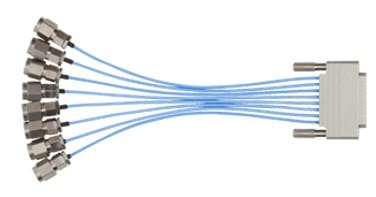
Visit SV Microwave to learn about components and custom solutions for the next evolution of quantum computing.
Like this article? Check out our other RF and Coax, High-Speed articles, our Datacom Market Page, and our 2025 Article Archive.
Subscribe to our weekly e-newsletters, follow us on LinkedIn, Twitter, and Facebook, and check out our eBook archives for more applicable, expert-informed connectivity content.

- Printing at the Edge of Possibility: How TE Connectivity Leverages Micro-3D Printing - October 13, 2026
- A Five-Layer Clad Solution for High-Performance Battery Interconnects - October 6, 2026
- High Voltage Interlock for Commercial Vehicles: A Must-Have or a Nice to Have? - September 29, 2026