What is SPE Cable?
SPE cable, or single-pair Ethernet cable, is an industrial grade cabling that uses just one twisted pair of wires to carry full IEEE 802.3 Ethernet signals instead of the traditional two or four pairs found in standard Ethernet cables like Cat5e or Cat6. It is a fast (10 Mb/s to 1 Gb/s), economical, small, and lightweight cabling option (up to 75% lighter than 4-pair Ethernet) for tight areas such as IoT and edge computing devices, building security and automation systems, robotics, sensors, and cameras. It is also used for in-vehicle networking as a replacement for CAN bus or MOST.
The Institute of Electrical and Electronics Engineers (IEEE) developed SPE in the 2010s in response to the automotive industry’s need for lightweight data transmission. The IEEE 802.3 Ethernet standards committee standardized the cable. The SPE Industrial Partner Network, a consortium that includes Phoenix Contact, TE Connectivity, HARTING, and others, was formed to accelerate ecosystem development and standards alignment.
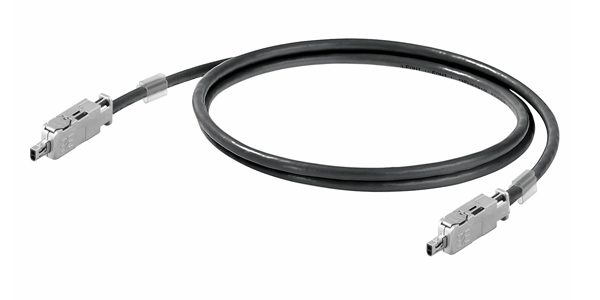
Two main cabling products support the standard. SPE data cables are available in different stresses with different sheath materials and also for moving applications for drag chain and torsional stress. Ready-to-use system cables are terminated with SPE connectors for fast and error-free installation, available with a wide variety of cables and connectors adapted to the respective application.
The cable classifications defined for SPE are the same ones used for Profinet:
- Type A: wires with solid wire for permanent installation
- Type B: wires with stranded conductors for flexible applications or vibrations
- Type C: wires with stranded conductors for high dynamic applications (such as drag chains)
- Type R: torsion tested cables with stranded conductors for robotic applications
Different jacketing materials are used for each cable type to suit specific applications. Type A and B cables are typically screened with PVC. Halogen-free, food safe, and oil- and chemical-resistant alternatives are available. Type C cables are available in PUR, PVC, and Santoprene. Type R robot cables are available in PUR and Santoprene.
Future evolutions
SPE connectors and cables will continue to develop in tandem with increasing speeds and expanding use in new applications. “To address evolving market requirements and future Industrial Ethernet architectures, the platform is currently undergoing qualification for 1000BASE-T1 performance up to 1250 MHz. This next-generation capability is designed to enable scalable transmission speeds of up to 1 Gbit/s while maintaining the compact and efficient design principles of the existing platform,” said Michael Radau, Sales Manager Industrial Harnessing – DACH Region Dätwyler. Dätwyler is a Swiss-based manufacturer of SPE cables that works in partnership with Weidmüller.

SPE cable solutions from Dätwyler provide precision, reliability, and consistent performance in demanding industrial environments. A highly optimized slimline cable architecture reduces installation space requirements while improving integration flexibility in modern infrastructure designs. Lower cable weight enables more efficient handling, simplified logistics, and accelerated installation processes, particularly in large-scale deployments.
Connectorization
SPE cable is terminated with connectors from the IEC 63171 family. The T1 Industrial connector (IEC 63171-6) is the primary field-installable SPE connector for industrial automation. The LC-Cu style SPE connector (IEC 63171-1) uses a fiber-optic LC form factor adapted for copper. M8- and M12-threaded circular connector variants (IEC 63171-5/-6) provide IP67 sealing for harsh environments. The emerging IEC 63171-7 standard aims to unify the M12 SPE pin pattern across manufacturers.
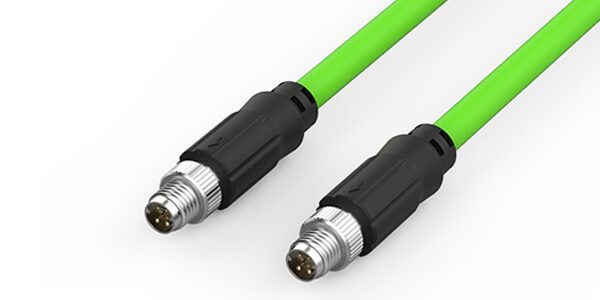
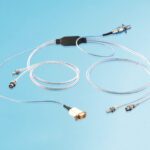
ATTEND’s SPE Hybrid Cable Assemblies integrate four independent Single Pair Ethernet (SPE) interfaces—supporting both data transmission and optional power—into a single, streamlined cable.
SPE cable selection affects whether a link meets its IEEE 802.3 channel requirement. The cable must be matched to the target standard (IEC 61156-11/12 for 1GBASE-T1 [40 m max] and IEC 61156-13/14 for 10BASE-T1L [1,000 m max]) since electrical parameters differ significantly between speed classes. Shielded cable (S/UTP) is required for 40 m industrial variants where it maintains signal integrity in electrically noisy factory environments. For PoDL (power over data line) applications, conductor cross-section determines the maximum deliverable current: AWG 22 supports higher PoDL power classes; AWG 26 limits usable power reach. Impedance continuity at the cable-connector interface is critical; mismatch causes reflections that degrade link margin. Flex-rated cable variants (IEC 61156-12 and IEC 61156-14) must be selected for robotic or drag-chain installations.
Termination methods
Common termination styles include crimping IDC (insulation displacement contact), and soldering. Shield termination is critical; most industrial SPE connectors provide 360° shield contact via a dedicated crimp ring.
Shielding & signal integrity
Shielding for SPE cable varies by application. Automotive SPE cables for 100BASE-T1 at lengths under 15 m are typically unshielded (U/UTP). Industrial SPE cables for 1GBASE-T1 at up to 40 m (10BASE-T1L at long distances) require shielding to maintain signal quality in electrically noisy environments. The most common industrial construction is S/UTP (overall foil shield) or SF/UTP (foil plus braid). Because SPE transmits bidirectionally on a single pair, shield integrity is more critical than in conventional Ethernet.
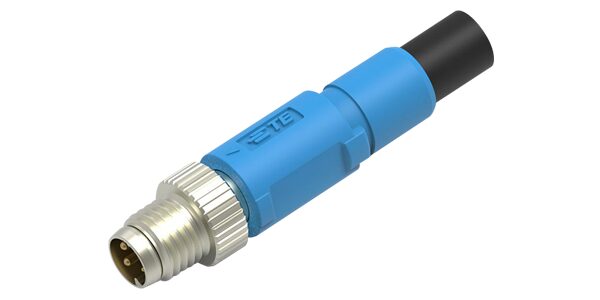
Hybrid SPE connectors combining SPE signal contacts with additional power contacts are available in TE Connectivity’s M8 Hybrid format, available from Mouser Electronics, allowing a single connector to handle both PoDL and supplemental load power.
Flexibility & durability
SPE cable is available in both fixed-installation and flexible variants. Fixed-installation cable (IEC 61156-11, IEC 61156-13) uses solid conductors and a stiffer jacket for permanent runs in conduit or cable tray. Flexible cable (IEC 61156-12, IEC 61156-14) uses finely stranded conductors and a more resilient jacket (PUR or TPE) to withstand repeated bending.
Environmental & chemical resistance
Industrial SPE cables for factory-floor or outdoor installations are typically jacketed in PUR (polyurethane) or TPE (thermoplastic elastomer) rather than standard PVC for resistance to mineral oils, coolants, and hydraulic fluids common in industrial environments, and maintain flexibility at temperatures as low as –40 °C. LSZH (low smoke zero halogen) jacketed variants are also available.
TECHNICAL SPECIFICATIONS
| IDENTIFICATION | |
| Product / Series Name | SPE Cable (Single-pair Ethernet cable); also marketed as T1 Cable. Variant designations: SPE fixed (IEC 61156-11/-13) and SPE flex / drag-chain (IEC 61156-12/-14) |
| Standards | IEC 61156-11 (1 Gb/s, fixed); IEC 61156-12 (1 Gb/s, flexible); IEC 61156-13 (10BASE-T1L, fixed); IEC 61156-14 (10BASE-T1L, flexible); IEEE 802.3bw / 802.3bp / 802.3cg; ISO/IEC 11801 TR9906; RoHS compliant |
| CONSTRUCTION | |
| Cable Configuration | Single twisted pair (1×2); shielded (S/UTP or SF/UTP for industrial) or unshielded (U/UTP for automotive short-range) |
| Conductor Count | 2 conductors (1 twisted pair); drain wire present in shielded constructions |
| Conductor Size (AWG / mm²) | AWG 26 (0.13 mm²) or AWG 22 (0.34 mm²) most common; AWG 24 also available. AWG 22 preferred for long-range PoDL; AWG 26 for space-constrained sensor drops. Fixed-install variants often solid; flex variants stranded. |
| Conductor Material | Bare copper (solid, fixed installation); tinned copper (stranded, flex applications) |
| Insulation Material | PE (Polyethylene) or FEP for fixed installation; cross-linked PE (XLPE) or modified PE for flex. Low-capacitance insulation critical to meet 600 MHz bandwidth requirement. |
| Insulation Wall Thickness | Approximately 0.2–0.35 mm (varies by AWG to meet IEC 61156 capacitance requirements) |
| Jacket Material | PVC (standard indoor/panel); PUR or TPE (industrial, oil-resistant, flex); LSZH/FRNC (fire-safety environments). Automotive: PP or XLPO. |
| Jacket Color(s) | Varies by manufacturer; grey, black, and green are common |
| Overall Diameter (nominal) | Approximately 3.5–6.5 mm OD (AWG 26 shielded ≈ 3.5–4 mm; AWG 22 shielded ≈ 5.5–6.5 mm); approximately 25% smaller diameter and 50% lighter than a comparable 4-pair Cat5e cable |
| SHIELDING | |
| Shield Type(s) | Foil (Al/Mylar, S/UTP) for most industrial grades; foil + braid (SF/UTP) for harsh-environment variants. Unshielded (U/UTP) for automotive short-range (<15 m). |
| Shield Coverage | Foil: 100% coverage; braid (where present): typically 85–95% coverage |
| Shield Material | Aluminum/polyester foil (overall); tinned copper braid (where present) |
| Drain Wire | AWG 24–26 tinned copper drain wire; present in shielded constructions |
| ELECTRICAL | |
| Voltage Rating (working) | Typically 100 V AC / 150 V DC (per IEC 61156 cable insulation rating); PoDL operates at low DC voltage per IEEE 802.3bu/cg class definitions |
| Current Rating | PoDL support up to 16 A (cable-dependent); AWG 22: higher PoDL current capacity; AWG 26: limited to lower PoDL classes. T1 Industrial connectors rated to 4 A per contact. |
| Conductor DC Resistance | AWG 26: ≤147 Ω/km (≈44.8 Ω/1000 ft); AWG 24: ≤93 Ω/km; AWG 22: ≤59 Ω/km at 20°C |
| MECHANICAL & FLEXIBILITY | |
| Minimum Bend Radius | Fixed installation: 4–6× cable OD (typically 20–40 mm); Flexible / drag-chain: 7.5–10× OD minimum dynamic bend radius (varies by manufacturer) |
| Flex Life (rated) | Drag-chain rated variants: typically 5–10 million flex cycles at rated dynamic bend radius (IEC 61156-12 / -14 flex cable class) |
| Tensile Strength (rated) | Varies by construction; typically 50–200 N for industrial grades (verify per product datasheet) |
| Weight (nominal) | Approximately 15–40 kg/km depending on AWG and construction |
| ENVIRONMENTAL | |
| Operating Temperature Range | Fixed (PVC jacket): –20 °C to +70 °C; Fixed (PUR/TPE jacket): –40 °C to +90 °C; Flexible (PUR): –30 °C to +80 °C; Automotive: –40 °C to +125 °C |
| Sunlight / UV Resistance | UV-stabilized jacket grades available (PUR, TPE) |
| Fluid / Chemical Resistance | PUR-jacketed grades: resistant to mineral oils, coolants, hydraulic fluids, and mild acids/bases. TPE grades offer moderate oil and fuel resistance. |
| Flame Rating | IEC 60332-1 (single cable flame spread); IEC 60332-3 (bundled); IEC 61034 smoke density for LSZH variants; UL VW-1 for UL-listed constructions |
| COMPLIANCE & CERTIFICATIONS | |
| UL / CSA Listing | UL Listed constructions available for North American market (UL AWM or UL CM/CMR); CSA certification available on select products. |
| RoHS / REACH / Halogen Free | RoHS compliant (EU Directive 2011/65/EU and 2015/863/EU); REACH compliant; LSZH / halogen-free variants available |
| Military / Aerospace Spec | No applicable MIL-SPEC for SPE cable as of 2025; aerospace and defense SPE deployments reference IEC 61156 cable standards and IEEE 802.3 PHY standards |
| Other Certifications | CE Mark; cULus (select products); ATEX-rated variants from select manufacturers; IEC 61918 (industrial network cabling) |
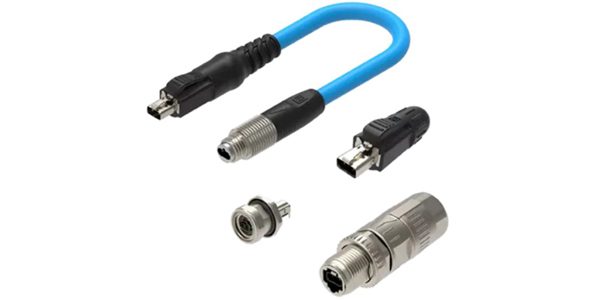
From Mouser Electronics, Belden Wire & Cable SPE connectors and cables are designed to enable the connection from IP20-controlled environments down to IP65/IP67 harsh industrial areas.
SUPPLIERS
ATTEND, Amphenol LTW, Phoenix Contact, TE Connectivity, Weidmüller, Belden (Mouser Electronics), through DIgiKey)
MARKETS & APPLICATIONS
Automotive, Industrial
In industrial automation, SPE cable connects sensors, actuators, cameras, and field devices directly to Ethernet switches and PLCs without fieldbus gateways, enabling IP connectivity from cloud to sensor. In process industries (oil and gas, chemical, water treatment), 10BASE-T1L SPE cable running 1 km on a single pair is positioned to replace HART and PROFIBUS PA wiring. In automotive, SPE is used in vehicle camera systems, lidar, ADAS sensors, and in-vehicle infotainment networks, replacing heavier proprietary wiring harnesses. In building automation, SPE enables lightweight Ethernet drops to lighting nodes, access control panels, HVAC sensors, and occupancy detectors. In robotics, the combination of small OD, low weight, and drag-chain rated constructions makes SPE attractive for multi-axis robot arms and collaborative robots. Aerospace and defense applications include lightweight avionics buses, C4ISR systems, and UAV sensor networks where SWaP (Size, Weight, and Power) is critical.
| Standard | Speed | Max Distance | Use |
| 10BASE-T1S | 10 Mb/s | ~25 m | Short-range, multi-drop |
| 10BASE-T1L | 10 Mb/s | up to 1 km | Industrial, long distance |
| 100BASE-T1 | 100 Mb/s | ~15 m (automotive) | Vehicles |
| 1000BASE-T1 | 1 Gb/s | ~15–40 m | High-speed automotive |
RELATED PRODUCTS
Like this article? Check out our other Meet the Connector and Connector Basics articles, our Wire & Cable Market Page, and our 2026 Article Archives.
Subscribe to our weekly e-newsletters, follow us on LinkedIn, Twitter, and Facebook, and check out our eBook archives for more applicable, expert-informed connectivity content.

- Connectivity Is Reshaping Police and Security Vehicle Fleets - September 8, 2026
- Thermal Management Strategies with Liquid Cooling Connectors - August 11, 2026
- Rodent-Resistant Electronics - July 28, 2026