Single-Pair Ethernet Presents a United Front
The arrival of the single-pair Ethernet (SPE) interface marked a significant advancement in industrial connectivity. The new interface reduced wiring, power, and complexity while setting the stage for new technologies, including AI, to become part of factory, building management, automotive, and IoT systems. Now the two organizations that separately championed the interface have joined forces.

The Single Pair Ethernet System Alliance and the SPE Industrial Partner Network, two leading consortia that have previously developed and promoted SPE ecosystems independently, announced plans to join forces on July 11, 2025. After years of offering different perspectives on SPE, this collaboration aims to streamline technical standards, accelerate global adoption, and ensure seamless interoperability across industries.
By combining resources and technical expertise, the two groups will offer clear guidance on connectors, cabling infrastructure, and test specifications. This unified approach not only eliminates redundancy but also simplifies implementation for OEMs, systems integrators, and end users who have, until now, faced a fragmented standards landscape. Most importantly, the two groups have agreed upon a new interface, the IEC 63171‑7 hybrid SPE connector. It will be the new SPE standard going forward.
“The industry has now agreed on a uniform connector face. The international standardization now initiated by ISO/IEC and the acceptance of this interface by Profinet will create clarity, security, and unambiguity for manufacturers and users and thus accelerate the breakthrough of this technology,” said Simon Seereiner, business development manager at Weidmüller.
The IEEE 802.3cg‑based 10BASE‑T1 series enabling simultaneous power and data over a single copper pair of wires (PoDL) has revolutionized industrial and IoT connectivity. SPE supports long‑distance runs (up to 1 km for 10BASE‑T1L, 25 m or so for 10BASE‑T1S), data rates from 10 Mb/s up to 1 Gb/s (via later higher-speed standards), reduced weight and footprint, and streamlined sensor‑to‑cloud deployments across industrial automation, building management, automotive, and other application areas.
However, confusion clouded the concept for users and system designers seeking compatibility. Until now, the two SPE consortia promoted different interfaces that each utilized the twisted pair concept. The SPE Industrial Partner Network includes connector suppliers KYOCERA AVX, HARTING, Hirose Electric, Molex, TE Connectivity, and Würth Elektronik. Meanwhile, the Single Pair Ethernet System Alliance is associated with Fischer Connectors, Phoenix Contact, Rosenberger, WAGO, and Weidmüller. Many technology companies beyond the interconnect space are members as well.
The SPE Industrial Partner Network promoted the IEC 63171‑6 connector family (M8/M12 hybrid style for IP20/IP67), optimized for industrial field‑deployment and rugged hybrid data‑power hybrid plugs.
Meanwhile, the SPE System Alliance championed the IEC 63171‑2 (IP20) and IEC 63171‑5 (M8/M12 – IP67), a “rectangular‑style” IP20 plug (‑2) and M8/M12 form‑factor (‑5) ideal for field sensors, sealing, and compatibility with IP67 environments. Phoenix Contact’s SPE IP67 connector line is based on this standard. Phoenix spearheaded the IEC 63171‑7 hybrid SPE connector, which is now the unified standard.
The new hybrid connector standard IEC 63171‑7 offers designers a common mating face for industrial Ethernet applications. The interface, an M12‑style plug that supports power and data simultaneously, was co‑developed by Phoenix Contact, TE Connectivity, and HARTING and is offered in IP20 and IP67 variants.

IEC 63171‑7 is the newly established hybrid SPE standard now backed by both consortia. The new spec defines one unified connector profile across vendors, enabling true interoperability in industrial and field installations. It supports PoDL power and data in an M12‑style form factor (Type I‑VII coding, 8–16 A, up to 600 V where appropriate) and works for IP20 or IP67 deployments.
A new SPE standard
Consolidation around IEC 631717 means designs can be futureproofed for multivendor interoperability. With one hybrid connector family covering IP20 and IP67 conditions, module designers and field cabling installers can streamline parts selection. The new interface also offers installation advantages: The M12 form factor with PoDL support enables compact field devices (sensors, I/O blocks, edge nodes) with fewer cables, standardized terminations, and robust environmental sealing.
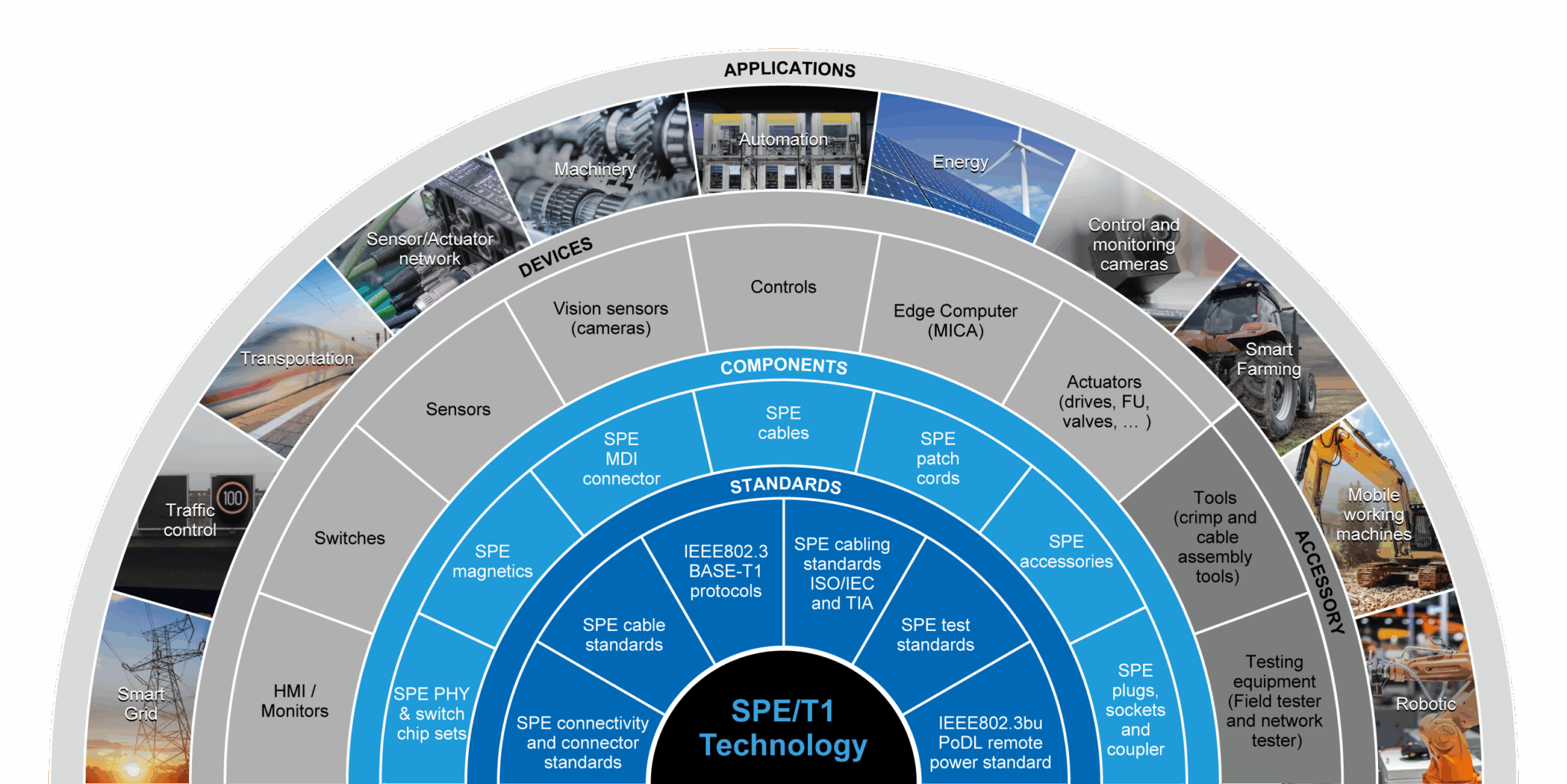
SPE connector systems encompass a wide range of products and can be used in numerous industries.
By combining resources and technical expertise, the new joint body plans to offer clear guidance on connector systems, cabling infrastructure, and test specifications. This unified approach not only eliminates redundancy but also simplifies implementation for OEMs, systems integrators, and end users who have, until now, faced a fragmented standards landscape.
The new standard will be exhibited at SPS Atlanta in September 2025 and SPS Nuremberg in November 2025.
To learn more about the companies mentioned in this article, visit the Preferred Supplier pages for Interstate Connecting Components (ICC), BizLink, Fischer Connectors, HARTING, Hirose Electric, KYOCERA AVX, Molex, Phoenix Contact, Rosenberger, TE Connectivity, WAGO, Weidmüller, and Würth Electronik.
Like this article? Check out our other Ethernet and Standards articles, our Industrial Market Page, and our 2025 Article Archives.
Subscribe to our weekly e-newsletters, follow us on LinkedIn, Twitter, and Facebook, and check out our eBook archives for more applicable, expert-informed connectivity content.

- Connectivity Is Reshaping Police and Security Vehicle Fleets - September 8, 2026
- Thermal Management Strategies with Liquid Cooling Connectors - August 11, 2026
- Rodent-Resistant Electronics - July 28, 2026