Building Secure, Connected OT Networks
New cybersecurity directives in Europe and the United States will change industrial network design. Managed Ethernet switches are at the heart of this shift, providing the visibility, access control, and redundancy that unmanaged devices simply cannot deliver.

By Basma Ahmed, Product Manager-Industrial Ethernet, Weidmuller USA
In today’s industrial landscape, cybersecurity for OT networks is no longer optional, it is a regulatory requirement. Europe’s upcoming Cybersecurity and Resilience Act (CRA), which supplements the NIS2 directive, requires manufacturers and operators to prove their systems are both reliable and secure. Similar guidelines, such as ISA/IEC 62443, are being adopted in the U.S. The law sets cybersecurity obligations for products with digital elements creating a framework that promotes transparency, secure development practices, and trusted products for end users.
Managed Ethernet Switches are at the heart of this shift, providing the visibility, access control, and redundancy that unmanaged devices simply cannot deliver. To help customers prepare for these new realities, they need solutions that align with industry-recognized security standards and support a scalable, future-ready foundation for connected production environments.
Visibility and control
As industrial networks grow in size and complexity, the need for flexibility, control, and visibility is mission critical. Without a strong foundation, organizations face blind spots, costly overhauls, and disruptive troubleshooting. Managed switches solve these challenges with the performance and intelligence modern networks require. Gigabit and 10G uplinks handle heavy automation and IIoT data loads, while encrypted SNMPv3, syslog integration, intuitive GUIs, and real-time diagnostics give operators visibility to detect anomalies early and respond quickly. Power over Ethernet (PoE) further simplifies IP camera deployment, extending flexibility to the network edge.
Suppliers like Weidmuller help operators build networks designed for connectivity, insight, and scalability. They deliver the visibility and control needed to transform networks from reactive infrastructures to a more intelligent proactive sentinel that actively protects your networks from hostile actors.
Strengthening security where it matters most
Cyber threats in industrial networks are increasing not only due to cloud connectivity and shared infrastructures without proper access controls, but also from mixing legacy, unprotected, isolated, or localized network-based equipment with switches and gateways. This exposes these systems to plant-wide networks and the cloud, creating new vulnerabilities and expanding the attack surface. To stay protected, organizations must go beyond VLANs with advanced measures: 802.1X NAC for device authentication, MAC filtering and port security to block unauthorized access, ACLs to control traffic, and encrypted protocols like SNMPv3, HTTPS, and SSH for secure management.
In industrial environments, managed switches form part of a broader security strategy. The IEC 62443 standard provides guidance for organizations and system operators on establishing effective cybersecurity policies and processes for Industrial communication networks, including network and system security. It covers areas such as risk assessment, incident response, patch management, and secure integration practices. By aligning with the IEC 62443 standard, operators ensure that technical measures like those implemented in managed switches will support the necessary governance, procedures, and operational discipline to maintain long-term resilience.
By combining advanced security features with the IEC 62443-2 standards for industrial automation and control, operators can build cybersecurity programs that address both technology and organizational practices while preparing for regulations like the Cyber Resilience Act (CRA). While IEC 62443-4-2 certifies systems or networks, individually approved components can be used to help drive towards compliance.
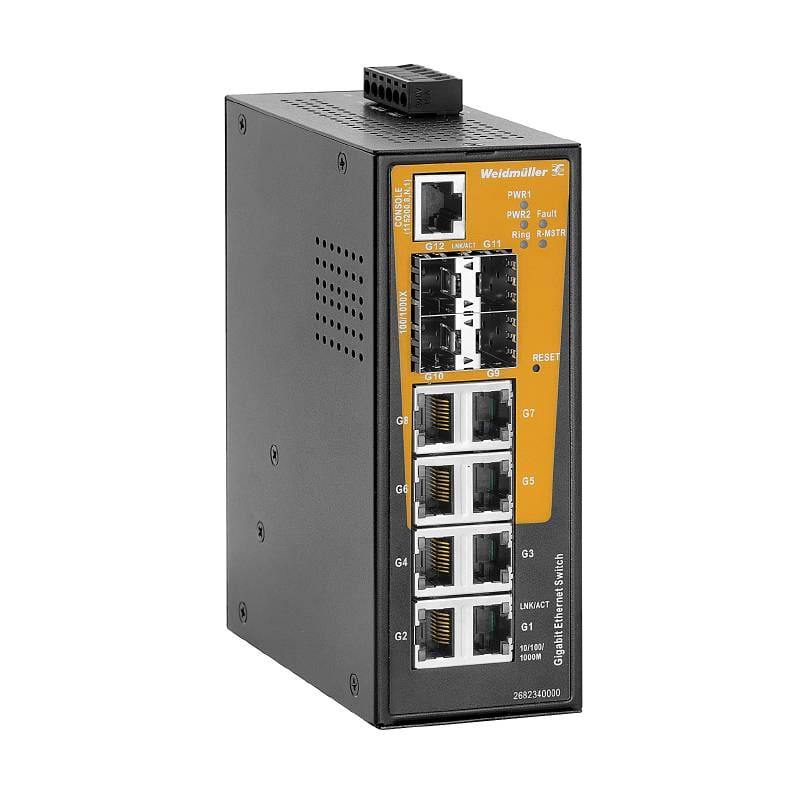
Weidmuller’s Advanced Line Gigabit with IEC 62448-2 certification.
Performance optimization for critical workloads
Automation environments depend on real-time communication. Managed switches provide Quality of Service (QoS) features that prioritize critical traffic, such as SCADA data, over less time-sensitive streams. They also support VLAN segmentation and IGMP snooping, which reduce unnecessary multicast traffic.
The result is prioritized and predictable data flow, ensuring that safety critical processes and advanced applications operate reliably, with minimal packet loss or delays.
Redundancy: Because every millisecond matters
In industrial automation, even a split-second disruption can halt production, damage equipment, or compromise safety. Managed switches counter this with redundancy, delivering recovery times under 30 milliseconds through ring topologies, RSTP/MSTP protocols, and dual power inputs to ensure continuity. These built-in features improve uptime, productivity, and protect your assets at very little added cost.
For example, in a data center, unmanaged switches leave operators blind to device activity, slow to recover from failures, and unable to enforce security at the port level. By contrast, managed switches provide encrypted monitoring (SNMPv3), 802.1X access control, and ACL-based traffic restrictions. With 30 ms redundancy and QoS prioritizing critical workloads, the network remains resilient, compliant, and optimized for uninterrupted uptime.
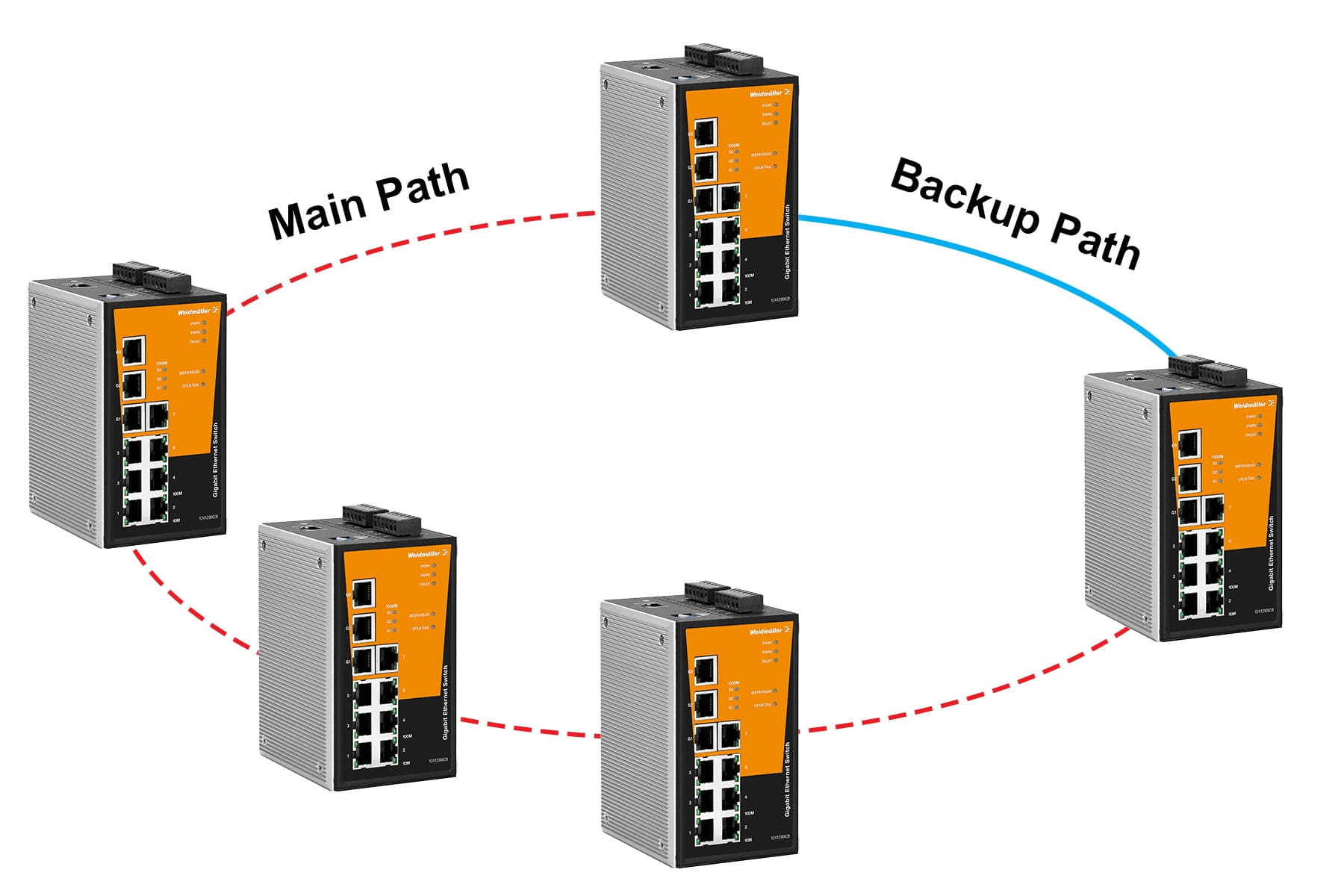
Always alternate paths between elements in a network.
Interoperability: Staying open in a multi-vendor world
Industrial networks typically combine equipment from multiple vendors, including PLCs, HMIs, and SCADA platforms. Managed switches that support protocols such as Modbus TCP, PROFINET, and EtherNet/IP enable seamless communication across these diverse systems. By ensuring interoperability, organizations avoid vendor lock-in and maintain flexibility to adapt and expand their networks. Vendors like Weidmuller have managed switches that are built with this compatibility in mind, supporting the mixed environments common in automation.
Secure remote access: An option with safeguards
In addition to local network resilience, many organizations require remote access for service teams, integrators, or operators. Remote access can be enabled through industrial routers or gateways, but it must always pass through a firewall to ensure external connections are inspected, filtered, and compliant with security policies.
Modern remote access solutions for OT environments bring several benefits:
- Encrypted VPN connections secure traffic end-to-end, preventing interception or tampering.
- Role-based access control ensures users only reach the systems relevant to their tasks, minimizing exposure.
By combining managed switches for in-plant visibility with remote access routed through firewalls, operators can extend secure connectivity beyond the plant floor without compromising OT security.
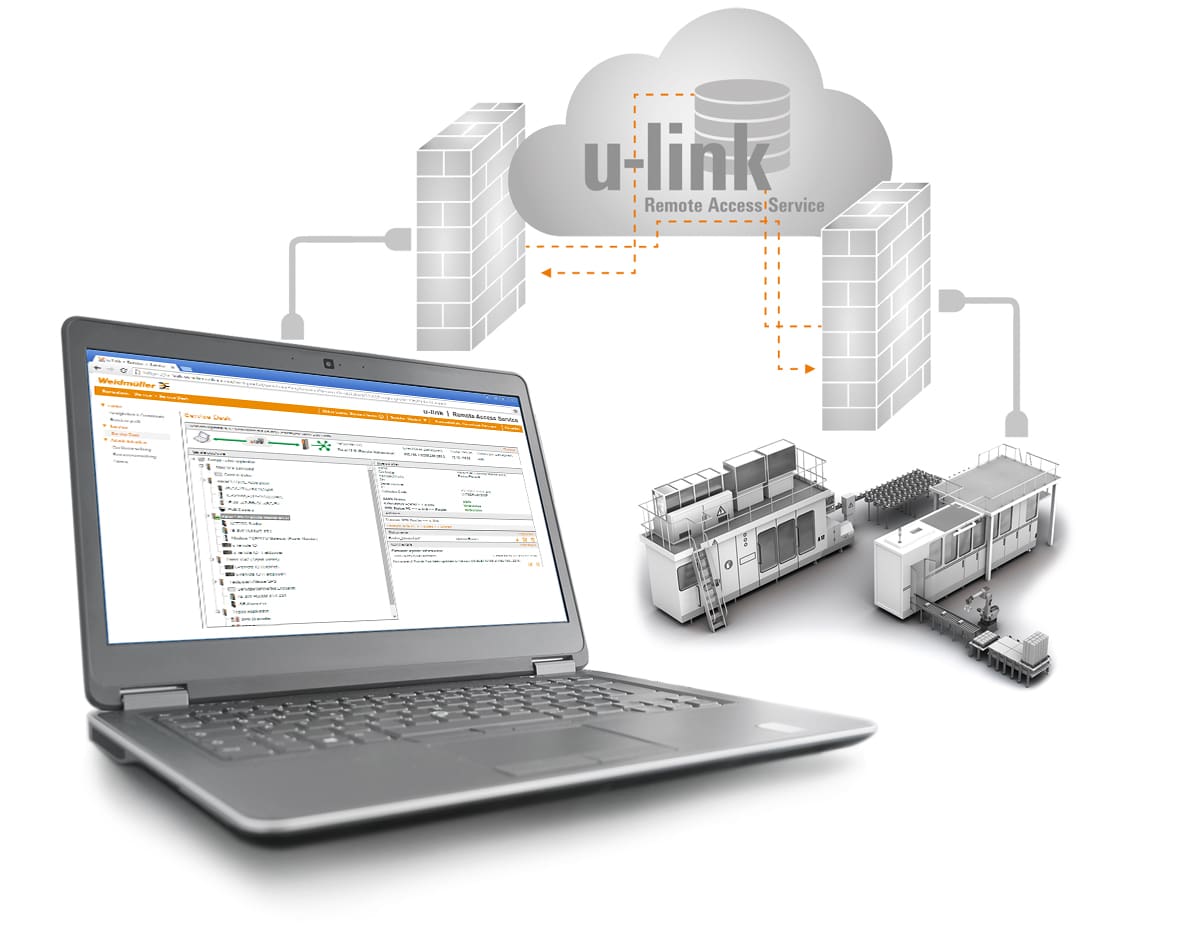
The u-link from Weidmuller offers secure remote access to your machines anytime, anywhere.
A holistic approach to OT security
Managed switches provide the secure backbone for OT networks, delivering the visibility, control, and redundancy needed to protect industrial operations. Remote access, when securely implemented, extends this protection beyond the plant floor, ensuring external connectivity does not compromise internal security. Together, they enable a comprehensive security posture that covers both in-plant infrastructure and external connections. The move from unmanaged to managed switches is therefore a critical step, allowing organizations to strengthen defenses, improve resilience, and build future-ready OT environments.
Visit Weidmuller to see more security solutions for industrial networks.
Like this article? Check out our other Ethernet and Europe articles, our Industrial Market Page, and our 2025 Article Archives.
Subscribe to our weekly e-newsletters, follow us on LinkedIn, Twitter, and Facebook, and check out our eBook archives for more applicable, expert-informed connectivity content.

- The Challenges of Electric Flight: How Engineers Are Rethinking Power - October 20, 2026
- Printing at the Edge of Possibility: How TE Connectivity Leverages Micro-3D Printing - October 13, 2026
- A Five-Layer Clad Solution for High-Performance Battery Interconnects - October 6, 2026