Q&A: Connectors and the Importance of DIN Standards
As electrification expands into harsh environments, design engineers require sealed, high-power interconnects that meet standards for compatibility and safety. Joe Ferris, Market Segment Manager at Anderson Power, explains how the growth of electrification, along with DIN-compliant connectors, will shape the future of electric designs.

Where is equipment electrification growing? Why?
Ferris: The electric and battery-powered equipment market is growing at a rapid pace. As advancements in lithium-ion technology enable fast, long-lasting charges, more industries are adopting industrial designs that reduce emissions, improve efficiency, and lower lifetime operating costs. We’re seeing growth in many markets, including:
- Airports: Electric ground support equipment (GSE) such as tugs, belt loaders, and de-icers save space, fuel costs, and get equipment back into service faster through rapid, on-site charging technologies.
- Construction: Manufacturers are introducing electric excavators, loaders, and compactors, particularly for urban job sites where noise restrictions are tightening.
- Lawn and garden: Riding lawnmowers, handheld landscaping tools, and other parts of the outdoor power equipment (OPE) market are shifting to battery power as runtime and charging speeds improve.
- Marine: Small electric outboards and battery-powered propulsion systems are gaining traction in recreational applications such as fishing kayaks and compact boats.
- Material handling: After embracing electrification for many years in equipment like forklifts, the material handling market continues to shift away from traditional internal combustion engines, especially in automated equipment systems.
- Off-road vehicles: Small all-terrain vehicles (ATVs) and utility-terrain vehicles (UTVs) are moving to electric designs for easier maintenance, cleaner operations, and lower fuel costs.
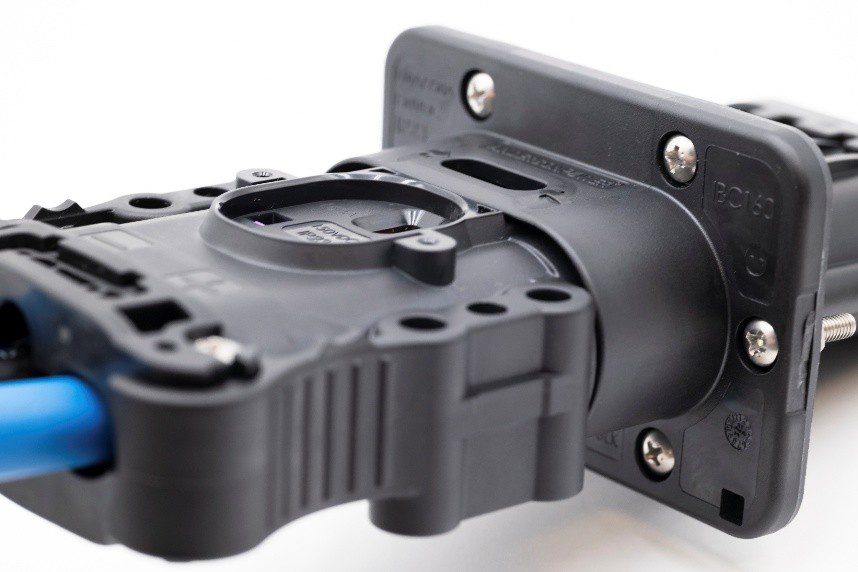
The Industrial Battery Connector (IBC) from Anderson Power is an example of a DIN-compliant connector.
As new equipment designs enter the market, regulations like DIN standards are starting to play a bigger role on the world stage.
What are DIN standards?
DIN standards are the tens of thousands of technical specifications published by the Deutsches Institut für Normung that apply to a broad range of component and machinery types across industries. While DIN standards originate in Germany, they are often harmonized into broader European standards (EN) or international standards (ISO) that extend DIN’s influence to an even wider range of countries. Technical standard names typically begin with DIN, DIN EN, DIN ISO, or DIN EN ISO to indicate the appropriate range of applicability.
What standards are important for electric industrial trucks?
When those in Europe’s electric fork truck industry refer to a DIN connector, they typically mean an appliance connector that complies with DIN VDE 0623-589. This standard applies to connectors used in electric industrial trucks and outlines requirements for dimensional compatibility, performance criteria, and safety compliance. All DIN VDE 0623-589 connectors are pin-and-socket connectors. As power and charging systems grow more complex, DIN adoption is growing because the auxiliary wires in DIN connectors enable additional communication. In addition, EN 1175:2020 is a European vehicle safety standard that specifies safety requirements related to the design and construction of electrical systems in battery-powered industrial trucks.
DIN standards are not as widely applied in North America. Multipole connectors that conform to UL standards (such as UL 1977) remain much more common in the North American market. However, as OEMs and engineers explore new equipment designs meant for global distribution, DIN VDE 0623-589 provides a clear framework for a connector’s dimensions and compatibility with European markets.
In addition to pin-and-socket designs, engineers requiring a high-power interconnect can also choose flat-wiping style connectors. Flat-wiping contacts can be installed and connected to one another from either end. Invented by Anderson Power in 1954, flat-wiping contacts are self-cleaning, self-securing, and deliver many other key advantages for equipment battery connectors.
Both pin-and-socket and flat wiping connectors can coexist within a design, serving complementary roles that elevate the performance and longevity of battery-powered equipment.
What should design engineers look for in battery connector designs?
As electrification accelerates across the globe, battery connectors that support wide-ranging standard compliance, environmental durability, and customizability offer engineers a design edge. Key considerations when selecting a connector include:
- Regional and international standards: Compliance with recognized standards provides confidence in connector performance and longevity. DIN standards in Europe and UL standards in the United States establish clear guidelines for safety and compatibility.
- Connector power requirements and sizing: Connector selection should align with the specific application’s voltage and current requirements. As one example, a small UTV would likely require less amperage than a robust riding lawnmower. Since connector size generally increases alongside power capacity, selecting the right-sized fit saves precious design space within smaller equipment. Mating cycle durability, contact resistance, and temperature rise under load are other important connector considerations.
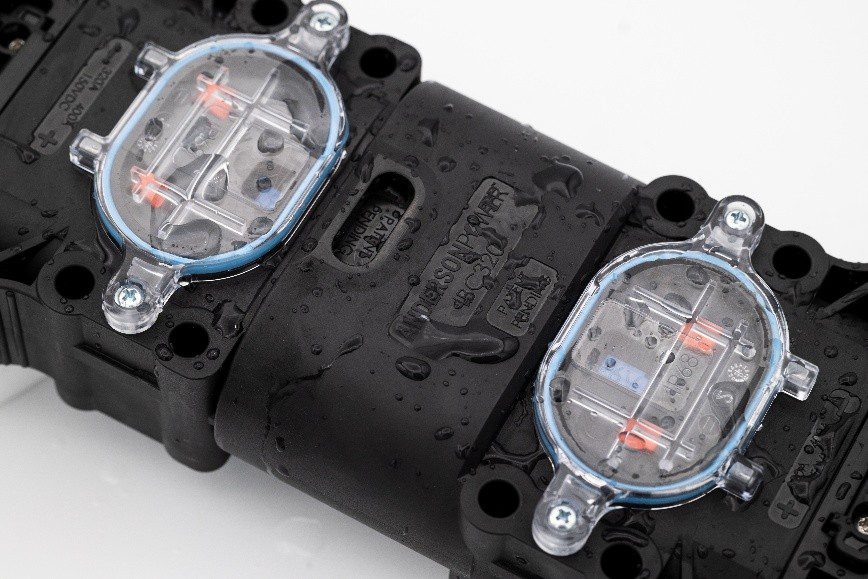
The IBC is available in three sizes that support up to 460A and includes an option for IP68 sealing, contact temperature sensing, latching handle security, and panel-mount configurations.
- Outdoor protection and sealing: Many industries that are newer to electrification require their equipment to be charged and operated outdoors. Whether on an exposed airport tarmac or rugged construction site, equipment that is charged outside requires harsh environment connectors with appropriate ingress protection (IP) ratings to resist dust, debris, and moisture while mated. IP68 is one of the highest IP ratings, indicating the connector is fully dust-tight and can withstand complete water submersion. To protect the charging system when unmated, IP-rated dust caps are another accessory available with some connectors.
- Required customization and add-ons: Manufacturers that offer connector accessories and customization provide engineers with greater design flexibility and peace-of-mind. For example, lithium-ion powered equipment can benefit from connectors with more auxiliary signals to support enhanced battery monitoring. Engineers with Li-ion designs can also choose connectors with a built-in negative temperature coefficient (NTC) sensor, enabling proactive contact temperature monitoring during fast charging. In high-vibration environments, adding a secure latching handle to the connector can reduce the risk of accidental disconnections. Finally, industrial equipment with a fixed charging interface instead of a cord requires a connector that offers a unique panel-mount configuration rather than a standard plug and receptacle version.
Electric and battery-powered equipment is expanding to new, exciting industries. By selecting connectors that match their unique application needs for regulatory standards, power requirements, and harsh environmental conditions, engineers can ensure reliable charging performance and long-lasting durability in their latest designs.
Contact Anderson Power to learn more about the Industrial Battery Connector.
Like this article? Check out our other Standards and Batteries articles, our Connector & Cable Special Topics Market Page and our 2025 and 2026 Article Archives.
Subscribe to our weekly e-newsletters, follow us on LinkedIn, Twitter, and Facebook, and check out our eBook archives for more applicable, expert-informed connectivity content.

- Connectivity Is Reshaping Police and Security Vehicle Fleets - September 8, 2026
- Thermal Management Strategies with Liquid Cooling Connectors - August 11, 2026
- Rodent-Resistant Electronics - July 28, 2026