What are MC4 Connectors?
Meet the Connector: MC4 Connectors
MC4, a type of PV connector, allows adjacent solar panels to be easily connected by hand to create a string of panels, but require a tool to disconnect, ensuring that the panels don’t accidently disconnect when the cables are pulled.
MC4 is a type of photovoltaic (PV) connector used primarily for solar installations. MC stands for Multi-Contact, the original manufacturer (now Stäubli Electrical Connectors), and the 4 refers to the 4 mm diameter of the contact pin. The MC4 connector, introduced by Multi-Contact in 2004, followed the MC3 (3 mm diameter pin) that was developed in 1996 and discontinued in 2016.
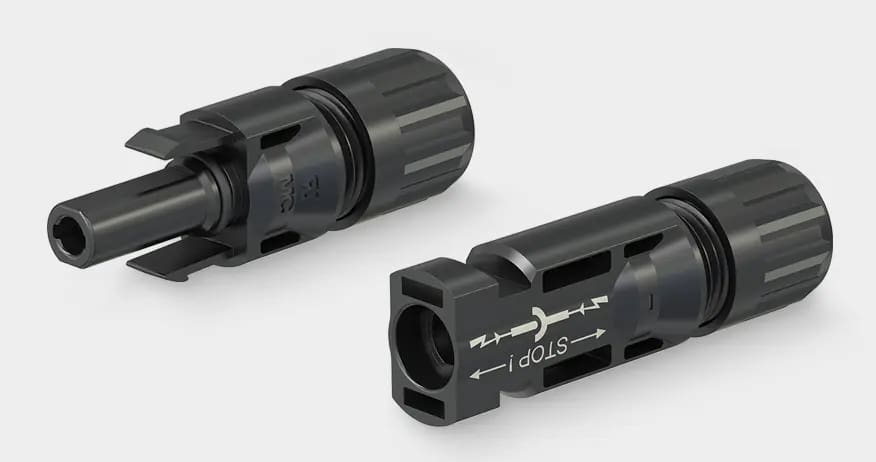
Original MC4 from Stäubli.
MC4 connectors allow adjacent panels to be easily connected by hand to create a string of panels. They require a tool to separate, ensuring that the panels don’t accidently disconnect when the cables are pulled. This ease of connection began with the MC3, which replaced the early technology that required a small electrical box and two wires connected to screw terminals. This arrangement was limited to a maximum of 50 V by NEC (National Electrical Code) and was vulnerable to water leakage, corrosion, and mechanical stress on the wires. MC4 connectors feature positive locking mechanisms, which were required by the NEC in 2008. This helped the connector gain widespread market acceptance.
The cable used with the MC4 must be the correct diameter. Cable used in solar applications range from 2.5 mm2 to 10 mm2 with 4 mm2 and 6 mm2 (12 AWG and 10 AWG) being the most common. Typically, the cable, designed for outdoor use, is double insulated (insulation plus black sheath), and resistant to UV and high temperatures, as well as cold climates and harsh environmental conditions like snow, hail, and freezing rain. Connectors are typically attached by crimping, though soldering may be possible.
Safety
In part because DC current continues to arc, unlike AC which self-extinguishes, an MC4 connector must not be connected or disconnected under load, regardless of voltage. An electric arc can damage contact materials and lead to high resistance and ultimately overheating. It is also extremely important to note that generally MC4 connectors are not interchangeable with connectors from different manufacturers or different models of connectors, because even slight variations can result in a poor connection or potential safety issue.
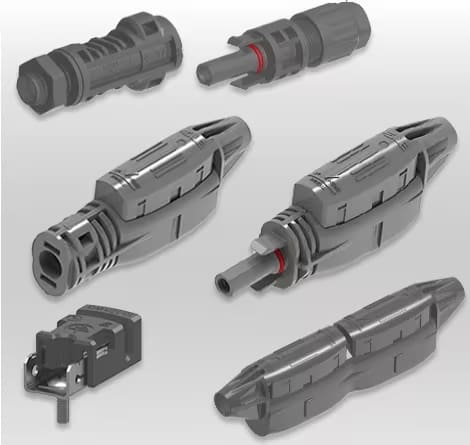
SOLARLOK connectors are TE Connectivity’s version of MC4. They provide simple, fast, and reliable connections, from photovoltaic modules with different insulation diameters to DC/AC converters. They can be used in multiple applications including residential, utility-scale solar plants, commercial and building integrated photovoltaic (BIPV).
Design Notes
Standards: Although there is no unified industry standard for PV connectors, the National Electrical Code (NEC) and the UL 6703 standard for PV connectors specify that connectors have to be from the same type and brand to avoid the dangers of cross-mating. In addition, IEC 62548 design requirements for PV Systems requires PV connectors to be of the same origin.
Mounting type or types: Panel-mounted, cable-to-cable, Y branch (one input and two outputs) and adapters
Termination: Crimping is most common; soldering is possible in some instances.
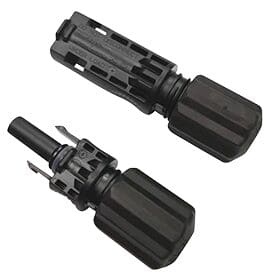
Amphe-PV H4 Plus cable connector, Amphenol Industrial Operations’ MC4-type connector, is a high-performance solar connector designed to meet the rigorous demands of modern photovoltaic (PV) systems. With robust certifications and enhanced features, it is ideal for both residential and commercial solar installations. The connector integrates advanced technology to ensure reliable, safe, and efficient energy transmission.
Physical properties:
An MC4 connector has a housing or plastic insulator, a metal crimp (occasionally solder) contact (note the male has a protruding pin that connects to the female), a grommet or rubber seal, and seal retainer. A cable clamp nut secures the terminated wire, seals the connector and acts as a form of strain relief in case the wire is inadvertently pulled. Each connector also has a positive locking mechanism that consists of two plastic locking tabs in the socket. The tabs must be pressed slightly toward the central probe to insert into holes in the front of the plug connector. When the two are pushed together, the fingers slide down the holes until they reach a notch in the side of the plug and pop outward to lock the two together.
Electrical properties:
Originally rated for 600V, newer versions of the MC4 connector are rated at 1500 V, which allows longer series strings to be created, and up to 95 A with the 6AWG PV cable. MC4-Evo 2 has both UL and IEC certification ratings of 1500 V DC and up to 70 A with 10 mm² PV cable, depending on the conductor size used in pairs.
Markets and Applications
MC4 connectors are used to connect solar panels. They are also used to connect panels to charge controllers and portable power stations.
Suppliers
MC4 connectors are only supplied by Stäubli Electrical Connectors. Similar PV connectors are supplied by TE Connectivity, Amphenol Industrial Operations, Phoenix Contact, and Weidmuller.
Like this article? Check out our other Meet the Connector and Connector Basics articles, our Industrial Market Page, and our 2025 Article Archives.
Subscribe to our weekly e-newsletters, follow us on LinkedIn, Twitter, and Facebook, and check out our eBook archives for more applicable, expert-informed connectivity content.

- Custom Cable Assemblies: A Value-Add Solution - October 13, 2026
- Fiber Optics Product Roundup - October 13, 2026
- October 2026 Connector Industry News - October 13, 2026