What are LVDS Connectors?
Meet the Connector: LVDS Connectors
LVDS (low-voltage differential signaling) connectors are high-speed, low-power connectors for transmitting data with minimal electromagnetic interference (EMI). Introduced in 1994,
LVDS connectors are designed for high-frequency signals, commonly reaching gigahertz speeds for display data. Key features are high-speed transmission, low power consumption, strong noise immunity, and compact design.
Differential signaling (paired, opposite-phase conductors) and low-voltage swing (approx. 350 mV) reduce EMI and noise. LVDS moves digital data quickly and efficiently by transmitting two opposing signals. When the receiver picks up the difference, unwanted noise is canceled out.
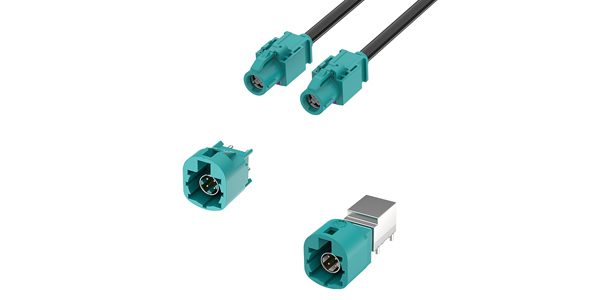
ATTEND’s HSD interconnect solution, consisting of fully shielded HSD connectors and matched cable assemblies, is designed for LVDS high-speed video transmission in automotive and industrial applications. Featuring 100 Ω differential impedance and compliance with USCAR-2 and USCAR-17, the system delivers stable and reliable signal integrity under vibration and wide operating temperature ranges. The HSD solution is widely used in automotive LVDS camera systems, infotainment and cluster displays, and point-to-point high-speed video links, and serves as a robust front-end interconnect for FPD-Link and GMSL-based architectures.
LVDS connector types
LVDS connectors are not standardized. They are designed to fit the application and environment.
Wire-to-board LVDS connectors are often used in applications with limited space and where vibration is an issue such as infotainment units, camera modules, and touchscreens.
Board-to-board LVDS connectors link two PCBs without the need for external wiring, often in dense, multi-board setups needing signal integrity with limited space.
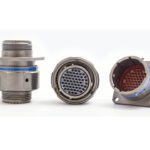
Aerospace and military applications that have specific environmental requirements such as shielding, moisture-resistance, or custom pin layouts may require specialized LVDS connectors.
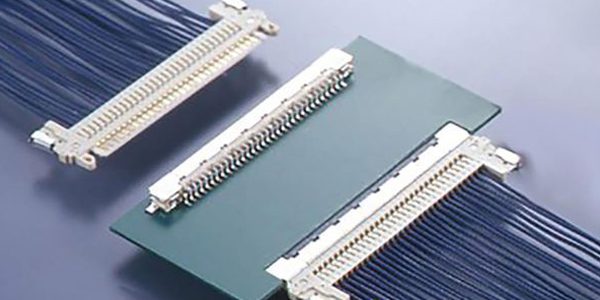
Specify LVDS connectors based on requirements for speed and signal integrity, mechanical and environmental considerations, connector compatibility, maintenance, and testing needs.
Design Notes
Standards: ANSI/TIA/EIA-644
Impedance: 100 Ω + 5 Ω (differential)
Pin count: Varies based on resolution (e.g., 30-pin, 40-pin)
Pitch: 0.5mm or 1.0mm
Termination: Often requires micro-coaxial cable or twisted pairs
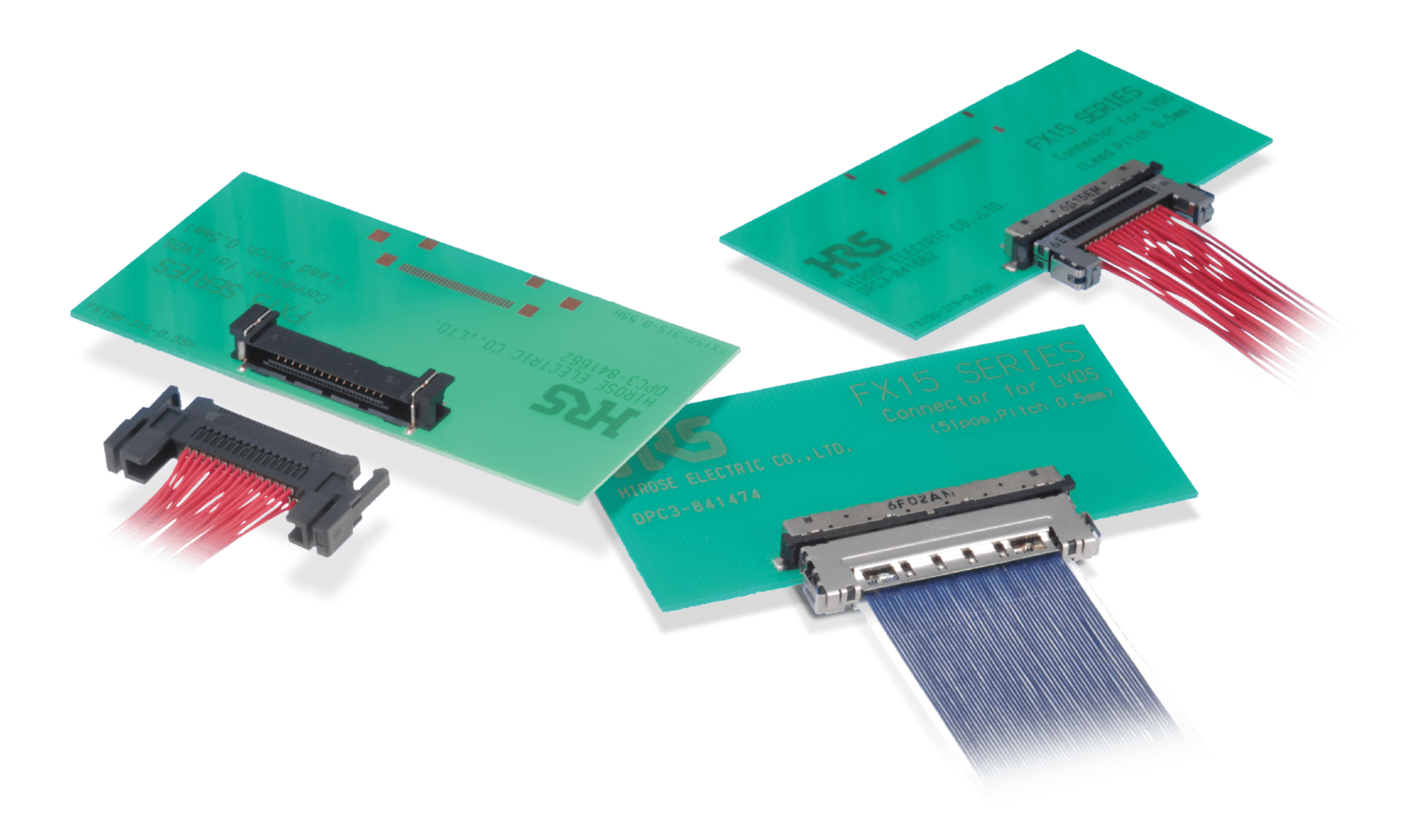
Hirose FX15 Series 1.0mm Pitch cable-to-board connectors supporting LVDS signal
Markets and Applications
Consumer, Automotive, Industrial, Medical, Military and Aerospace
LCD screens, TVs, automotive cameras and infotainment, medical displays, 3D imaging, and industrial devices.
Suppliers
ATTEND, JAE, Hirose, Molex, I-PEX, TE Connectivity
Related products
LVDS cables
Like this article? Check out our other Meet the Connector and Connector Basics articles, our Industrial Market Page, and our 2025 and 2026 Article Archives.
Subscribe to our weekly e-newsletters, follow us on LinkedIn, Twitter, and Facebook, and check out our eBook archives for more applicable, expert-informed connectivity content.

- Ceramics in Space: BME X7R MLCC - October 20, 2026
- Test & Measurement Product Roundup - October 20, 2026
- Advanced Connectivity-Automation, Robotics, AI, and Machine Learning - October 20, 2026