Building New Connectivity Products with Safer Substrates
The next generation of interconnects will need to provide a higher level of performance using materials that meet higher global standards for human health. New material options help suppliers build these better components while meeting the challenges of new technologies.

The interconnect industry is navigating a period of significant materials transition. Tightening global environmental regulations, growing scrutiny of per- and polyfluoroalkyl substances (PFAS, PFOA, and PFTE), and expanding demand for implantable and body-adjacent electronics have given rise to a new generation of safer, more sustainable materials.
For the past two decades, the electronics industry has sought new and alternative materials in an effort to comply with regulations. The RoHS (Restriction of Hazardous Substances) directive addresses the impact of electronic waste on human health and the environment by restricting the use of certain hazardous substances, including heavy metals, flame retardants or plasticizers. These materials enter the environment during production or end-of-life waste streams. Currently 10 substances are banned by RoHS, including lead. Following RoHS, the European Union’s REACH (Registration, Evaluation, Authorization, and Restriction of Chemicals) regulations impact more than 10,000 chemicals. This multi-phase law oversees the use and manufacture of chemicals that pose risks to human and environmental health. The European directives have inspired similar legislation in other countries. China’s GB/T standards mirror EU frameworks in many ways, effectively making European compliance a baseline for global market access.
In recent years, the industry has set its focus on PFAS. Known as a “forever chemical,” this pervasive substance is now found in even the most remote parts of the planet. It is in air, water, and umbilical cord blood, raising concerns for future generations. PFAS compounds have been widely used across the interconnect supply chain for decades: as surface treatments on wire insulation, in cable jacketing, in laminate manufacturing, and in coatings on connectors. Their persistence in the environment has triggered regulatory action in multiple countries. Major OEMs in automotive, aerospace, and consumer electronics are beginning to pass PFAS-free requirements down to their Tier 1 and Tier 2 suppliers ahead of formal regulatory deadlines.
Traditional materials enhanced by new technologies
New processing technologies have brought older, safer materials back into use. “Ceramics have exceptional performance properties and have always worked better than PTFE and similar materials, but they fell out of use due to their higher costs,” said E.J. Nordstrom, Director of Sales and Technical Applications, Boston Micro Fabrication (BMF), a Boston-based manufacturer of micro-precision 3D printers. “In the past, PTFE was the cheaper option. The equation has changed in the last 10 years. We’ve seen the price differential drop by ten-fold due to tariff pressure and other factors in the global environment. As the price of other materials increased, ceramics became competitive by comparison. At the same time the costs have shifted, additive manufacturing capabilities have improved, and we are now capable of making parts that have never been possible before.”

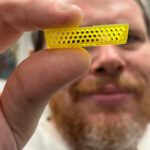
BMF’s additive manufacturing capabilities enable small, complex forms with internal geometries.
Ceramic can handle high heat better than plastic and offers building advantages through specialized additive manufacturing processes (3D printing technology). “BMF’s ceramic material is a mix of 100 nanometer ceramic particles in a slurry of ceramic with a binder,” he said. A finished part goes through a curing process that involves rinsing it, debinding it in a furnace for three to five days, then finishing it in a sintering oven at temperatures over 1700 °C. The result is a part that is biocompatible, autoclavable for medical applications and ruggedized for military, aerospace, and other high challenge environments. It can also be plated.
BMF’s process has been used to create ceramic insulators and other parts for connectors, antennas, and optical systems, and Nordstrom says the company is still discovering new possibilities. “We make parts that are exceptionally thin, have channels or tunnels, or ventilation holes. “We can 3D print ceramic parts with micron-sized features and micron-level tolerances, enabling internal geometries that were not possible before. We are the only company in the world capable of printing ceramic parts at this level of precision,” said Nordstrom.
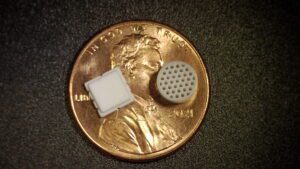
Connector housings, insulators, and other components can be created using BMF’s ceramic materials.
BMF’s unique capabilities enable it to manufacture specialty parts for some of the world’s largest connector companies. It’s also able to assist in research and development efforts for emerging interconnect technologies. “Our products are in fiber optics and waveguides and other places where people have been restricted by design limits in the past. Now, we are able to offer new abilities.”
Reducing PFAS without compromising reliability
Ralph Chiaravollotti, product manager at Greene Tweed, sees PFAS reduction as more realistic than eliminating its use in electronics at this time. “We work with suppliers that are upstream in the value chain to reduce PFAS usage where it’s feasible without reducing product performance or the reliability of the finished parts that we make for our customers,” he said. (Watch Greene Tweed’s webinar Innovating Beyond PFAS.)
PFAS remains in some high-reliability components due to its superior performance. “Our products are relied on to perform consistently in critical applications,” said Chiaravollotti. The company designs and manufactures materials and precision parts for sealing applications, light weighting, structural parts, components for wear, friction, and abrasion resistance, and connectors that operate reliably in highly corrosive environments.
“We take part in industry education where we have expertise, engage with industry associations and consortiums like the National Association of Manufacturers and groups like SEMI.org to provide information about the production and performance of the materials that we have experience with,” he said. “We monitor and respond to local and global regulations to ensure continued compliance now and into the future, and we proactively collaborate with our suppliers to overcome potential technical challenges as they innovate to reduce PFAS. We’re trying to utilize some of our formulation science capabilities in our ability to take materials and specially engineer products to develop PFAS-free solutions.”
Greene Tweed has an extensive PFAS free thermoplastic product line, and the company is working towards continued innovation in the area of PFAS alternatives. The company’s sealing product compounds – tetrafluoroethylene propylene (FEPM), fluoroelastomer (FKM), and perfluoroelastomer (FFKM) – are considered polymers of low concern (PLC) by the Organization for Economic Co-operation and Development (OECD) Expert Group on Polymers due to their lack of bioavailability and toxicity, meaning they have insignificant environmental and human health impacts.
For interconnects, the most viable PFAS alternatives depend on the application. Thermoplastic polyurethane (TPU) and cross-linked polyethylene (XLPE) are established substitutes for fluoropolymer insulation in many wire and cable applications, offering comparable electrical properties at lower environmental cost. Halogen-free flame retardant (HFFR) formulations are increasingly specified in data center and building wiring, where fire safety requirements previously drove fluoropolymer adoption. For high-frequency applications where fluoropolymers have historically been difficult to replace due to their low dielectric loss, newer engineered polymers, including modified polyphenylene oxide (mPPO) and liquid crystal polymer (LCP) compounds, are coming into use.
Future material developments
A focus on research is bringing a new generation of materials into use, including safer substrates, biocompatible materials, and biodegradable materials that will improve the electronic industry’s impact on the environment, from manufacturing to decommissioning.
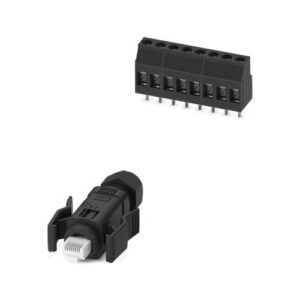
Phoenix Contact’s MKDS 3 PCB terminal block and RJ45 connector (version 6), along with its ICS 20 series of electronics housings contain bio-based materials.
“Phoenix Contact has been involved in monitoring PFAS legislation and evaluating alternative substances for many years. We have replaced these substances in as much of our product catalog where possible, and continue to work toward eliminating these substances as suitable replacements are found. It will remain a continuous process due to changing legislation and technical requirements in the future,” said Adam Kraynak, Product Compliance Manager, Phoenix Contact.
“In the U.S., we are members of the NEMA Materials Management Coalition and ECIA Environmental Compliance groups, among others. Both of these groups are primarily concerned with current and future substance and material restrictions and prohibitions, including PFAS, but with different industry and product scopes. Globally we have members on numerous other environmental committees and working groups as well. This participation keeps us engaged with substance and materials legislation, as well as chemical restrictions at state, federal and international levels,” said Kraynal.
“Participation in these groups helps also allows us to be involved early in the legislative process and gives us a voice to provide advocacy, suggest improvements, and discuss management of requirements. As you may be aware, the topic of PFAS has been at the forefront of much of this discussion at over the last few years, and it is vital to remain involved in these types of activities when facing such a rapidly changing regulatory landscape.”
To learn more about the companies mentioned in this article, visit the Preferred Supplier pages for Boston Micro Fabrication, Greene Tweed, and Phoenix Contact.
Like this article? Check out our other Innovation, Standards and Materials articles, our Connector & Cable Special Topics Market Page and our 2025 and 2026 Article Archives.
Subscribe to our weekly e-newsletters, follow us on LinkedIn, Twitter, and Facebook, and check out our eBook archives for more applicable, expert-informed connectivity content.

- Connectivity Is Reshaping Police and Security Vehicle Fleets - September 8, 2026
- Thermal Management Strategies with Liquid Cooling Connectors - August 11, 2026
- Rodent-Resistant Electronics - July 28, 2026