SPE Technology as a Driver of Digital Transformation
Single-pair Ethernet enables devices to be connected over distances of up to 1,000 m with a transmission speed of 10 Mb/s via just one cable. SPE continues to evolve, and future advancements will extend that reach and add more advantages.

By Andy Schäfer, Product Manager PCB Connectors, Phoenix Contact GmbH & Co. KG, Blomberg, Germany
The properties of single-pair Ethernet (SPE) provide real added value for modern communication infrastructure. Conventional Ethernet solutions traditionally require two or even four wire pairs. SPE, on the other hand, requires just one wire pair – and can transmit both data and power. The technology achieves transmission rates from 10 Mb/s at a maximum transmission distance of 1,000 m up to 1 Gb/s at a maximum transmission distance of 40 m. This is sufficient for even the most demanding tasks, such as in applications that include the intensive use of networked sensor technology with smart measurement transducers and camera systems. Because of this, SPE can be used in fields that were previously limited in terms of data rates, ranges, and seamless communication.

Single Pair Ethernet enables new solutions for successful digitalization – such as the SPE terminal block for the PCB.
Connections of up to 1000 m
One of the key limitations of conventional Ethernet solutions is the maximum length of just 100 meters for a point-to-point connection. In the past, additional repeaters or switches had to be installed to cover greater distances in industrial systems, such as in production lines and conveyor belts – interfaces that are prone to faults and involve additional maintenance work.
SPE technology, on the other hand, enables devices to be connected over distances of up to 1,000 m with a transmission speed of 10 Mb/s via just one cable. It also enables the use of Power over Data Line (PoDL) technology as an option. This means that SPE solutions with data rates of up to 10 Mb/s can replace specific fieldbus technologies in the future.
SPE is also suitable for implementing complex network topologies. With transmission speeds ranging from 10 Mb/s to 1 Gb/s, SPE can support a wide range of applications. The IEEE 802.3 consortia is currently discussing SPE standards with extended performance frameworks. This would also enable even higher data rates of >=10 Gb/s for short distances (<15 m) and 100 Mb/s for distances of up to 500 m. Completely new application fields would be able to be developed with these new SPE standards (Figure 2).
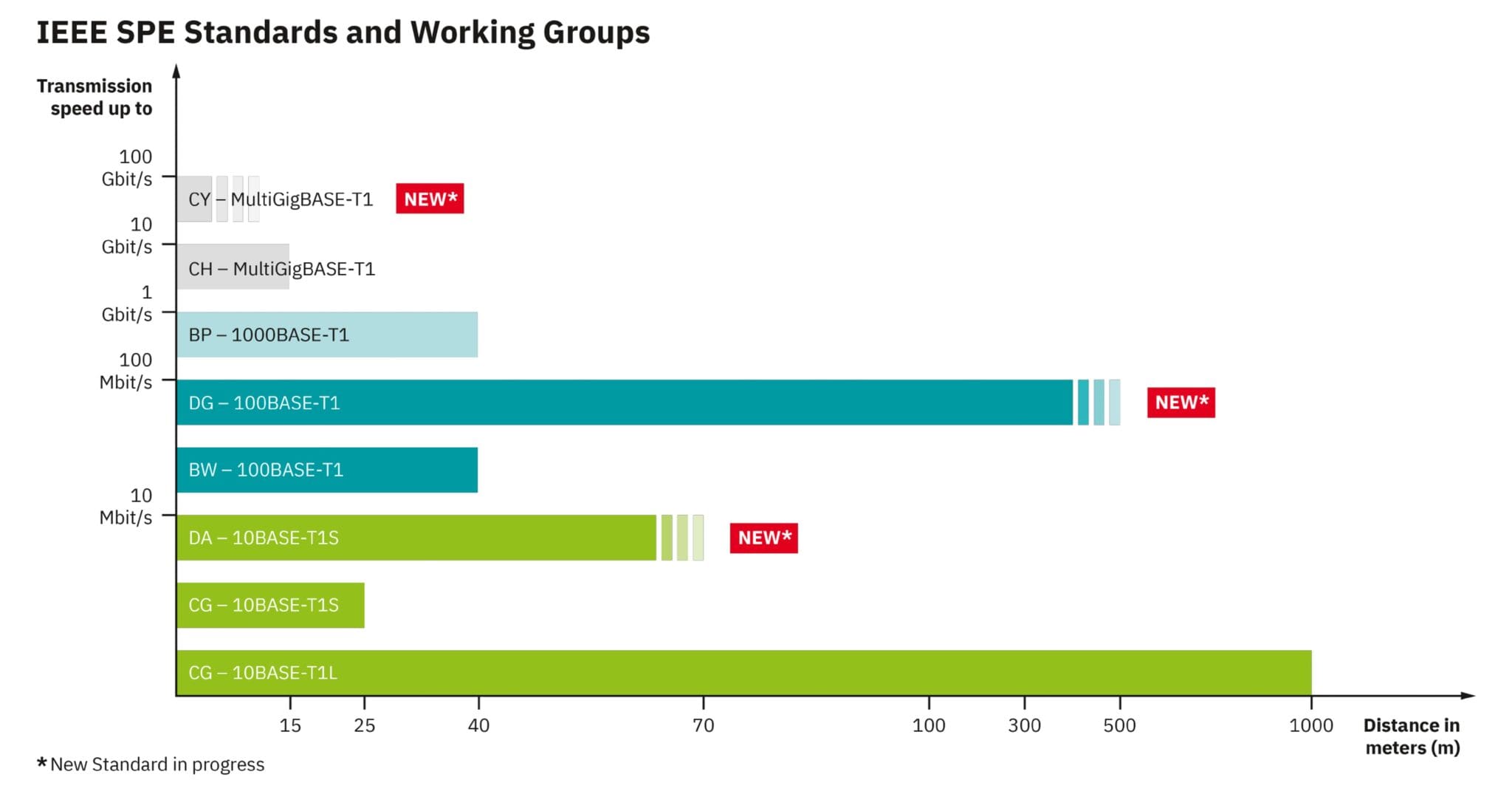
The SPE standards are defined in IEEE 802.3. This standard describes the technical framework for Ethernet-based data transmission via one wire pair.
Seamless and secure data communication
Previously, classic industrial systems often included an Ethernet network and a large number of fieldbus systems at the field level. The advent of the Industrial Internet of Things (IIoT) and the need to replace fieldbuses with more efficient communication systems render these established topologies obsolete. A similar shift is occurring in all fields that require smooth communication between sensors and/or networks. For such applications, a seamless, secure data connection is critical.
Cost-efficient factory automation
An average factory already generates about one terabyte of data per day – and this amount of data continues to grow. Continuous communication is essential to effectively evaluate this data. Here, SPE can ensure consistent networking, from the sensor to the cloud.
Also, in light of the growing number of sensors and intelligent end devices used in industrial applications, SPE offers the ideal cabling solution. It is simple, secure, compact, and cost-effective. When setting up infrastructure, SPE solutions will be much cheaper in the future than the current combinations of bus and Ethernet components.
SPE and robots: Space-saving and high-performance
SPE offers many advantages for autonomous and collaborative robots. With data transmission rates higher than those of conventional fieldbus systems, it enables robots and the controller to communicate with each other with higher sampling rates and increased data volumes.
Added to this is the simplified cabling, with data and power in just one line. To ensure that performance demands that go beyond the defined PoDL standards can be mastered in the future, hybrid SPE solutions will also be available that feature data and power contacts in just one connector. Fewer cables and connections will result in fewer fatigue errors, faster troubleshooting, and easier maintenance. SPE’s smaller bending radius can also help optimize the design of the robot handling system. (Figure 3)
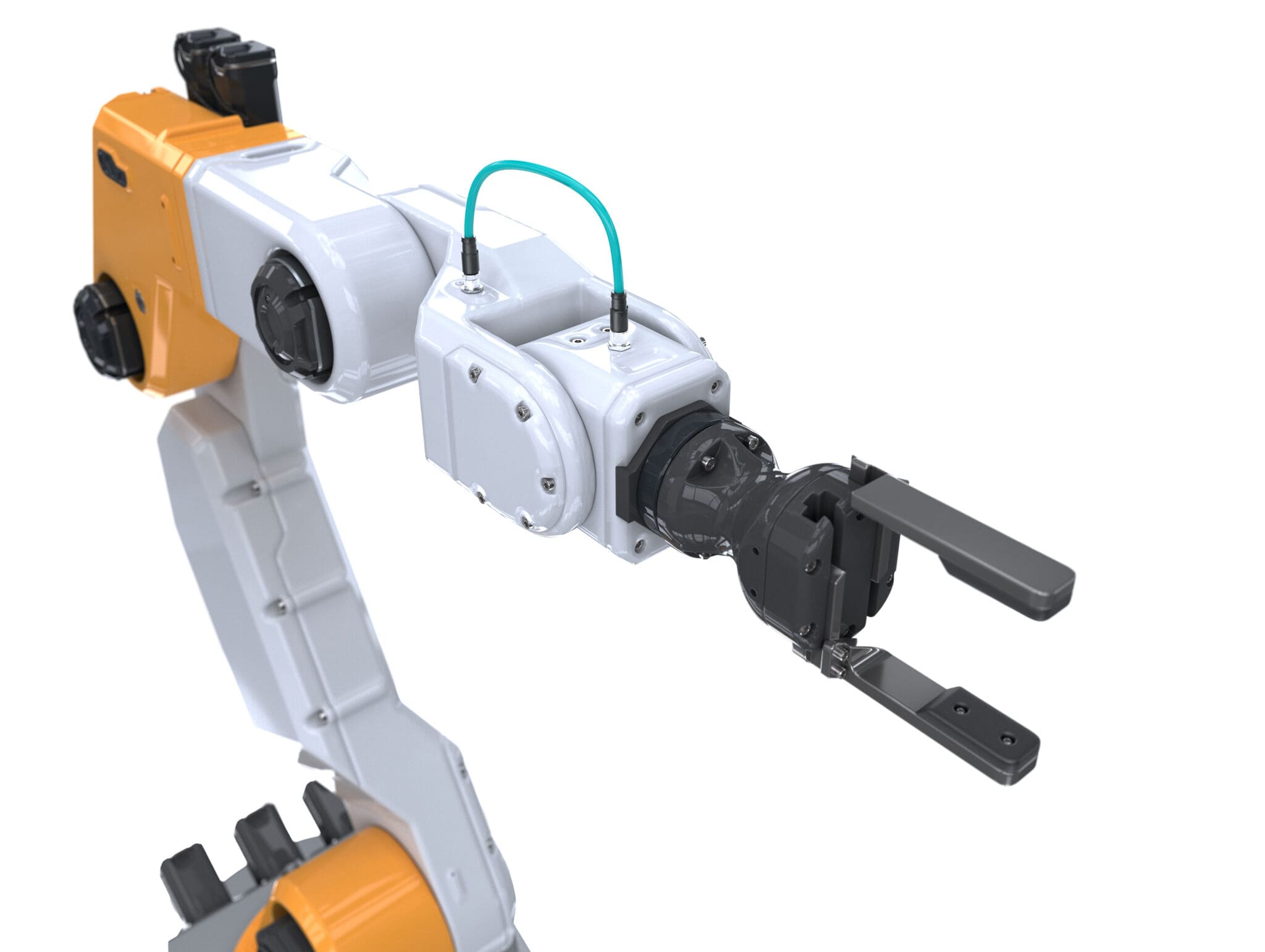
In the robot sector, SPE scores points with its performance and low space requirements.
Process automation with SPE
In process automation, such as in the oil and gas sector, there are often enormous sites housing massive buildings or tanks. For many companies, a comprehensive status overview and the remote control of all global locations, with a consistent data flow from sensors to the cloud or ERP systems, is essential. SPE can provide efficient network structures without the need for intermediary network devices for signal modulation or gateways. PoDL, in combination with SPE, offers the advantages of simultaneous data and power transmission in these applications as well.
APL technology for explosion-protected areas
A separate SPE standard, Advanced Physical Layer (APL), has been introduced to meet the high requirements on data and power transmission in explosion-protected areas (zones 0, 1, and 2). This solution is used in the process industry or other hazardous locations. Here, the 10BASE-T1L standard from IEEE 802.3cg is used in conjunction with the IEC TS 60079-47, 2021-03 (2-WISE) standard (2-WISE = 2-Wire Intrinsically Safe Ethernet).
This technology covers large distances (trunk lengths of up to 1000 m, spurs up to 200 m). In addition, devices and systems from different manufacturers are compatible and can interoperate with each other. This means that a significant amount of additional data can be acquired and analyzed for measures such as predictive maintenance.
APL has numerous advantages for those in the oil, gas, and chemical sectors. It enables secure and efficient networks that are future-proof. This technology can also help modernize existing systems cost-effectively by leveraging existing cabling and Ethernet protocols such as EtherNet/IP, HART-IP, OPC UA, and PROFINET. (Figure 4)

Flow meters from the process industry are integrated into the network via APL technology with the existing cabling.
Range advantages for the energy sector
The renewable energy industry can also benefit from the advantages of SPE. These energy sources are subject to fluctuations and require intelligent management for use in power grids and for using the energy itself. Accordingly, intelligent data management is essential.
Whether for wind turbine generators or photovoltaic systems, the energy generated must be measured at all times and fed into the power grid intelligently. Here, special requirements have to be met. For example, from the nacelle to the ground, modern wind turbine generators are more than 100 m high. Conventional copper-based Ethernet connections cannot cover this distance, so operators still resort to fiber-optic or wireless solutions. Solar parks and power-to-grid/gas systems also have to cover distances of more than 100 m. SPE’s increased range is also advantageous here.
SPE via connector or terminal block
SPE’s performance capabilities can play a crucial role in developing devices with increasingly smarter, more compact, and more complex functions, whether in building technology or industrial applications. This is precisely where device manufacturers need to think about the connection technology.
Field devices often require IP protection. In addition to the possibility of integrating an IP-protected connector into such field devices, there is also the option of using a cable gland to achieve the desired degree of protection. This means that the PCB terminal blocks, tested and suitable for SPE data transmission, can also be used inside the devices.
This has a range of advantages. On the one hand, the device manufacturer has the freedom to decide upon the position of the small SPE terminal blocks on the PCB precisely as needed. On the other hand, the familiar screw and Push-in connection technologies make life easier for the on-site installers.
Technicians face challenges depending on where such devices are installed. With their clear color coding, the white and blue wires of the SPE cable can be clearly and intuitively assigned even in environments that are difficult to access or under poor lighting conditions, avoiding errors during installation.
Space-saving connection technology
In addition to installing IP-protected field devices, the SPE PCB terminal blocks can also demonstrate their strengths in an IP20 environment, such as in building technology. Because of space constraints, a connector can only be used here in certain circumstances. Examples of this include applications in a distributor box and in flush-mounted sockets. This is precisely where the terminal blocks represent an extremely space-saving alternative. These terminal blocks enable flush-mount and DIN rail devices to be connected directly via an SPE installation cable and integrated into the network.
There are a large number of other fields in which IP-based networks with SPE can be useful additions or reconstruction solutions – in principle, all applications that demand consistent and IP-based communication over large distances and where space is limited.
The possibilities of this key technology are huge. In the sweeping field of digitalization, the experts have the accumulated knowledge, the right tools, and the individual services necessary for realizing and integrating SPE into a wide range of fields to meet the challenges of the future.
To learn more about SPE, visit Phoenix Contact.
Like this article? Check out our other Ethernet, Smart Factory and Networking articles, our Industrial Market Page, and our 2025 Article Archives.
Subscribe to our weekly e-newsletters, follow us on LinkedIn, Twitter, and Facebook, and check out our eBook archives for more applicable, expert-informed connectivity content.

- Printing at the Edge of Possibility: How TE Connectivity Leverages Micro-3D Printing - October 13, 2026
- A Five-Layer Clad Solution for High-Performance Battery Interconnects - October 6, 2026
- High Voltage Interlock for Commercial Vehicles: A Must-Have or a Nice to Have? - September 29, 2026