What are CO2 Sensors?
What are CO2 Sensors?
CO2 (carbon dioxide) sensors measure CO2 to monitor indoor air quality, often as part of an HVAC system. They are also found in medical equipment and various industrial applications.
The amount of carbon dioxide in the air is an indicator of the performance quality of the HVAC system. CO2 sensors help ensure an adequate fresh air supply. CO2 increases as occupancy increases. CO2 sensors, along with other HVAC sensors, help meet building safety guidelines by adjusting the intake of fresh outside air to dilute the amount of CO2 present as well as dust, VOCs (volatile organic compounds), and other contaminants. This allows the ventilation system to maintain comfort and safety and prevents over-ventilation of low-occupancy areas.
Types of CO2 sensors
NDIR sensors
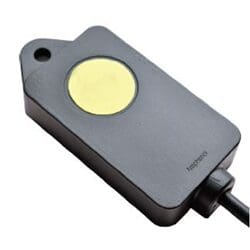
CO2 meters for air quality typically use NDIR (non-dispersive infrared) sensors. These are spectroscopic sensors that detect CO2 in a gaseous environment and are the most common and accurate means of measuring CO2.
NDIR combines an infrared source, a light tube, an interference (wavelength) filter, and an infrared detector. Gas is pumped or diffused into the light tube and electronics measure the light absorption. The amount of absorbed light is directly proportional to the concentration of CO2 in the air. The sensors ideally have sensitivities of 20-50 PPM. These devices ensure compliance with building standards that focus on the wellbeing of building occupants.
Other uses of NDIR CO2 sensors include measuring dissolved CO2 in carbonated beverages, pharmaceutical fermentation, and CO2 sequestration applications.
Photoacoustic sensors
CO2 concentration is measured by subjecting a sample to pulses of electromagnetic energy tuned to the absorption wavelength of CO2. The CO2 molecules in the sample absorb and generate pressure waves, which are detected with an acoustic detector and converted to a usable CO2 reading with a computer or microprocessor.
Chemical sensors
Chemical CO2 gas sensors have very low energy consumption and can fit into microelectronic-based systems. However, short and long term drift effects and short overall lifetime make them less effective than NDIR. Most CO2 sensors are fully calibrated prior to shipping from the factory. Over time, the zero point of the sensor needs to be calibrated to maintain the sensor’s stability.
Other sensor types are electromechanical and metal oxide semiconductor (MOS) sensors.
Markets and Applications
Industrial, Medical
Monitoring air quality, HVAC systems.
For patients under anesthesia or in intensive care, they are used in capnography, which measures the carbon pressure in the lungs
Suppliers
Heilind Electronics (Amphenol Advanced Sensors)
Related products
Temperature sensors
Humidity sensors
Pressure sensors
Vibration sensors
Like this article? Check out our other Meet the Connector and Connector Basics articles, our Industrial Market Page, and our 2025 Article Archives.
Subscribe to our weekly e-newsletters, follow us on LinkedIn, Twitter, and Facebook, and check out our eBook archives for more applicable, expert-informed connectivity content.

- Custom Cable Assemblies: A Value-Add Solution - October 13, 2026
- Fiber Optics Product Roundup - October 13, 2026
- October 2026 Connector Industry News - October 13, 2026