Agricultural Robots Pick with Precision
Farm country is rapidly becoming the land of automation, with sensor-led crop monitoring systems, drones that strategically apply chemicals, and tractors that navigate fields using lidar guidance. Now robotics built with harsh environment connectivity are replacing human labor in the fields as precision agricultural robots harvest crops.
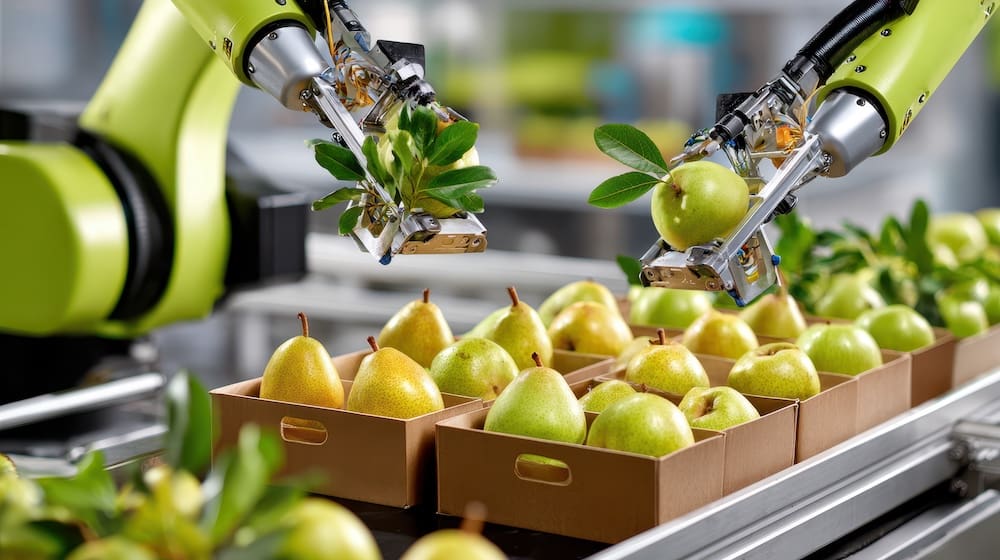
Agricultural robots are beginning to take on the precise and delicate task of harvesting crops. The automation of outdoor agriculture has been arriving in stages, taking a variety of forms. Unmanned tractors navigate fields using GPS and sensor systems at industrial farms. Drones and IoT-enabled monitoring systems evaluate field conditions. Irrigation and chemical applications are automated with the use of data-driven controls.
“Large farms are increasingly investing in precision agriculture methods, with 68% of large-scale crop farms implementing advanced technologies to run their operations. While smaller farms are adopting technology at slower rates, there is an active movement toward testing and leveraging accessible, lower-cost tools like mobile-controlled irrigation systems and GPS-enabled equipment to improve efficiency and increase profitability,” said Katie Pinke, manager, supplier marketing, DigiKey.
Crop harvesting, particularly delicate crops like berries and tree fruit, still requires the human touch though. These crops require visual assessment, gentle handling, and decision-making in real time. Recent improvements in machine vision, force sensing, and embedded computing, however, are now making robotic harvesting viable. Agricultural robots use a combination of rugged interconnects, high-speed connectivity, sensing capabilities, and artificial intelligence to accomplish site-specific tasks and harvest crops without damaging them.
DigiKey tests agricultural technologies at Grand Farm in North Dakota in collaboration with growers, OEMs, and others. “Their innovation campus offers farmers the opportunity to visit, learn, offer feedback, share personal operational challenges and connect with technology companies who are actively running trials, such as solar-powered, autonomous robots that hoe soil without using lasers or chemicals,” said Pinke. “Trials at Grand Farm found that they can be used all season in any weather without resealing or swapping batteries. The robots run remotely, and thousands of pictures are used to adjust, monitor, and move with crop growth.”
At the core of these systems is a sensor suite that mimics human observation. RGB and multispectral cameras identify ripe produce. Time-of-flight and stereo vision systems determine depth and orientation. Force and torque sensors embedded in end effectors ensure that fruit is picked without bruising. All of this data feeds into real-time control loops that guide robotic arms with millimeter-level precision. These harvesting robotics take on many forms, including standalone equipment and robotic attachments for other equipment. One company, Agrobot, offers a berry harvesting platform that has 24 robotic arms and uses lidar to follow rows to the end, harvesting along the way.
DigiKey’s Farm Different series is now in its fourth season.
Components designed for dirt, water, and vibration
Unlike factory automation, agricultural robots operate in unstructured, highly variable environments. Dust, mud, rain, fertilizer, chemicals, vibration, and temperature extremes are constants. Harsh environment interconnects are essential for every power, sensing, and communication system in these technologies. Bulgin’s robust, sealed connectors, switches, and indicators are widely used in farming equipment including agricultural vehicles and attachments, cattle feeding machines, marine fish agriculture, and livestock processing systems.
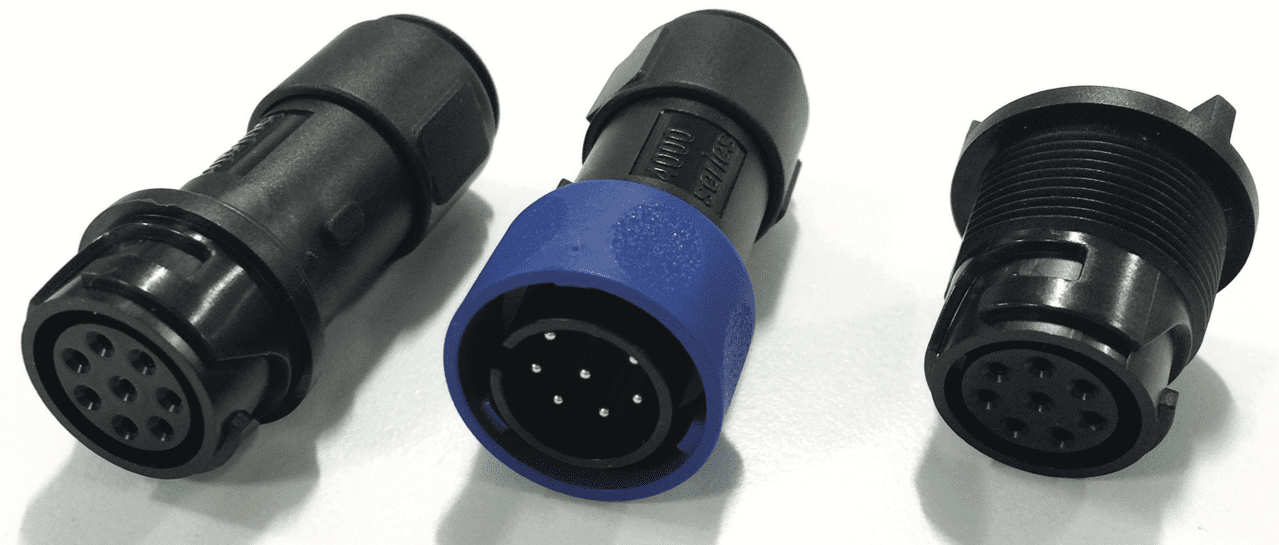
Compact, sealed circular connectors within Bulgin’s Buccaneer range are ideal for designs requiring a small footprint, such as robotic arms or agricultural tool attachments.
For robotics and other compact equipment, the 400 and 600 Series miniature power connectors, and the even smaller 4,000 series, can be used, with the same features and specifications as the larger Buccaneer rugged connector family: lightweight and rugged construction, dust-tight and waterproof IP ratings, and quick-turn bayonet coupling mechanisms. These connectors offer highly reliable power or signal connections for agricultural applications.
One agricultural customer needed connectors that could stand up to freezing conditions through 125 F° desert temperatures, full submersion and exposure to sprinkler systems, and mud — all part of normal agricultural conditions. They also needed to be easy to connect and sit disconnected for potentially months or years without corrosion or unreliability. “Integrating technology can be a challenge and so being able to simplify it in order to set up the equipment and put it into the grower’s hands is key,” said Carlos Rodriguez, product manager at Bulgin. The company ended up working with the customer on a semi-custom solution.
“They approached us with this performance criteria and they also needed to incorporate an ID smart chip into our products. We’ve done lots of different development projects for clients where we embed intelligent devices into the connector. We do a series of electrical tests, contact resistance, installation resistance, low-level testing to some degree, but the key one was to make sure that this device being molded into the connector was still functional. We needed to be sure that it survived the process of being overmolded. Once we did that, we developed the PCB and evaluated the wiring diagrams to make sure it would work exactly as intended,” said Rodriguez. Next came prototype testing and then samples were sent on field trials. Over a couple years in the field, the design has proven that it can withstand significantly more stress as well as environmental conditions.
Reliable power in the fields
While small, precision electronics enable robotic hands to rotate, open and close, and manipulate produce, farm equipment also requires rugged power connectors to regulate the flow of energy to these devices. binder’s Harsh Environment Connector (HEC) is one option engineered for reliable performance in demanding outdoor applications. This connector’s robust materials, advanced sealing technology, and durable construction ensures dependable connectivity in the extreme conditions agricultural equipment faces in the fields. It ensures reliable power and signal connections in tractors, harvesters, or pumping systems even under heavy mechanical stress and changing weather conditions.
binder’s HEC connector has an IP68/IP69K rating, and robust protection against dust ingress, contamination, and high-pressure or steam-jet cleaning. UV-stable and corrosion-resistant materials contribute to extended durability in applications exposed to strong solar radiation or high moisture levels.
“The HEC from the 696 series, offers our customers a robust, durable, and easy-to-use connector solution developed specifically for harsh outdoor conditions,” says Sebastian Ader, product manager at binder.
Connectivity as a system enabler
Every component used in agricultural equipment must exhibit this high level of ruggedization to support the reliable operation of the entire system. Vision systems require sealed housings with appropriate IP ratings, optical windows that resist scratching, and connectors that maintain signal integrity without corrosion, despite vibration and contamination. Proximity and environmental sensors must tolerate washdown procedures and chemical exposure. Robotics require smaller components and greater flexibility for small, precise movements.
Harvesting robots are not standalone machines. They are nodes in a connected agricultural system that includes heavy equipment, attachments, power systems, software, cloud analytics, and human supervisors. This pushes connector and cable design beyond simple pin counts. Signal integrity for high-speed links must be preserved over flexible cables subject to constant motion. Shielding and grounding strategies must account for long cable runs near motors and solenoids. Power connectors must handle peak current loads while remaining compact enough for mobile platforms. Locking mechanisms must be easy to use and designed to survive repeated mating cycles in the field. For robotics, cameras are essential to crop monitoring and identification. Is the fruit ready to harvest? Camera data, interpreted by AI, directs harvesting equipment accordingly. Force-sensitive resistors, strain gauges, and capacitive touch sensors provide continuous feedback on grip pressure. Combined with motor current sensing and encoder feedback, these systems allow robotic grippers to adapt in real time to fruit size, shape, and firmness.
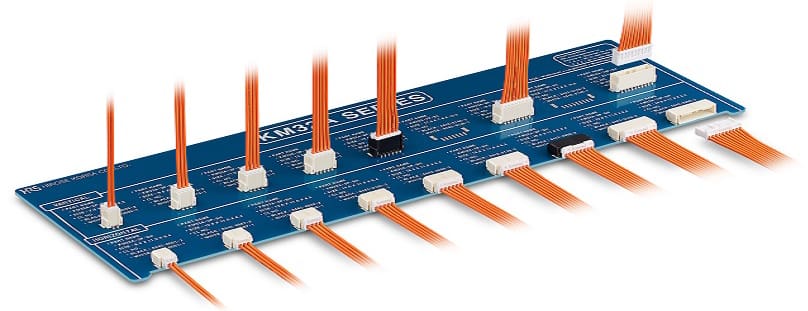
Hirose’s KM32A Series, a compact and high-performance wire-to-board connector with a 2.0 mm pitch and 0.5 mm terminal tab size. Designed for space-constrained automotive, agriculture, and heavy equipment applications, it offers straight and right-angle interface options for flexible board layouts.
Hirose has adopted solutions from its industrial robotics and automotive portfolios for agricultural applications. Hirose’s reliable, high-speed connectors streamline camera integration with a combination of board-to-board, coaxial, and FPC/FFC solutions optimized for ADAS vision systems.
As agricultural robots move from pilot projects to fleet deployments, automation is expanding beyond controlled factory environments. As labor shortages grow and pressure increases to improve yields while reducing chemical use, sensor-rich harvesting robots will become a standard part of modern farming. Their success will depend on rugged connectors, cables, and sensors that keep these systems operating reliably row after row, season after season.
To learn more about the connector companies in this article, visit the Preferred Supplier pages for binder, Bulgin, Hirose Electric, and DigiKey Electronics.
Like this article? Check out our other Harsh Environment and Automation articles, our Connector & Cable Special Topics Market Page and our 2025 and 2026 Article Archives.
Subscribe to our weekly e-newsletters, follow us on LinkedIn, Twitter, and Facebook, and check out our eBook archives for more applicable, expert-informed connectivity content.

- Connectivity Is Reshaping Police and Security Vehicle Fleets - September 8, 2026
- Thermal Management Strategies with Liquid Cooling Connectors - August 11, 2026
- Rodent-Resistant Electronics - July 28, 2026