What are QSFP Transceivers?
Meet the Connector: QSFP Transceivers
This high-speed optical transceiver has gone through many iterations and continues to evolve with higher port density and increased data rates.
The QSFP (quad small form-factor pluggable), defined in the initial Multi-Source Agreement (MSA) in 2006, is a high-speed optical transceiver. It is small and hot-swappable with higher port density than previous form factors like SFP and XFP.
QSFP utilizes four independent channels, each operating at 1 Gb/s, supporting a total maximum data rate of 4 Gb/s. This allows it to replace up to four individual SFP transceivers, for simpler cabling and greater efficiency. It supports both fiber optic cables and direct attach copper (DAC) connections.
Soon after the introduction of QSFP, the demand for higher bandwidth led to the release of QSFP+, which supports 10 Gb/s, for a total of 40 Gb/s. The evolution continued with higher bandwidth versions, including QSFP28 (four 28 Gb/s channels for up to 112 Gb/s) and QSFP-DD (double density).
QSFP-DD has an additional row of contacts providing for an eight-lane electrical interface. With PAM4 modulation technology, a data rate of 50 Gb/s per channel enables 400G network transmission, while a 100 Gb/s PAM4 per channel rate achieves 800G transmission. QSFP-DD supports backward compatibility with existing QSFP+, QSFP28, and QSFP56 modules.
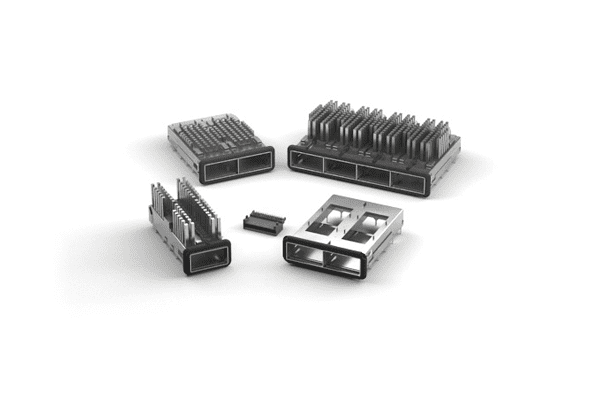
Adam Tech’s Quad Small Form Factor Pluggable (QSFP) and QSFP-DD product families deliver high-density, high-speed connectivity for next-generation networking and data center applications. They include a broad range of cages, connectors, and cable assemblies, with configurable options such as single- and multi-port designs, integrated heat sinks for thermal management, light pipes for port indication, and EMI gaskets or springs to ensure signal integrity and compliance. This flexible portfolio allows designers to optimize performance, density, and reliability across a wide range of high-speed system architectures.
“By combining multiple high-speed data channels into a single compact interface, these solutions support data rates up to 400 Gb/s and beyond. The QSFP-DD platform expands on the traditional QSFP form factor by doubling the electrical interface density, enabling increased bandwidth without increasing port size, ideal for hyperscale, AI, and cloud infrastructure,” reported Adam Tech.
Design Notes
Standards: Mechanical specifications are governed by MSA (Multi-Source Agreement) groups like SFF-8436 and SFF-8679t and ensure interoperability for optical and copper interfaces. High-speed networking performance is defined by various IEEE standards, including IEEE 802.3ba (40G/100G), 802.3bm (100G QSFP28), 802.3bj (100G), and 802.3bs (200G/400G).
Mounting types:
QSFP cages: Physical slots on switches, routers, and Network Interface Cards (NICs) where the module is plugged in.
Latch mechanisms: Modules feature either bail-clasp (a metal wire handle) or pull-tab latches to secure the module into the cage.
Port configurations:
- 1×1 (single) individual, stacked, or ganged cage options1xN (ganged) multiple ports arranged side-by-side
- 2×1 (Stacked): Two ports stacked vertically
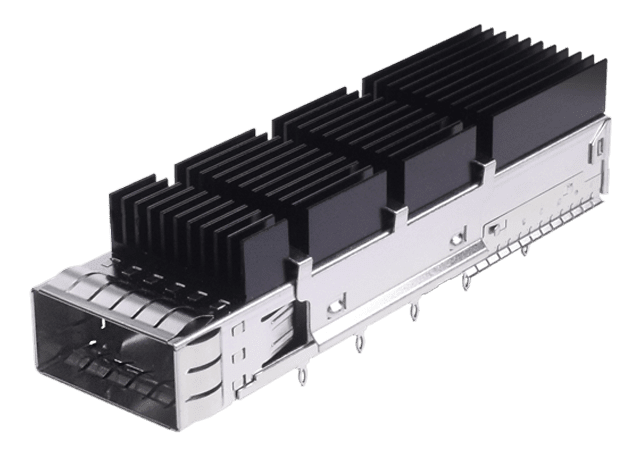
Heatsinks/Light-pipes: May be added to the cage to manage high-speed thermal loads and provide status indicators.
Mating cycles: 100 cycles for the host connector; 50 cycles for the pluggable module
Positions: Varies by type, according to MSA
Contacts: Electrical interface pads on a QSFP module that plugs into a compatible cage and connector on a host networking device, such as a switch or server.
Material specifications: Housing/Shell. Typically die-cast zinc or aluminum for EMI protection and thermal management.
Optical components: Laser diodes (e.g., 850nm VCSEL for MMF, 1310nm DFB for SMF) and photo detectors (ROSA/TOSA).
PCB: High-speed, low-loss, rigid printed circuit boards tailored for high-speed data transmission (e.g. 25Gb/s NRZ, 56Gb/s PAM4).
Connectors: Typically used MPO/MTP for multi-mode fiber (SR4), LC for single-mode fiber (LR4, ER4), or MSA-compliant copper interfaces for DAC cables.
Dimensions: Standardized form factor roughly 70-72 mm in length; 18.35 -18.4 mm in width; 8.5-14.2 mm in height.
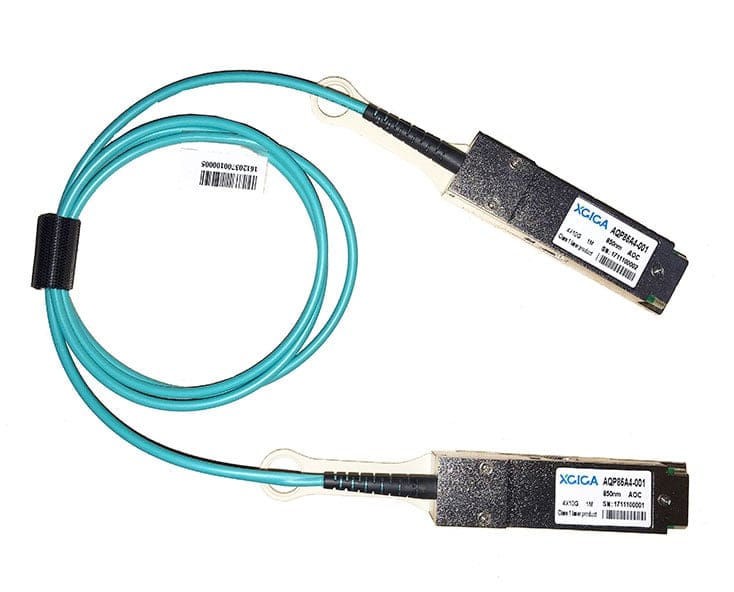
Amphenol Communications Solutions provides a series of 40G QSFP+optical module products, including SR4, eSR4, IR4, LR4, ER4 lite, AOC, and AOC breakout series. This series of products adopts LC or MPO optical port and is compatible with IEEE802.3bm, SFF-8436, and other standards; It has the characteristics of low power consumption, small size, high speed, and is applied to large data centers, campus networks, metropolitan area networks, and other environments.
Thermal and power specifications
Power consumption. Typically <3.5 W for QSFP+, up to 6 W for QSFP28, and up to 14-15 W for high-speed 400G+ QSFP-DD modules.
Heat management: Metallic housing allows for conduction; newer designs (QSFP-DD) are optimized for air-cooled, high-density environments.
Markets and Applications
Computers, Telcom, Datacom
Data centers (including hyperscale data centers), cloud computing, AI, telecom networks, and enterprise networking
Suppliers
Adam Tech, Amphenol Communications Solutions, Cinch Connectivity Solutions, Molex, Samtec, TE Connectivity
Related products
Active optical cable (AOC) assemblies
Like this article? Check out our other Meet the Connector and Connector Basics articles, our Connector & Cable Special Topics Market Page, and our 2025 and 2026 Article Archives.
Subscribe to our weekly e-newsletters, follow us on LinkedIn, Twitter, and Facebook, and check out our eBook archives for more applicable, expert-informed connectivity content.

- Custom Cable Assemblies: A Value-Add Solution - October 13, 2026
- Fiber Optics Product Roundup - October 13, 2026
- October 2026 Connector Industry News - October 13, 2026