Connector Company Gives Orthotics Startup a Hand
A power orthotics startup worked with Würth Elektronik to develop a powerful new solution for the 100 million people living with limited hand mobility.
Article Contributed by: Würth Elektronik
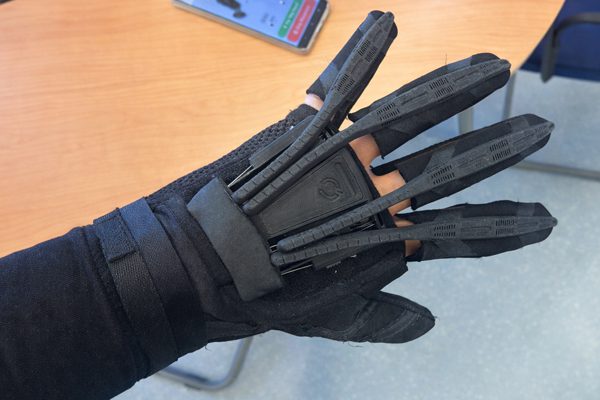
Würth Elektronik partnered with Mannheim startup Powered Orthotics to engineer a medical-grade wearable solution for the 100 million people worldwide living with limited hand function. Stroke, spinal cord injury, multiple sclerosis, cerebral palsy, and traumatic accidents can all reduce or eliminate the ability to grip, pinch, or open the fingers, turning routine actions like holding a cup, brushing teeth, or turning a door handle into significant challenges. Assistive technology is a powerful solution.
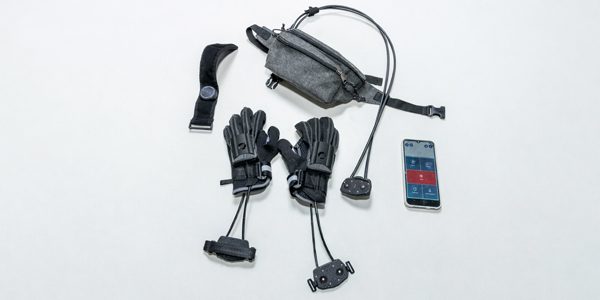
MotionMate is a wearable, glove-like hand orthosis that supports finger motion using electric motors and a cable-pull system. Users operate it through movement signals drawn from the hand, arm, or shoulder via a Bluetooth-connected control element that can be positioned on different parts of the body. A companion smartphone app and voice command support are also built in.
Würth Elektronik’s startup support program Electronics for Positive Impact identifies early-stage companies whose products address meaningful social or environmental challenges. Powered Orthotics was a natural fit. Würth Elektronik’s engineering team, led on this project by design engineer Guillermo Regidor, concluded that a custom development was the only viable path. The resulting transformer measures 21.5 mm × 29 mm × 12 mm and achieves 98% efficiency, which meaningfully extends battery runtime. It was designed for automated series production.
“The power supply for an orthosis has to meet some pretty specific requirements. It needs to be compact, efficient, and also meet the strictest safety standards of protection classes IEC 60601-1 and 1 MOPP (Means of Patient Protection). After all, the device is worn directly on the body,” said Regidor. “What was required was a flyback transformer with an input of 12 to 15 V, an output of 12 V, and a power rating of 1.5 A. Our search for an off-the-shelf component quickly showed that none of the solutions exactly met our customers’ requirements. The safety regulations, in particular, were a critical factor. For this reason, we decided on a specially adapted new development.”
The cables linking MotionMate’s distributed subsystems face similarly demanding requirements. Flex life is critical: the forearm-to-belt cable must accommodate full arm movement across thousands of daily cycles without degradation of insulation or conductor integrity. Low weight is non-negotiable, since every gram added to the cable run is a gram the user must carry. And the cable’s outer jacket must resist the cleaning agents and incidental fluid exposure that any daily-worn device will encounter.
Beyond the custom transformer, Würth Elektronik standard components are used throughout the MotionMate system, including on the main control board, the embedded electronics within the glove itself, and the wireless control button. Würth Elektronik’s Waldenburg facility also conducted internal laboratory testing on the device, evaluating performance under mechanical shock, vibration, and thermal cycling.
The MotionMate project illustrates a broader dynamic in medtech development: hardware startups working at the intersection of safety-critical electronics and medical applications often hit component walls that neither pure engineering effort nor off-the-shelf procurement can solve alone. Würth Elektronik’s willingness to commit engineering resources to a custom solution reflects a bet on the long-term relationship and on the social value of the application.
With the core technical challenges resolved, Powered Orthotics is now building 15 additional units beyond the initial prototype for extended real-world testing with users who have relevant hand mobility impairments. Feedback from that trial phase will be incorporated before series production begins later in 2026.
Learn more about Würth Elektronik’s component portfolio and startup support program.
Like this article? Check out our other Connector Basics articles, our Medical Market Page, and our 2026 Article Archive.
Subscribe to our weekly e-newsletters, follow us on LinkedIn, Twitter, and Facebook, and check out our eBook archives for more applicable, expert-informed connectivity content.

- Printing at the Edge of Possibility: How TE Connectivity Leverages Micro-3D Printing - October 13, 2026
- A Five-Layer Clad Solution for High-Performance Battery Interconnects - October 6, 2026
- High Voltage Interlock for Commercial Vehicles: A Must-Have or a Nice to Have? - September 29, 2026