From Cameras to Connectivity: How AI Is Redefining Transportation
TE Connectivity’s CTO shares insights into the growing role of artificial intelligence in sensing, safety, electrification, and next-generation transportation platforms.
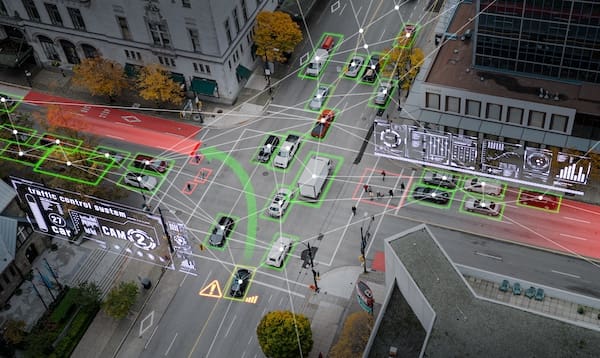
The impact of AI on transportation technologies is multifold and just beginning to take hold across the multimodal systems that move people and goods around the world. At a components level, AI is already changing the way interconnects used in vehicles are designed and specified. On a software level, it’s streamlining the way equipment operates and interacts with other systems. In terms of efficiency, it’s bringing new visibility to logistics networks and reducing the energy needed for production. And that’s just the beginning.
Davy Brown, Vice President & Chief Technology Officer, Transportation Solutions, is on the forefront of the AI era in connectivity. “AI has become a major focus across the engineering community at TE. As CTO, I have to think about the impact of AI on the systems we sell — systems that ultimately determine vehicle architectures, data flows, and overall platform design. At the same time, I deal with AI every day in my role as part of how we accelerate the design process,” he said. “I sit at the intersection of these two perspectives.” Brown spoke with Connector Supplier about transportation connectivity in an era of rapid change.
How is AI impacting transportation technologies?
AI is changing how we engineer and how we solve customer problems. Simulation capabilities have reached levels of sophistication and speed that we’ve never seen before. We already use a significant amount of generative design — AI-assisted technology that helps optimize designs for weight, performance, and other parameters. We’re also using AI in areas like requirements analysis, right at the start of the engineering process. From requirements through design and validation, AI is supporting our engineers and assisting with data generation.
This represents a fundamental shift in how we engineer, and that shift will continue. At TE, we have a five-year roadmap that will embed AI very deeply into our engineering processes, supported by AI agents that assist engineers throughout their work. It’s exciting today, and it’s going to be even more exciting tomorrow.
When you talk about engineering, are you referring to developing new interconnects, or helping customers design existing products into their systems?
It’s both, but predominantly the former. We’re engineering new interconnect systems, and AI is transforming how we do that, both in terms of how quickly we can move and in our ability to explore design spaces we couldn’t reach before. AI is also helping our customers find the right products by matching their requirements to our existing portfolio, while also supporting the design of new products. That’s happening today, and it’s truly transformative.
Do you foresee a TE connector designed entirely by AI in the near future?
I expect an increasing amount of our work to be accelerated and supported by AI, but I don’t see a fully AI-driven process from concept to delivery. Our view is that, for the foreseeable future, engineering will remain human-led and AI-accelerated. We want to use AI as a cognitive multiplier, while ensuring that our engineers remain fully aware of what they’re designing so we can be confident the products truly meet customer needs.
That sounds more collaborative than some people might imagine with AI.
Yes, exactly. I also wanted to pivot from how we engineer to what AI technologies are active in transportation today. When people think about AI in transportation, they often jump immediately to autonomous vehicles, whether on-highway or off-highway. We see autonomous operation today, with off-highway applications generally more advanced due to regulatory and environmental factors. Adoption of various levels of autonomy on highways continues to increase as well.
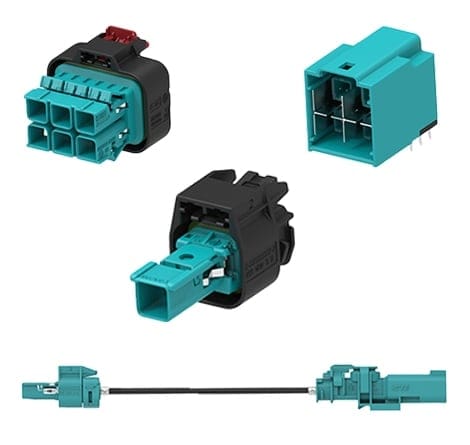
TE’s MATEnet connector system offers true automotive robustness and is compatible with both unshielded Twisted Pair (UTP) and Shielded Twisted Pair (STP) variants. MATEnet connector system can transmit up to 1 Gbps according to 100BASE-T1 and 1000BASE-T1 standard. In addition, MATEnet connector system uses higher modulation data transmission technologies, enabling it to support data rates up to 4 Gb/s.
Another mature area for AI is safety. In off-highway applications like agriculture or mining, AI augments human operators by improving hazard detection and situational awareness. AI expands safety beyond the operator’s field of view by providing awareness all around the vehicle. ADAS is another clear example. Features like lane departure warnings and automatic braking supplement driver capabilities and improve safety.
Predictive maintenance is a growing application, particularly in commercial vehicles such as trucks, buses, and off-highway equipment. AI helps determine when maintenance is needed, maximizing uptime. We’re also beginning to see predictive maintenance capabilities appear in passenger vehicles through smarter service intervals.
Beyond the vehicle itself, AI plays a role in traffic management. Many smart cities are piloting AI-driven traffic optimization systems, and traffic management is one of the most impactful early smart city applications. Finally, digital cockpits and AI assistants are becoming standard in premium vehicles. Voice interfaces and AI assistants—similar to what people use on their smartphones—are increasingly expected features. All these applications are already in use today, and all of them are underpinned by AI.
Which parts of the world are leading adoption of these technologies?
Broadly speaking, the U.S. and China lead in AI adoption in transportation, particularly in autonomous operation and the underlying technologies that support it. That said, the technology itself is advancing rapidly in all regions. Regulation is the key differentiator. Europe, for example, has traditionally moved more cautiously in this area, which affects visibility and adoption rates. Ultimately, this is a global phenomenon, and I expect all regions to catch up over time.
In which mode do you see the first major uptake — rail, off-highway, or elsewhere?
Off-highway, without a doubt. Autonomous operation delivers tremendous value in constrained environments, where regulatory and safety considerations are easier to manage.
Agriculture is a particularly exciting example. With sensors and AI, decisions can be made at the plant level; where to apply fertilizer, water, or remove a plant. Precision agriculture is advancing quickly, and AI allows these operations to be performed faster, more reliably, and with better outcomes than purely human-driven approaches.
How is AI being used in Smart Cities and vehicle-to-everything applications?
Smart city applications are wide-ranging, but traffic optimization receives significant attention. AI plays a role in two primary ways. First, long-term modeling uses historical data to understand traffic patterns and optimize scheduling, such as traffic light timing. This is very achievable today using camera feeds and traffic data. Second, and more exciting, is real-time traffic management. AI can analyze live traffic conditions and dynamically adjust traffic flow to optimize movement and improve safety. AI also enables rapid response to incidents. Using computer vision, systems can detect accidents, breakdowns, or unsafe behavior and feed that information into traffic management systems.
Vehicle-to-everything (V2X) technology is currently in the pilot phase. Cities like Dubai are already using AI at smart intersections and plan to add V2X capabilities. Software-defined vehicles allow hardware to be deployed today, with functionality added later through over-the-air updates as standards and applications mature.
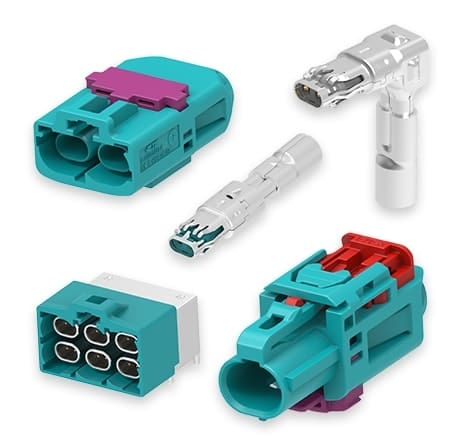
TE Connectivity’s (TE) GEMnet connector system is designed for multi-gigabit Ethernet and SerDes applications, supporting up to 56 Gb/s.
AI is also making inroads into logistics.
Absolutely. One example is autonomous mobile robots and autonomous guided vehicles, which we use extensively in our own manufacturing operations and also support through our connectivity solutions. These vehicles coordinate with one another in real time, adapting routes based on congestion and human presence. Computer vision is also enabling automated picking and packing in logistics environments.
Predictive maintenance plays a role here as well. Sensors monitor equipment like vehicles and conveyor systems to help prevent downtime. Our sensor and connectivity portfolio enables many of these intelligent logistics applications.
What types of connectors are enabling these AI technologies?
When we focus on AI, everything starts with data. That means higher-speed data capabilities are becoming essential in automotive platforms. Modern vehicle architectures increasingly resemble networks of compute and sensor nodes. These systems require reliable, high-speed interconnects that can operate in harsh automotive environments with heat, vibration, and long service life requirements.
Cameras are a great example of high-value sensors. They support safety, driver monitoring, maneuvering, and autonomous operation. As camera resolution and quantity increase—potentially reaching 20 or more cameras in premium vehicles—data rates move from the megabit range into the gigabit range.
Our coaxial connector systems, such as the MATEnet and Mini-Coax families, support camera applications, while our MATEnet automotive Ethernet connectors support data transfer between vehicle zones. For higher-speed applications, our GEMnet connectors support multi-gigabit Ethernet and SerDes applications.
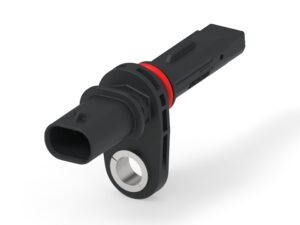
The High Resolution Wheel Speed Sensors provides precise and detailed wheel rotation data, essential for enhancing the performance of vehicles with advanced driver-assistance systems (ADAS) and autonomous driving capabilities. These sensors excel in accuracy and reliability, delivering critical information that supports a wide range of modern and next-generation functions.
You described a camera as a sensor; I haven’t heard it framed that way before.
That’s correct. A camera is an image sensor, but when combined with AI and computer vision, it becomes a powerful sensing system. AI transforms video streams into actionable data — detecting hazards, estimating distance, and enabling new functionality through software updates. In that sense, the camera is one of the most versatile sensors in the vehicle, much like human vision.

TE’s Hydraulic Brake Pressure Sensor ensures optimal brake performance by monitoring hydraulic pressure in brake lines. Crucial for modern braking systems, they provide critical data to the Electronic Control Unit for safe and efficient vehicle operation.
TE has become a strong sensor provider. How does this portfolio support AI integration?
Our automotive sensor portfolio includes pressure, position, temperature, force, torque, vibration, and speed sensors. These sensors are designed for harsh automotive and commercial environments and are used across applications such as braking, steering, wheel speed, humidity sensing, and predictive maintenance. We work with partners on cameras. Our core competence is in the interconnect systems that support camera operation, particularly in challenging automotive environments where vibration and alignment are critical.
Looking ahead, how do you see AI shaping transportation?
We’ll continue progressing through higher levels of driving automation. As sensor capability, data processing, and AI improve, autonomous operation will become more common. For us, the challenge is enabling more data and more sensing without adding weight or space. That means higher-speed data, more efficient network topologies, and lighter interconnect systems. This trend will continue well into the future, especially as we balance performance with efficiency in electric vehicles.
Learn more about transportation connectivity at TE Connectivity.
Like this article? Check out our other Artificial Intelligence and Sensors articles, our Transportation Market Page, and our 2025 and 2026 Article Archive.
Subscribe to our weekly e-newsletters, follow us on LinkedIn, Twitter, and Facebook, and check out our eBook archives for more applicable, expert-informed connectivity content.

- Connectivity Is Reshaping Police and Security Vehicle Fleets - September 8, 2026
- Thermal Management Strategies with Liquid Cooling Connectors - August 11, 2026
- Rodent-Resistant Electronics - July 28, 2026

