CNC Rotary Transfer Architecture for High-Density Connector Production
As connector form factors multiply and lead-free alloys become the norm, the mechanical transfer machine production is being pushed to its limits. CNC integration offers a solution for high-volume pin and socket production.
Article contributed by MIKRON
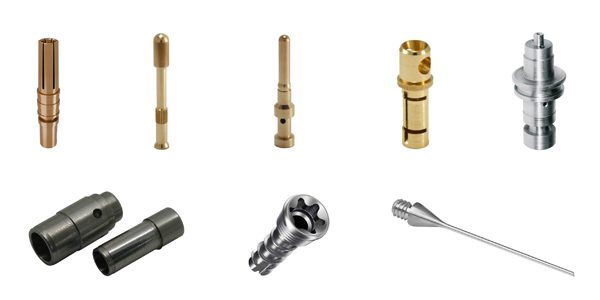
The rotary transfer machine is at the center of connector manufacturing. Capable of cycling through dozens of machining operations in a single platform, it has underpinned connector pin and socket production for decades. But the conditions that made the mechanical transfer machine the default choice have changed. CNC-integrated platforms that preserve the throughput offer advantages while eliminating a growing list of mechanical constraints.
The changeover problem
The first pressure point is changeover frequency. The expansion of new connector designs driven by technologies such as EV advancements, AI server backplane architectures, and medical device requirements has fragmented production into shorter runs. A mechanical transfer machine handles changeovers through physical cam replacement and mechanical retooling, a process that can consume four to eight hours of productive machine time. When batch sizes shrink, overhead becomes increasingly difficult to absorb. The practical implications of that change ripple through nearly every aspect of how a connector plant operates.
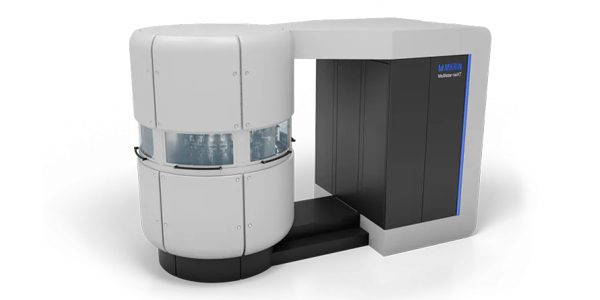
Mikron Multistar neXT is offered in four station-count configurations (8, 12, 16, and 24 stations) that share a common mechanical and electrical architecture. A facility scaling from an 8-station to a 16-station machine carries over its tooling interfaces and operator knowledge directly, without requalification.
One solution is the Mikron Multistar neXT. Designed specifically for the dimensional demands and material realities of connector manufacturing, it replaces the cam-driven tooling architecture of conventional transfer machines with full CNC control at every machining station and on the rotary indexing table. Because feed rates, depths of cut, and cycle parameters are defined in software rather than in cam geometry, switching between connector part families becomes a parameter-change operation rather than a mechanical one. For a plant managing a diverse connector portfolio, the compounding effect of faster changeovers across a year’s production can be substantial.
The impact of using lead-free brass
The second pressure point is the behavior of lead-free brass and copper alloys under cutting conditions. Lead functioned as an internal chip-breaker in traditional brass alloys, producing short, manageable chips that evacuated cleanly from the work zone. Eliminating lead for RoHS and ELV compliance produces long, stringy, continuous chips with high aspect ratios. In a multi-station transfer machine, those chips migrate between stations, accumulate on gauging surfaces, pack around interfaces, and re-enter the cutting zone on subsequent passes.
Re-cutting is a specific failure mode of special concern. A chip that re-enters the cutting zone introduces unpredictable edge loading, accelerates tool wear, and scores finished contact surfaces in ways that affect both dimensional yield and surface finish specifications. In connector bore-to-pin fits where surface roughness below Ra 0.4 µm is required to control contact resistance, a re-cut score is a scrapped part.
The neXT’s machining area isolates working-unit zones to provide physical separation between stations to limit chip migration. Directed coolant flow channels engineered for continuous evacuation force chips away from the workpiece on every cutting pass. The optimized flow geometry also reduces total coolant oil volume required, which has a secondary benefit: lower thermal load on the coolant system.
Single clamping and the concentricity equation
The third challenge is geometric: achieving coaxiality tolerances in the 5–15 µm TIR range that high-performance connector fits require, consistently, across millions of parts. The conventional approach to complex connector geometries involves multiple operations on separate machines or setups — a turning pass, then a re-clamping for bore work, then potentially a third operation for secondary features. Each re-chucking event potentially introduces errors. In a production environment with standard collet chucks, re-chucking repeatability typically runs 3–15 µm TIR depending on collet condition and clamping force consistency. For connectors targeting 5–10 µm coaxiality, that budget is exhausted before any other process contributor is accounted for.
The neXT’s combination of multi-direction machining capability — high-power spindles with fast U-axis recessing units — allows complete machining of both male and female connector profiles in a single clamping operation within the Ø14 mm × 75 mm workpiece envelope. Single clamping eliminates the re-chucking error source entirely. All features share the same datum, and coaxiality is determined by machine geometry and thermal stability rather than by chuck-to-chuck repeatability variation.
The Multistar neXT reconfigures control architecture to match conditions. The throughput class of 50 beats per minute is competitive with high-speed mechanical transfer platforms. CNC-integrated servo feedback enables in-process response to dimensional drift, tool-life management based on actual cutting loads rather than fixed intervals, and changeover cycles measured in minutes rather than shifts.
For connector manufacturers navigating shorter product lifecycles, expanding form factor portfolios, and the material challenges of lead-free alloy machining, those differences are significant. New solutions help advance future connectivity goals.
Visit MIKRON to learn more about precision manufacturing processes.
Like this article? Check out our other articles on Manufacturing and Supply Chain, our Automotive Market Page, and our 2026 Article Archive.
Subscribe to our weekly e-newsletters, follow us on LinkedIn, Twitter, and Facebook, and check out our eBook archives for more applicable, expert-informed connectivity content.

- The Challenges of Electric Flight: How Engineers Are Rethinking Power - October 20, 2026
- Printing at the Edge of Possibility: How TE Connectivity Leverages Micro-3D Printing - October 13, 2026
- A Five-Layer Clad Solution for High-Performance Battery Interconnects - October 6, 2026