Linear Optics and CPO Support Power Conservation in the Data Center
Linear optical transceivers and co-packaged optics are evolving interconnect technologies that target the spiraling increase of power consumption. Strategies like these will be key to enabling future generations of high-performance computing systems.

A common mantra in the computer design community today is the urgent quest to slow the growth of power consumption. Industry pundits debate how the power demands of AI data centers have become unsustainable and threaten the capacity and reliability of the grid. AI data centers that draw megawatts of costly energy must address the resulting excess heat that has become increasingly difficult to dissipate. The environmental impact of AI data centers has made sustainability a factor in the design of new data centers that now reach hundreds of acres in size. Some data center operators have adopted “behind the meter” strategies including building dedicated power generation systems to serve a single data center. The insatiable power demands of AI data centers have sparked serious consideration of new modular nuclear power plants, overcoming years of deep fear of having another nuclear meltdown in our backyard.
Extraordinary levels of energy consumption by data centers have been a problem for years. Early computers that used vacuum tubes consumed inordinate amounts of power. The ENIAC computer built in 1946 utilized over 17,000 vacuum tubes consuming up to 175 kilowatts (kW) of power. The resulting excessive heat caused frequent component failures. Energy efficiency of transmitting or processing one bit of data in advanced semiconductors today is measured in picojoules per bit — a tiny amount of energy, but when multiplied by billions, total power consumption quickly adds up. With the advent of artificial intelligence and its immense workloads, reducing power consumption has become a top priority in new system design.
As speeds continue to rise, the energy lost in copper signal conductors increases, requiring more power to maintain reliable transmission. As the length of the signal path increases (reach), channels may require boosting to maintain minimum bit error rates.
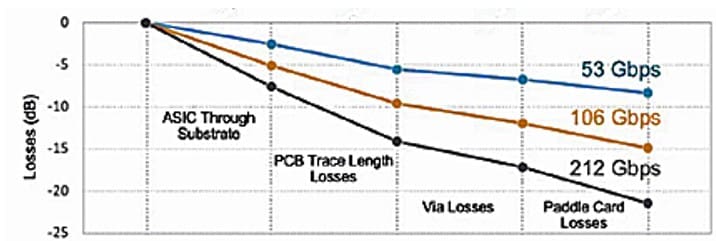
Ensuring that data streams at the receiver have adequate amplitude and are not corrupted by a host of factors, including crosstalk, reflections, skew, and electromagnetic interference, often requires compensation in the form of amplification and error correction. Engineers have done an incredible job of finding ways to send high-speed electrical signals over copper, but the laws of physics dictate that adding features to achieve signal integrity also increase total power requirements. Advanced AI computer clusters are often based on the concept of everything is connected to everything. The result is a massive increase in the number of interconnects and resulting power consumption.
In addition to improved design practices, engineers are adopting several strategies intended to have a significant impact on the upward spiral of energy consumption.
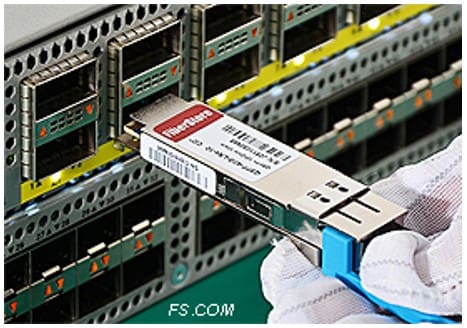
Recognizing the advantages that optical interconnects offer in terms of bandwidth, capacity, and reach, system designers have adopted pluggable optical modules in many input/output (I/O) applications.
QSFP/QSFP-DD and OSFP optical transceivers efficiently convert electrical signals to optical pulses at the I/O panel and offer reliable transmission to 120+ kilometers. Recent user surveys indicate that a growing number of users expect to deploy up to 800G coherent optical pluggables starting in 2026. An extensive ecosystem of competitive module manufacturers provides multiple plug-compatible sources. Pluggable optical transceivers are easy to deploy and reconfigure as system requirements change.
No technology or solution is perfect and pluggables present their own set of challenges. Advanced computing systems, especially AI computer clusters, require extreme levels of connectivity. A server I/O panel that is fully populated with the maximum number of transceivers that can physically fit on the panel may not be capable of providing enough I/O capacity to support the system and become a data bottleneck.
As transmission rates and reach increase, the energy pluggable optical transceivers consume also grows. A QSFP-DD transceiver can draw from 7 to 25 watts. The build-up of heat in a fully configured I/O panel has required transceiver receptable manufacturers to develop advanced thermal management features that transfer heat away from the module
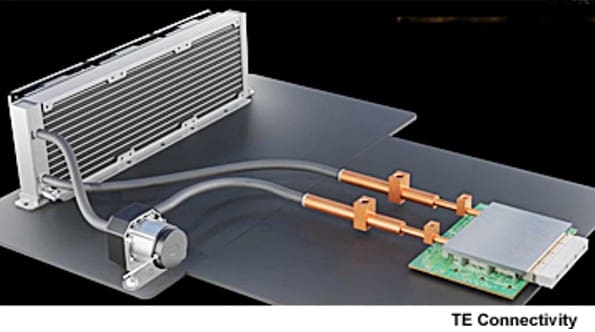
TE Connectivity recently demonstrated a cold plate attached to an optical transceiver receptacle.
In an effort to reduce the amount of energy required by pluggable transceivers, interest has grown in linear optical transceivers that eliminate some or all of the digital signal processors (DSPs) that have been identified as power hogs.
Low power optics/linear pluggable optics (LPO) achieve this by eliminating select components that have been part of the design of standard pluggable optical modules. Fewer components result in lower power consumption, less heat, and potentially improved reliability.
Traditional optical transceivers include retimers on both the transmit and receiver circuits. Retimers can compensate for higher channel loss and tolerate increased noise and crosstalk. These transceivers consume 12-13 watts when coupled with multi-mode fiber and 15-16 watts when coupled with single-mode fiber.
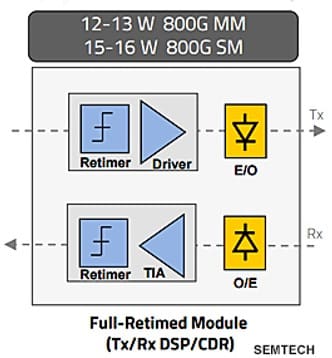
Half-retimed modules feature retiming only on the transmitter, not the receiver. They consume 8-10 watts when coupled with multi-mode fiber and 10-13 watts when coupled with single-mode fiber.
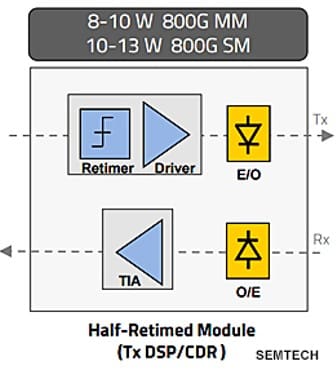
Non-retimed modules eliminate all retimer DSPs and offer the lowest power consumption. These transceivers may require host switch equalization as well as strict conformance to signal integrity standards. They consume 4-5 watts when coupled with multi-mode fiber and 7-8 watts when coupled with single-mode fiber.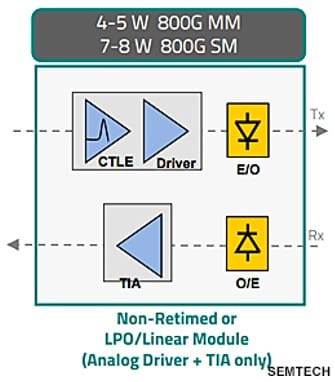
Early linear optical transceivers suffered from their inability to be fully plug compatible, often requiring tweaking system circuitry and settings to assure performance. To alleviate this problem, OIF issued several specifications that define circuit requirements to guarantee plug-and-play performance. LPO attracted further attention when a consortium comprising semiconductor, networking, and optics manufacturers established the LPO Linear Pluggable Optics Multi-Source Agreement. This initiative is dedicated to developing specifications intended to foster an ecosystem of interoperable LPO solutions. LPO MSA specifications will define the electrical and optical requirements to guarantee mechanical, electrical, and optical compatibility of LPO transceivers sourced from competitive manufacturers.
Co-packaged optics (CPO) offers a second option to reduce system power consumption by reducing the electrical signal path to an absolute minimum. CPO architecture locates optical engines close to a high-speed switch or ASIC. Shortening the length of copper trace between an ASIC chip and optical engine reduces distortion and power. The transformed optical signal is directed to the I/O panel, where high-density optical connectors consume much less space than pluggable optics. The result is reduced power consumption and greater I/O panel signal capacity and density.
The evolutionary progression of CPO started with traditional direct attached copper cable to copper PCB traces, leading to a high-performance device. The next steps of near package optics (NPO) brought optical fiber closer to the device and reduced copper conductor length.

The most current iterations of CPO utilize miniature optical engines in the form of chiplets mounted on the same substrate as an ASIC and surrounding the active device.
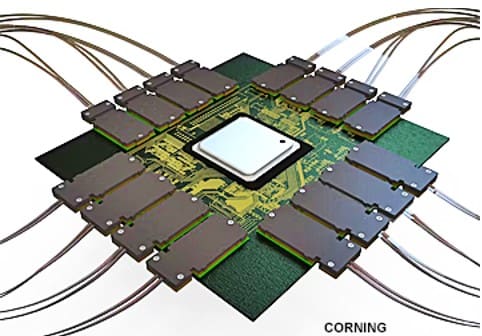
The length of copper traces is reduced to a minimum. Future generations of CPO may integrate the optical engine directly into the ASIC or switch device.
Some configurations of CPO place the necessary laser source on the same substrate as the device, raising some reliability, repairability, and thermal management issues. An alternative solution is to utilize an external laser mounted on the I/O panel. The external laser small form factor pluggable (ELSFP) module can easily be replaced from the front panel if a laser were to fail.
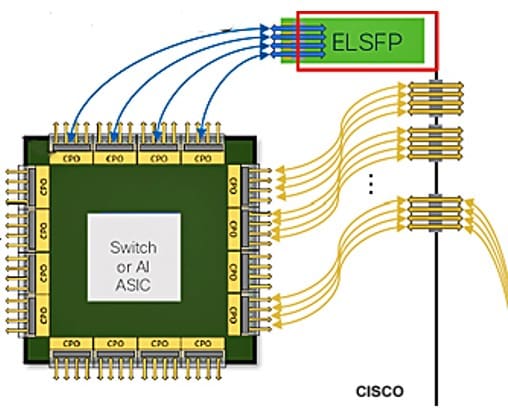
The Optical Internetworking Forum (OIF) has created implementation agreements for a 3.2 Tb optical module and ELSFP form factor with the objective of providing design guidance to hasten the adoption of CPO technology.
Linear optical transceivers and co-package optics are still in the early stages of development with limited user experience and supply chain. With the prospect of energy reduction that ranges between 40% to 70%, CPO has grabbed the attention of several industry leaders, including Nvidia, Microsoft, and AMD. When fully developed and documented, CPO offers compelling reasons for adoption, including packaging density, serviceability, manufacturability, and reliability as well as a path to higher bandwidth. Designers of 224 Gb/lane channels will find CPO useful but will be essential at 448 Gb/lane and above. Many engineers feel broad adoption of CPO is inevitable
High-performance computing and AI clusters require massive connectivity. The resulting increases in the number of high-speed/low latency data transmission links make high-density, low power optical I/O a necessity. Much work is yet to be done to make CPO a mainstream technology, but forecasts have already estimated the total NPO and CPO market value will reach $5.5 billion in 2027.
Linear optical transceivers and co-package optics are examples of evolving interconnect technologies that target the spiraling increase of power consumption and will be key to enabling future generations of high-performance computing systems.
Visit Bob Hult’s Connector Supplier archives to read his ongoing coverage of high-speed advancements and see his industry event reports, including DesignCon and OFC 2025.
Like this article? Check out our other Artificial Intelligence and High-Speed articles, our Military and Aerospace Market Page and our 2025 Article Archives.
Subscribe to our weekly e-newsletters, follow us on LinkedIn, Twitter, and Facebook, and check out our eBook archives for more applicable, expert-informed connectivity content.

- The Power of Having Options - September 15, 2026
- XPO, Addressing the I/O Panel Bottleneck - June 30, 2026
- Agentic and Neuromorphic Computers Enable the Future of Digital Computing - May 26, 2026