OFC 2026: High-Speed Networking in the AI Era
Artificial intelligence has become the primary driver of advanced high-speed copper and optical technology and products.
The 2026 edition of the Optical Fiber Communications Conference and Exhibition filled both the south and west exhibition halls of the Los Angeles Convention Center, with some presentations spilling out to nearby hotel venues. Attendance continues to grow with 17,800 registered attendees from 91 countries, 706 exhibitors, and 115 invited speakers. Over 600 technical presentations, short courses, workshops, plenary sessions, and panel discussions were conducted over March 15 to 19. The most current advances in optical technology designed to enable current and next generation applications in telecom and computing were on display and verified in live demonstrations.
As was also apparent at the recent DesignCon conference, artificial intelligence has become the primary driver of advanced high-speed copper and optical technology and products. Some concern about the ability of the industry to keep up with the unprecedented pace of AI advances and resulting performance demands was the topic of several industry presentations. The rate of increased demand for bandwidth at the system level raises questions about the future of copper interconnects as 400 Gb/lane goes mainstream. The ability to scale current interconnect technology to support next generation agentic AI is seen as a significant data bottleneck going forward. The overall atmosphere at OFC 2026 was of extreme optimism and anticipation for continuing breakthroughs in technology and products.
Many exhibitor’s booths promoted expertise in automated chip design, simulation, verification, packaging, and fabrication. Others featured pluggable transceivers designed to support up to 1.6 Tb/s bandwidth. Manufacturers of optical connectors and related termination equipment, adhesives, cleaning, performance measurement, inspection, and failure prediction tools were well represented. Leading connector manufacturers featured both copper and optical interconnect products.
Some of the trends discussed in technical sessions and seen on the exhibit floor include:
- Demand for high speed, high density, low power connectivity, both copper and fiber are critical issues in next generation AI networking and computing clusters.
- Integration of silicon photonics was identified as a foundational technology that will enable the density and performance requirements of next generation equipment.
- Reduced diameter and high fiber count optical cables are one solution to supporting demand for higher bandwidth.
- Lane speeds are continuing to evolve from 224 Gb to 448 Gb/lane. PCIe 7.0 doubled the per lane rate from 64 GT/s to 128 GT/s. PCIe 8.0 will deliver 256.0 GT/s lane rates to provide an aggregate of up to 1 TB/s bi-directionally via x16 configuration.
- Pluggable optical transceivers have become the workhorse of AI networks. 400 Gb, 800 Gb, and 1.6 Tb pluggable transceivers were displayed by multiple suppliers, with a roadmap to 3.2 Tb pluggables now in development. Sales of optical transceivers reached $23.8 billion in 2025 with significant sales growth expected in 2026.
- End-to-end connectivity was a common theme among interconnect suppliers, offering a full system solution rather than individual components to address specific applications.
- Coherent optical transceivers that feature greatly increased bandwidth and reach are being used in longer haul applications but are a more costly solution in short runs. Utilization of coherent pluggables is expected to grow as single mode transceivers become incapable of supporting bandwidth demands.
- Connector manufacturers have taken a smorgasbord approach to their product offerings. Rather than bet on either copper or fiber optic solutions, most connector suppliers offer interconnects that support near and co-package optics, as well as near and co-package copper connectors. This may reflect the fact that the industry is in the process of transitioning to optical interconnects in high-performance applications and prefers to remain with familiar lower-cost media as long as possible.
- The role that multi-source agreements continue to play in the evolution of new interconnect technology was evident with the introduction of the OCI MSA, Open CPX MSA, and XPO MSA at OFC 2026.
- Where relatively short interconnects are required, direct attach and active electrical cables, along with active optical cables, offer lower cost options. Active electrical cables that incorporate retimers are rated to 1.6Tb. The long-predicted death of high-speed copper cables continues to be pushed out in applications where copper delivers required performance and lower cost.
- Interest is growing in the use of multicore optical fiber to address demand for increased bandwidth without increasing bulk. Hollow core fiber production is being ramped up to support applications that demand reduced latency.
- Designing for reliability at the system level is now the new mantra. The extreme complexity of AI computer clusters made ensuring system reliability a major topic of many technical presentations.
- Multiple semiconductor manufacturers are developing 3 nm and 2 nm DSP building blocks that will enable up to 6.4 Tb/s transmission. Others are focusing on refining the manufacturing and integration of silicon photonic devices. Marvell showed a PCIe Gen8 SERDES running over 0.5 meter of passive copper cable.
- Interconnects are now seen as a primary source of data bottlenecks in current AI clusters and are limiting advances in scale up and scale out system performance. Next generation AI cluster fabrics will require high-speed, low latency, highly efficient interconnects between thousands of GPUs, TPUs, storage, and compute functions as disaggregated system architecture continues to grow.
- With the advent of NPO and CPO, fiber density on the front panel has become a critical issue. A single ASIC or switch chip could require 1024+ fiber connectivity.
- Unsustainable growth of power consumption remains a major issue in system design. Many exhibitors added reduced power consumption to the list of attributes of featured products. The industry may need a disruptive innovation to change the current trajectory of power consumption.
- Supporting PCIe 6 and 7 with optical interconnects was the subject of multipole technical sessions as well as demonstrations on the exhibit floor. Several connector vendors had active demonstrations of their connectors operating at PCIe 8 SERDES rates.
- As was the case at DesignCon 2026, cold-plate technology is the cooling method of choice in today’s systems. Rather than a secondary attachment, cold plates are being integrated directly into some new connector designs.
- Solutions to the challenge of scaling up and out high-performance AI computer clusters as well as achieving lane speeds beyond 800Gb were the focus of several panel discussions, as well as product demonstrations. Opinions among engineers indicated they had no idea how next generations of per-lane speeds will be achieved but are confident that they will find a way.
Examples of technologies and products from leading connector suppliers displayed at OFC 2026 include:
Amphenol was one of several exhibitors that featured the new XPO pluggable optical connector. Supported by Arista and the new XPO MSA, this I/O panel mounted connector converts co-package copper lines from a near package ASIC to high-density external optical connectors. Although 2.7 times larger than an OSFP pluggable transceiver, each XPO module offers 8 times the bandwidth for a total of up to 204.8 Tb of switching capacity on a 1 RU front panel.
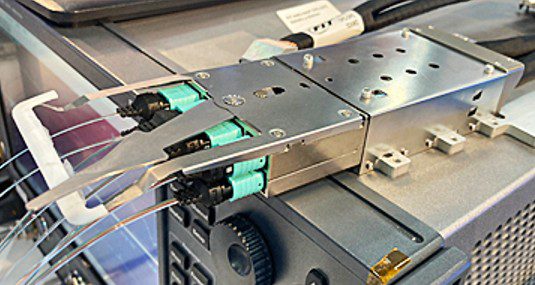
The module supports 112 and 224 Gb/s PAM4 signaling and is scalable to 448 Gb/lane. This is one of the first new connectors to feature an integrated cold plate to ensure reliable performance.
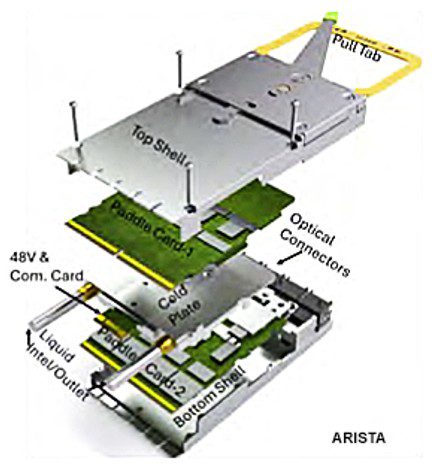
The Amphenol display utilized an OverPass connector assembly to provide 64 high-speed lanes directly from the chip (NPC/CPC) to the XPO connector or a backplane using 30 AWG or 32 AWG OverPass cable assemblies.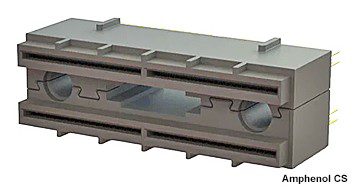
Amphenol also featured a live demonstration of a PCIe Gen6 link over 3 meters of optical fiber terminated in QSFP-DD LPO transceivers. Optical links up to 50 meters are possible.
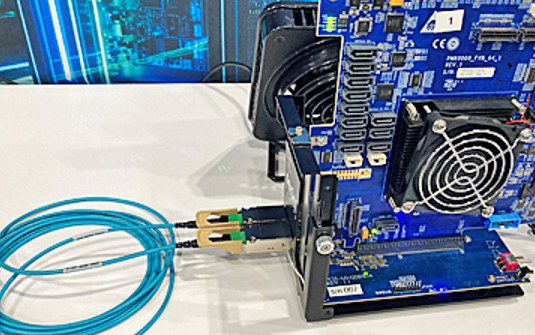
FIT has greatly expanded its pluggable copper and optical transceiver offerings. The company’s booth featured a 1.6 Tb OSFP transceiver as well as an ELSFP module for use in CPO applications.
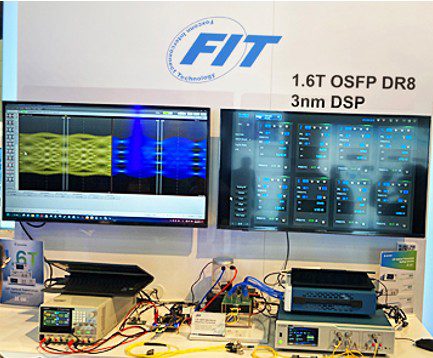
FIT also promoted the XPO module and connector.
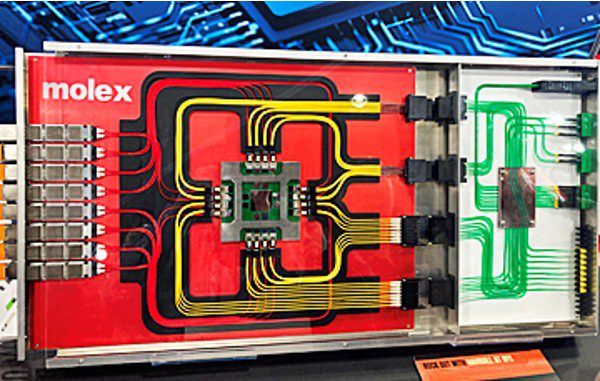
Molex highlighted several new optic and copper interconnect products. In addition to offering the new XPO copper to optic converter, the new Gemini Mezz connector was offered as an ideal high-speed stacking interface for near-package applications.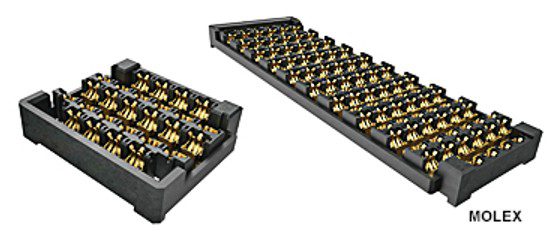
Rated to 224+ Gb/s PAM4, this hermaphroditic connector features a mated stack height of only 5.0 mm. Up to 185 fully shielded differential pairs on an easy to route 3.0 pitch offer extreme signal density.
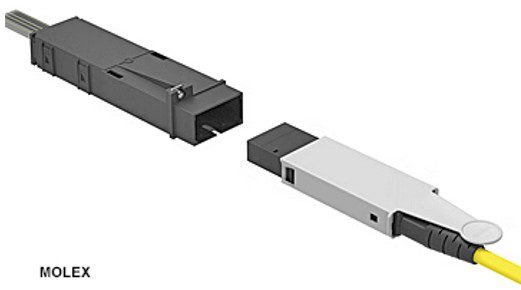
The Molex VersaBeam EBO optical interconnect utilizes expanded beam technology to deliver low-loss reliable fiber connectivity. The connector terminates 12, 16, or 144 single or multi-mode fibers in a simple push/pull housing.
Additional displays included 336G ACC, 224G AEC, and 112G AEC cable assemblies per the Active Copper Cable MSA.
The Samtec booth featured many of the products shown at the recent DesignCon conference.
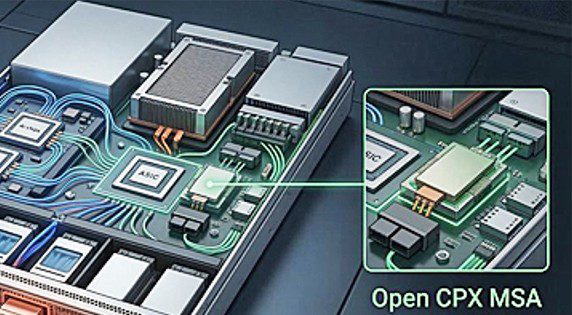
Samtec is a founding member of the Open CPX MSA, which is a new industry initiative focused on creating standards for optical engines used in co-package and near package optical interconnects.
Samtec was promoting the FireFly™ and Halo® optical transceiver families along with the Si-Fly® HD interconnect system to address emerging applications in AI data center applications.
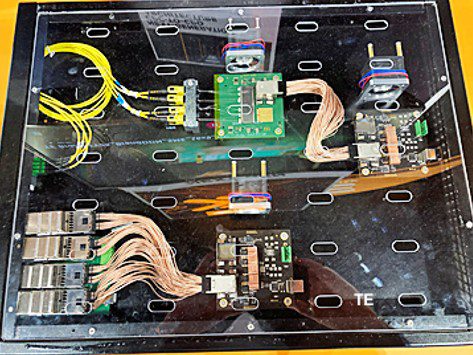
The company also showed products designed to support 224 G full linear transceivers as well as 448 Gb systems as defined in OIF CEI specifications, which will be required to enable 400G/800G/1.6Tb and 3.2Tb applications in the future.
TE Connectivity demonstrated several advanced co-package optics and co-package copper solutions including a CPC-to-CPO architecture featuring 1.6T Linear Receive Optics (LRO) enabled by TE’s AdrenaLINE Catapult ultra-high-density connectors alongside 3.2T CPO integration
A demonstration shelf combined multiple technologies, including an end-to-end NPO backplane using 2X6 4Tb optical engines with RAM Photonics detachable fiber array units (FAUs), pluggable external laser modules, a 3000 fiber optical backplane, and integrated liquid cooling.
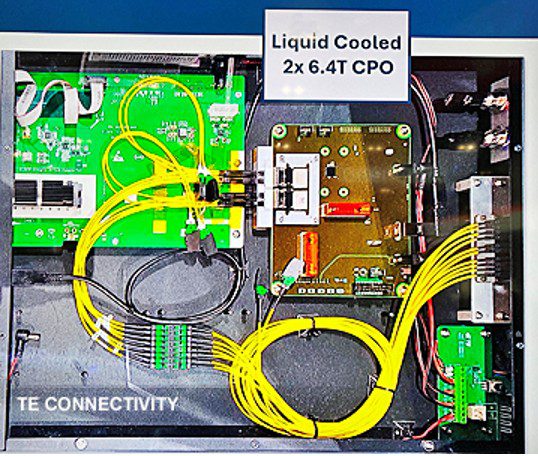
RAM Photonics was recently acquired by TE to address near-chip interconnect challenges.
Additional demonstrations included 1.6 Tb LRO high-speed cable assemblies, optical transceivers, and FAU technology supporting next-generation optical interconnect architectures.
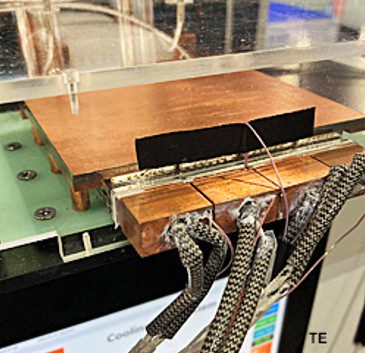
Recognizing the challenge that increasing packaging density results in increased thermal density, TE is developing integrated cooling strategies including cold plates and TE Thermal Bridge components.
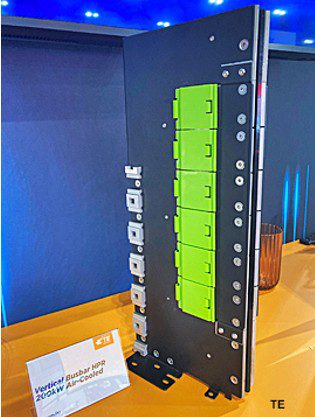
TE also offers high-current bus bar assemblies with integrated air and liquid cooling.
A few of the highlights from among the over 700 OFC 2026 exhibitors included:
A joint demonstration between Infraeo Solutions and VIAVI featured Infraeo’s 1.6T OSFP (AEC) and 800G QSFP-DD AEC, verified by VIAVT’s high-performance test and measurement platform.
The large Corning booth introduced a multicore-fiber to increase density, a Contour Flow micro cable to interconnect multiple data centers, a new 32-fiber MMC connector to simplify and accelerate data center deployments, and co-packaged optics systems to enable scale-out of larger AI networks.
ARISTA featured a live demonstration of XPO connectivity listing the advantages of higher reliability, increased I/O panel density, high bandwidth, reduced power consumption and integrated liquid cooling The XPO MSA is supported with multiple sources offering potential lower cost.
The overall theme of the OIF Joint booth with 40 member companies was “Breaking the 1.6 Tb Barrier” and device interoperability. CEI-224G and 448 G circuits using both PAM4 and PAM6 modulation illustrated the advances made over the past year. Many operating demonstrations included 400 Gb over copper to 500 mm.
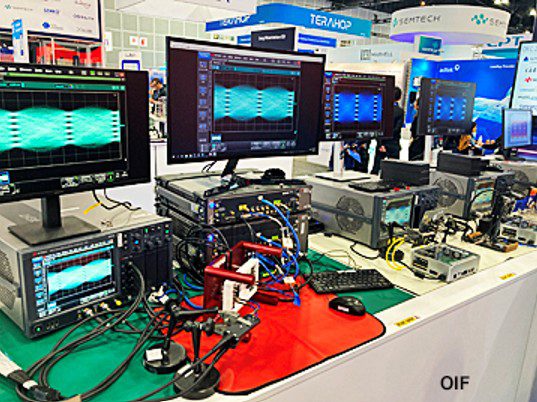
Ethernet Alliance presented the 2026 roadmap and featured products across the range from 25 G to 800 G with interactive displays and hints of what to expect with 1.6 Tb interconnects. Optical booth-to-booth links emphasized the support of optical networking. As with many vendors and organizations, the concept of “end-to-end connectivity” and interoperability were key themes.
Coherent showcased pluggable optical transceivers spanning 1.6 Tb and 3.2 Tb including emerging architectures for 12.8 Tb. 1.6 Tb optical links utilized a variety of technologies including 400 G/lane PAM4 and silicon photonics to increase design flexibility.
NLM Photonics announced sampling of 1.6 Tb and 3.2 Tb silicon photonic integrated circuits (PICs) that run at 200 Gb/s and are 40% smaller than conventional PICs.
Sumitomo showcased their multi-core fiber featuring single mode four core fiber measuring 125 mm diameter and 40 mm core pitch.
SENCO showed a new Metallic PIC wafer-level detachable connector for testing co-packaged optics using silicon photonic circuits and a micro-prism array.
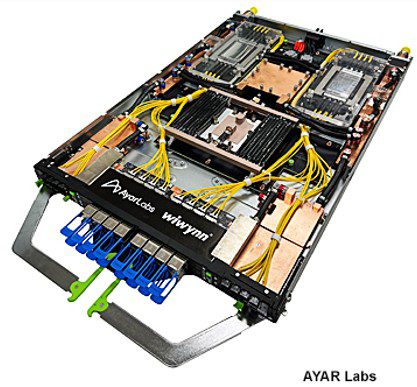
AYAR Labs announced a partnership with Wiwynn, an IT infrastructure provider. The AYAR booth showed a HVDC rack-level system featuring liquid cooling, ELSFP remote CPO light sources, and AYAR TeraPHY optical engines.
USCONEC showcased their many optical connectors featuring the newer MMC high-density push–pull connector terminating up to 16 single and multi-mode fibers.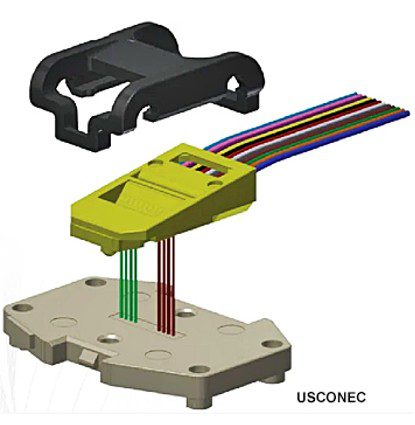
The PRIZM TMT connector features high-density, low loss, and expanded beam technology. The mating face is recessed to prevent potentially contaminating finger contact.
Growing interest in reducing latency of optical data transmission was reflected in multiple venders such as Prysmian and Samba Photonics Lab promoting versions of hollow core fiber.
LIGHTSPEED Photonics showed a PCIe Gen 5/6 expander card with reach of up to 50 meters of OM4 fiber. The low latency optical capability supports disaggregation within the AI data center while reducing power consumption.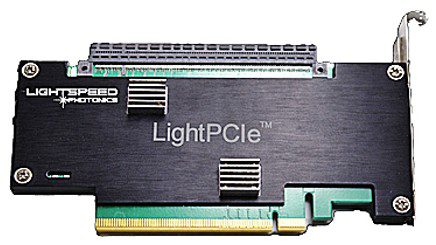
OFC has become the optical and electrical showcase of the future and reflects the global momentum of optical networking and connectivity in support of the AI revolution. Spanning the range from established industry leaders to start-ups, OFC 2026 provided the platform for the exposure and exchange of concepts and technology that will enable future generations of high-performance computing and communication equipment.
Visit Bob Hult’s Connector Supplier archive for more high-speed coverage, his Tech Trends series, and show reports.
Like this article? Check out our other articles on our Sensors/Antennas Market Page, our Artificial Intelligence and Trade Shows articles and our 2025 and 2026 Article Archive.
Subscribe to our weekly e-newsletters, follow us on LinkedIn, Twitter, and Facebook, and check out our eBook archives for more applicable, expert-informed connectivity content.

- The Power of Having Options - September 15, 2026
- XPO, Addressing the I/O Panel Bottleneck - June 30, 2026
- Agentic and Neuromorphic Computers Enable the Future of Digital Computing - May 26, 2026