What are MT Ferrules?
Meet the Connector: MT Ferrules
MT ferrules are key fiber optic components in the system architecture required for today’s higher data rate, high-density, high-precision applications.
An MT (mechanical transfer) ferrule is a high-precision, rectangular, ferrule designed to align multiple optical fibers simultaneously. It typically accommodates 12, 24, or more fibers within a single compact interface.
The critical elements for fiber alignment are the ability to hold extreme tolerances for precision during the molding process, and the shape, tolerances, and material composition of the alignment pins. Alignment is dependent on the eccentricity (how far the fiber holes and alignment pin holes deviate from their perfect, centered positions) and pitch (the center-to-center distance between the adjacent fiber holes or guide pin holes). Lower eccentricity (tighter tolerance) means better alignment. MT ferrules have precise guide pin holes to ensure accurate fiber alignment, enabling repeatable optical performance across multiple mating cycles.
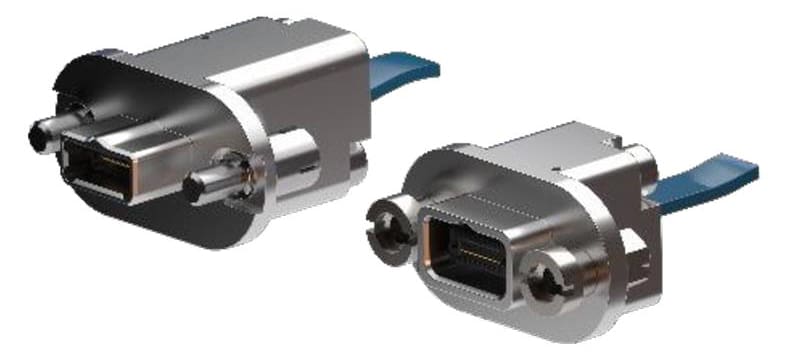
Nicomatic’s DMM connector with MT ferrule enables the integration of optical and electrical channels within a compact rectangular format. This approach supports high data throughput while helping reduce system complexity and electromagnetic interference. Nicomatic has developed a comprehensive fiber optic ecosystem addressing both electrical and mechanical integration challenges. This offering spans connectors, cable assemblies, testing, and training, enabling system-level support from design through qualification.
“As system architectures demand higher data rates and greater integration density, multi-fiber optical interfaces have become essential. The MT ferrule is one of the key building blocks enabling these architectures,” said Simon Gandais, Nicomatic. “Originally developed for telecommunications, MT technology has evolved to support MIL-aero and defense environments. Today, MT-based interfaces are commonly found in VPX systems, including VITA 66.1 and VITA 66.4 optical backplanes; embedded mission systems requiring high-bandwidth and EMI-immune links; and hybrid architectures, combining optical and electrical signals within the same connector. In these applications, mechanical robustness, vibration resistance, and long-term stability are as important as optical performance.”
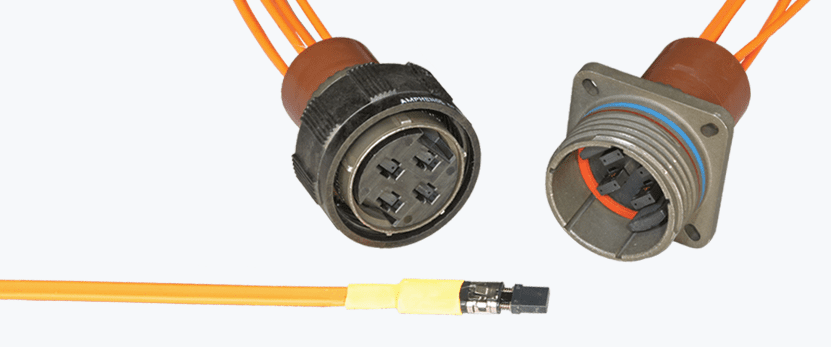
Design Notes
Interconnects vary widely and each has important considerations for specifying. Some of those details for MT ferrules are addressed below.
Standards: IEC and TIA specifications for dimensions (like 2.4mm x 6.4mm), fiber counts (4, 8, 12, 16, 24, up to 72), alignment (using guide pins), and performance grades (IEC 61755 for end-face precision). TIA-604-18 addresses higher fiber counts like 16-fiber formats.
Key specification parameters:
Fiber Count & Arrangement: How many fibers (e.g., 12, 24, 32, 72) and their physical layout (e.g., 1×12, 2×12).
Fiber type: Single-mode (SM) or multimode (MM).
Ferrule grade: Determines precision; stricter tolerances mean lower loss.
- Standard (basic precision for general use)
- Low loss/elite/super low loss (tighter tolerances on fiber/pin holes for better alignment and lower loss, e.g., ≤ 0.5 dB)
End-face polish: PC (physical contact), UPC (ultra physical contact), or APC (angled physical contact) for return loss
Connector housing: Usually MPO or MTP, which dictates overall dimensions and guide pin type (male/female)
Performance metrics: Target insertion loss (IL) and return loss (RL)
Application/Environment: Influences ruggedization, shock/vibration specs
Material specifications: Ceramic or polymer, depending on application (e.g., high temp, ruggedization). Durable, glass-filled polymers (like PPS) provide stability.
Markets and Applications
Military, Aerospace, Datacom/Computer, Telecom
MT ferrules are commonly found in VPX systems, embedded mission systems, and hybrid architectures. They are widely used as the foundation for data centers and high-speed communication networks. In data centers, they are used for links between spine and leaf switches and between leaf and ToR (top of rack) switches.
Suppliers
Nicomatic, Amphenol Aerospace, TE Connectivity, Mouser Electronics, Glenair, US Conec, Senko, Sumitomo, Hakusen.
Like this article? Check out our other Meet the Connector and Connector Basics articles, our Military and Aerospace Market Page, and our 2025 and 2026 Article Archives.
Subscribe to our weekly e-newsletters, follow us on LinkedIn, Twitter, and Facebook, and check out our eBook archives for more applicable, expert-informed connectivity content.

- Custom Cable Assemblies: A Value-Add Solution - October 13, 2026
- Fiber Optics Product Roundup - October 13, 2026
- October 2026 Connector Industry News - October 13, 2026