How to Specify RF Connectors
A look at the origin, features, and applications that make radio frequency connectors a critical component in military and communications equipment.

By PEI-Genesis
Radio frequency or RF connectors are specialized components that secure connections between coaxial cables and electronic equipment used in telecommunications, broadcasting, aerospace, military communications, medical devices, and industrial devices. Their primary role is to minimize signal loss while maintaining stability in systems that operate at radio and microwave frequencies. Selecting the right RF connector involves balancing factors such as frequency range, power handling, and environmental resilience, all critical considerations in any RF design.
RF connector innovation began in the 1930s, when the growing demand for high-frequency signal transmission required more sophisticated interconnects than basic wire terminations. Amateur radio operators experimenting with very high frequency (VHF) systems around 1926 laid the groundwork, and ultra-high frequency (UHF) connectors were developed in the early 1930s. These early designs provided the foundation for many connector families that remain in use today.
Key RF connector families
The widely used Type N connector was invented in the 1940s by Paul Neill of Bell Labs. This early RF connector was among the first capable of carrying microwave frequencies with reliable performance. It is still widely used in low-frequency microwave systems.
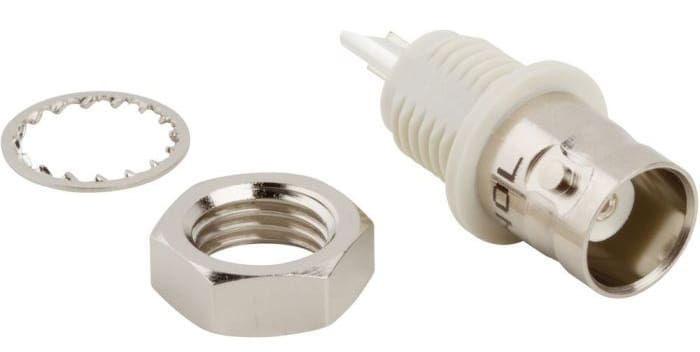
The BN connector was developed in 1951 by Neill and Carl Concelman, and soon after, the BNC (Bayonet Neill–Concelman) connector was created to offer quick connect/disconnect functionality for military applications. The BNC connector interface went on to serve video, test equipment, and RF circuits up to 2 GHz in many industries.
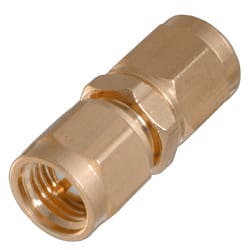
SMA Connector – Designed in 1958 and standardized in 1968, the Sub-Miniature A (SMA) connector addressed the need for compact, high-frequency interconnects. SMA connectors remain critical in wireless communication, antennas, and instrumentation.
The steady evolution of RF connectors reflects advances in both frequency capability and mechanical durability, driven by the demands of emerging communication technologies for commercial and aerospace applications.
Modern RF connector characteristics
Frequency Range and Performance
Modern coaxial connectors are designed to operate across a wide spectrum, from a few megahertz up to 65 GHz in specialized designs. Low voltage standing wave ratio (VSWR) and minimal insertion loss are key design targets, ensuring maximum signal integrity in high-performance systems. Advanced manufacturing tolerances and materials such as stainless steel and beryllium copper help achieve consistent performance across repeated mating cycles.
Power Handling
Power handling is a critical specification for RF connectors. In consumer-grade and low-power applications such as Wi-Fi routers, RFID systems, or handheld radios, connectors like SMA and MMCX are common, supporting milliwatt to watt-level power ratings. By contrast, high-power systems, including radar, base stations, and broadcast towers, require connectors such as the 7/16 DIN, capable of handling several kilowatts with minimal passive intermodulation (PIM). Improperly matched connectors can lead to overheating, distortion, or even mechanical failure, making accurate specification essential.
Environmental Resilience
Environmental factors significantly affect connector performance. Exposure to dust, moisture, vibration, and temperature extremes can degrade signals and shorten service life. To counter these challenges, it’s essential to specify rugged connectors with sealing and other specific features to endure harsh environments.
- IP-rated connectors provide dust and water protection for outdoor or marine environments.
- High-temperature insulators, such as Teflon or ceramic, maintain stability in aerospace engines or industrial heating equipment.
- Corrosion-resistant materials like stainless steel ensure durability in humid or corrosive atmospheres.
These design considerations ensure connectors remain reliable even in demanding field conditions like military and aeronautics.
Key application areas for RF connectors
Telecommunications and Broadcasting: In telecommunications, RF connectors form the backbone of cellular base stations, satellite links, and wireless infrastructure. Broadcast towers rely on high-power connectors for signal transmission, while consumer electronics use miniature connectors for compact designs.
Aerospace and Defense: RF connectors are indispensable in aerospace and defense systems, where reliability under vibration, shock, and extreme temperature is critical. Applications include radar, avionics, electronic warfare, and secure communications. Many connectors in this sector must meet rigorous military specifications (MIL-STD).
Medical and Industrial Equipment: Medical imaging devices, diagnostic systems, and wireless patient monitoring equipment use RF connectors to ensure accurate data transmission. In industrial settings, they are applied in robotics, test instrumentation, and high-frequency sensing technologies.
Connector Selection Guidelines
A carefully selected connector improves signal integrity, minimizes maintenance, and extends system life.
Choosing the right RF connector requires engineers to evaluate multiple factors:
- Frequency Range: Ensure compatibility with the system’s operating band.
- Power Capacity: Match connector limits with expected power transmission.
- Mechanical Durability: Consider mating cycles and connector material.
- Environmental Conditions: Evaluate IP ratings, corrosion resistance, and temperature tolerance.
- Size and Form Factor: Balance miniaturization with performance, especially in portable devices.
Outlook for RF innovation
With the rapid expansion of 5G networks, satellite communications, and high-speed data transmission, demand for connectors that support frequencies beyond 40 GHz continues to grow. Emerging designs focus on lower insertion loss, better shielding against electromagnetic interference (EMI), and compatibility with automated assembly processes. Miniaturization remains a strong trend as devices become smaller but require higher performance.
From their early development in the 1930s to their role in modern high-frequency systems, RF connectors have become indispensable components of global communication and technology infrastructure. Their evolution highlights continuous innovation in electrical performance, mechanical resilience, and environmental adaptability. For engineers and system designers, selecting the right connector, whether for low-power wireless devices or high-power broadcast systems, remains a fundamental step in ensuring reliable and efficient RF performance.
To learn more about high reliability RF connectors, visit Nicomatic.
PEI Genesis is an authorized distributor for select Nicomatic RF products.
Like this article? Check out our other Harsh Environment and High-Reliability articles, our Military and Aerospace Market Page and our 2025 Article Archives.
Subscribe to our weekly e-newsletters, follow us on LinkedIn, Twitter, and Facebook, and check out our eBook archives for more applicable, expert-informed connectivity content.

- Printing at the Edge of Possibility: How TE Connectivity Leverages Micro-3D Printing - October 13, 2026
- A Five-Layer Clad Solution for High-Performance Battery Interconnects - October 6, 2026
- High Voltage Interlock for Commercial Vehicles: A Must-Have or a Nice to Have? - September 29, 2026