Make Way for SPE: A New Standard for Industrial IoT
The standardization of single-pair Ethernet removes the confusing array of connector types. The new universal connector standard significantly simplifies industrial IoT networking for digital AI services and smart factories.

By Thomas Keller, Product Manager Industries, Rosenberger
Single-pair Ethernet (SPE) has proven itself in the automotive, automation, and IoT industries. Increasing connectivity in software-defined vehicles requires secure, compact cabling in the confined space of a vehicle to connect sensors and controls for autonomous driving, battery management, and driver assistance systems. Many years of protocol and interface development have led to the design of new connector solutions that use a single twisted pair of wires. This is reflected in the new hybrid connector standard IEC 63171-7 (ED2), which forms the basis for comprehensive interoperability.
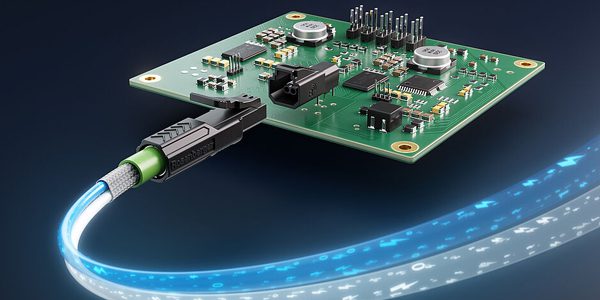
The IEC 63171-7 ED2 standard, initiated by the PROFIBUS User Organization (PNO), is a new industry standard that forms an important basis for the further development and success of Single-pair Ethernet. (Image from Rosenberger)
SPE can serve a wide range of applications
Long-range transmission technology that combines power supply and data transmission in a single cable is important in industrial networking as Industry 4.0, digitalization, and networking become increasingly relevant. Although other protocols are used in industrial networking, accessing data in a cost-effective, sustainable, and efficient manner involves a complex array of connectivity strategies. As sensor and actuator technology in IoT applications provide information that is analyzed by AI systems for predictive maintenance or simulations, for example, the demand for affordable, intelligent networking continues to grow. SPE offers a solution for these challenges and also enables security strategies such as Time Sensitive Networking (TSN) for security- and safety-critical real-time applications.
SPE technology is particularly relevant in automation and robotics, where much narrower, more flexible SPE cables contribute to greater freedom of movement for equipment. Agricultural vehicles increasingly incorporate data on soil conditions and weather. Applications are also emerging in electromobility, such as sensor technology in charging stations and the reuse of vehicle batteries in large energy storage systems that require complex cabling. SPE can simplify the networking of train compartments, and can offer greater connectivity in building automation.
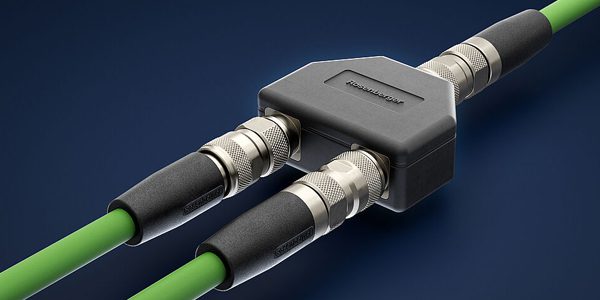
SPE industrial connectors with adapter.
For high-performance networking, SPE excels with features such as miniaturization, power supply via the data cable (Power over Dataline, or PoDL), and significant material savings. Multi-drop topology also allows multiple sensors and actuators to be controlled simultaneously via a single cable. In the IoT environment, many small devices also need to be powered at the same time, so wireless approaches are insufficient for industrial applications.
In industrial networking, dozens of protocols communicate with each other. Gateways are needed to translate these protocols, however, implementation is costly because it requires an elevated level of expertise. This leads to relatively high development costs in areas such as machine and plant design. With SPE, a complete system could communicate exclusively via Ethernet protocol without gateways and save on development costs.
Standardization strengthens SPE
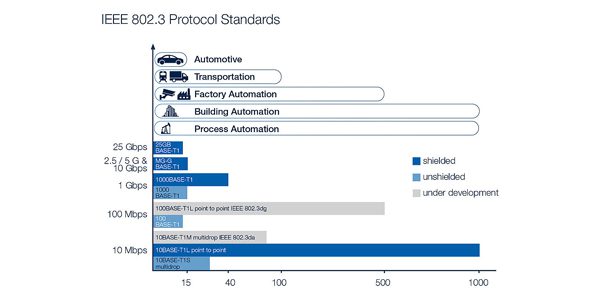
The IEEE 802.3 standard defines and integrates SPE with corresponding extensions that meet the unique requirements of industries including automotive, transportation, and factory, building, and process automation. IEEE 802.3 lays the foundation for SPE protocols in terms of the physical layer and data transfer speeds. While 25 Gb/s are required in the automotive industry due to the high data volumes, this would be oversized in the building industry, for example. In up to 80% of industrial use cases, 10 Mb is sufficient, and 100 Mb can cover almost all cases. The respective protocols also take different distances into account: While in greenhouses or chemical parks, sensors must interact over hundreds of meters or several kilometers, only short cable distances are necessary in a machine, plant, or robot.
An entire range of standardized industrial SPE connectors are described in the sub-standards of IEC 63171. In addition, there are many non-standard connectors on the market. In 2024, the PROFIBUS User Organization (PNO) announced its intention to standardize a uniform connector face with IEC 63171-7 (ED2) to cover all application scenarios, including those in protected areas.
The standardization process culminated in a published standard in 2025. However, SPE is still uncharted territory for many, and there is a considerable need for advice: an important aspect is still the need to analyze each application case in detail and based on this, select the proper physical layer and protocol to maximize the benefits. A connector supplier that took part in the development of this new standard brings the informed insights and expertise needed to streamline communication protocols, enhance productivity and performance, and reduce costs with this powerful new interconnect.
Visit Rosenberger to learn more.
Like this article? Check out our other articles on our Wire and Cable Assemblies Market Page, and our 2026 Article Archive.
Subscribe to our weekly e-newsletters, follow us on LinkedIn, Twitter, and Facebook, and check out our eBook archives for more applicable, expert-informed connectivity content.

- Printing at the Edge of Possibility: How TE Connectivity Leverages Micro-3D Printing - October 13, 2026
- A Five-Layer Clad Solution for High-Performance Battery Interconnects - October 6, 2026
- High Voltage Interlock for Commercial Vehicles: A Must-Have or a Nice to Have? - September 29, 2026