XPO, Addressing the I/O Panel Bottleneck
Introduced at OFC 2026, the new XPO pluggable modules provide a solution to the challenges of signal density, thermal management, field serviceability, and power efficiency.

Continuing advances in artificial intelligence face multiple constraints including power consumption, access to memory, thermal management, and limitations of copper connectivity. Solving these challenges could still result in hobbled systems if input/output (I/O) channels cannot keep up with immense streams of generated data. Ensuring adequate bandwidth density at the I/O panel has become a focus of advanced system designers. Demand for high-speed scale up, scale out, and scale across architecture is putting pressure on component manufacturers to avoid becoming a bottleneck to higher system performance.
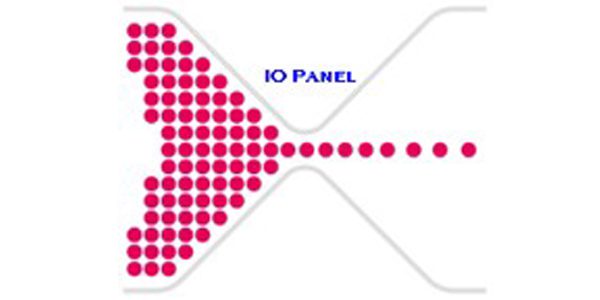
Network switches in particular are experiencing exceptional bandwidth upgrades that have soared from 12.8 Tb/s in 2019 to 102.4 Tb/s in 2026. The Broadcom Tomahawk 7 switch scheduled for production in 2027 will feature bandwidth of 204.8 Tb/s. Managing that amount of data while minimizing power consumption and heat in a high-density standard form factor rack has become a major challenge.
Pluggable OSFP optical transceivers have become the I/O workhorse for the industry. To minimize signal loss and distortion introduced by copper traces embedded in the PCB, designers are replacing the traces with discrete or ribbon twinaxial cables which offer much better high-speed performance. On substrate or near substrate connectors terminated with twinaxial cables convey high-speed signals from an ASIC or switch to a front panel mounted OSFP receptable. The mating optical transceiver converts the electrical signals to high-density optical signals that can efficiently transmit data long distances.
Switch chips continue to increase bandwidth while the physical space available to provide adequate interconnect in a 1 Open Rack Unit (1OU) limits the placement of only about 32 OSFP transceivers on the front panel delivering a maximum of 51.2 Tb/s. As adoption of copper near-package and co-package architecture increases, a new high-density front panel interconnect was required to support the massive increase in the number of I/O links.
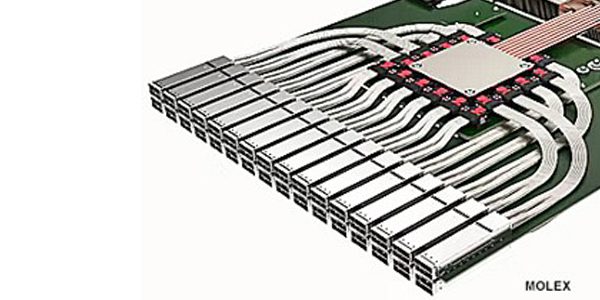
The new XPO (eXtra-dense Pluggable Optics) transceiver was formally introduced at the March 2026 edition of OFC and is supported by Arista Networks and the XPO MSA.
XPO pluggable modules provide a solution to the challenges of signal density, thermal management, field serviceability, and power efficiency.
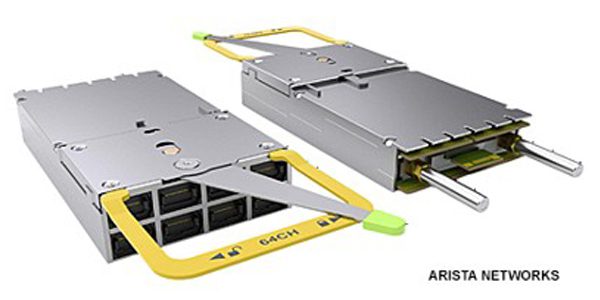
Modules convert near or co-package copper signals from a switch or ASIC to high-density external optical connectors at the front panel. Each XPO module provides 64 differential pairs running at 224 Gb PAM4 to deliver 12.8 Tb per module while consuming only 80 watts of power. A fully configured front panel with 16 XPO modules can deliver a total of 204.8 terabits of switching throughput per 1OU front panel. The XPO roadmap includes doubling throughput to 25.6 Tb by transitioning to 400 Gb/s lanes. It is unclear if adoption of PAM6 or PAM8 signaling would be required.
Although it is physically 2.7 times wider than an OSFP pluggable transceiver, each XPO module offers 8 times the bandwidth. That equates to 4X panel density improvement compared to current 1.6 Tb OSFP solutions. That level of signal density can result in a significant reduction in the number of racks that will be required by next generation AI clusters.
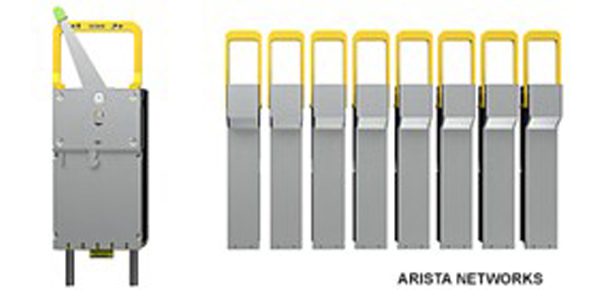
These modules are configured to accept eight MPO-16 fiber optical connectors. A simple lever minimizes mating and ejection forces of the XPO module.
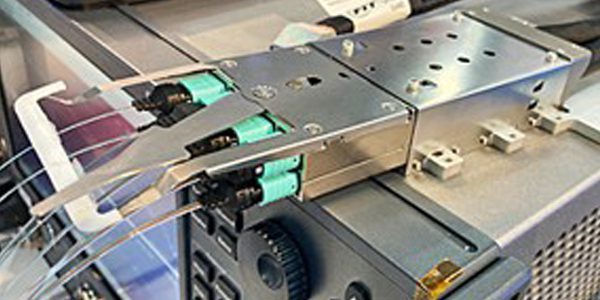
XPO-LPO optical transceiver
In an effort to assure interoperability and broad application adoption, XPO modules are designed to support multiple optical standards including DR, FR, LR, SR, ZR/ZR+, and will offer options to be compatible with linear (LPO), half-retimed, (LRO) and fully retimed systems. 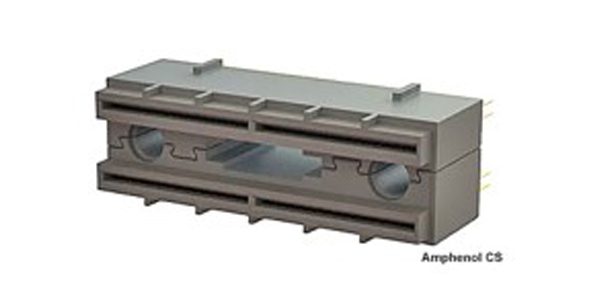
Given the extreme density of the XPO module, an integrated cold plate using circulating liquid ensures that safe internal temperatures are maintained. XPO modules are designed to support up to 400 watts of cooling using blind mate quick disconnect dripless liquid connectors.
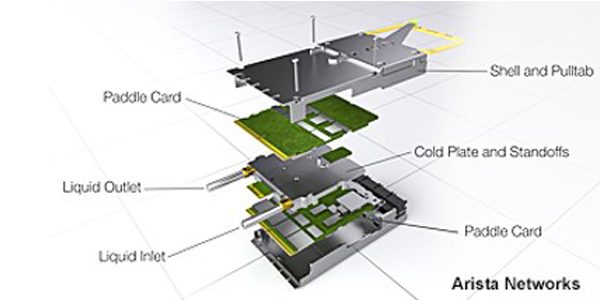
XPO provides a new option to fill the gap between traditional copper and emerging optical interconnects while maintaining the use of familiar copper technology and simple field serviceability.
A new front panel high-speed signal copper cable connector delivers 64 high-speed channels from the chip to XPO module for a total bandwidth of 12.8 Tb/s per module.
A separate power connector has also been specified by the XPO MSA.
Co-Package optics (CPO) technology locates the electro-optic conversion process directly on the switch substrate, reducing the length of the copper circuit to a minimum and offers superior performance. CPO is seen as the long-term solution that provides extreme bandwidth density. By eliminating power hungry digital signal processors (DSPs) CPO is expected to address the current unsustainable rise of system power consumption. CPO is currently under intense investigation but faces concerns in terms of field repairability, thermal management and required changes in the design and manufacturing processes. The CPO supply chain ecosystem today is limited at best. Early implementations have been largely proprietary. At this point CPO is an evolving technology that is likely be the final step toward on-chip optics (OCO) where optic fiber will terminate directly to the switch or ASIC chip, eliminating lossy external copper circuits.
The XPO MSA was established with nearly 100 supporting companies dedicated to creating a competitive supply ecosystem capable of simplifying the implementation of this technology. Multiple connector manufacturers have committed to support XPO with individual components as well as custom twinaxial cable assemblies creating a globally competitive multisource supply chain. The MSA is emphasizing the advantages that XPO brings to the market including:
- 4x increase in front panel signal density over the current 1.6 Tb OSFP footprint.
- Integrated cold plate cooling and reduced parts count improve system reliability.
- Compatibility with multiple optical transmission standards.
- Increased power efficiency via linear optics and adoption of 50 VDC power.
- Increased reliability with reduced component count.
- Pluggable modular field serviceability features
- Design that supports 12.8 Tb XPO-LPO bandwidth now with a roadmap to 25.6 Tb in the future.
XPO is poised to fill an important gap in the toolbox of AI computer design engineers. This new pluggable interface offers a nice blend of performance, serviceability, and especially bandwidth density while maintaining the advantages of modularity and manufacturability. XPO and CPO implementations are expected to co-exist well into the future. It also reflects recognition of the bandwidth, attenuation, signal density and power consumption limitations of high-speed copper interconnect that will make the broad transition to optical signaling inevitable.
Visit Bob Hult’s Connector Supplier archive for more high-speed coverage, his Tech Trends series, and a review of OFC 2026 and other industry events.
Like this article? Check out our other Artificial Intelligence and Data Center articles, our Datacom Market Page, and our 2026 Article Archive.
Subscribe to our weekly e-newsletters, follow us on LinkedIn, Twitter, and Facebook, and check out our eBook archives for more applicable, expert-informed connectivity content.

- The Power of Having Options - September 15, 2026
- XPO, Addressing the I/O Panel Bottleneck - June 30, 2026
- Agentic and Neuromorphic Computers Enable the Future of Digital Computing - May 26, 2026