Anderson Power and JPCPT Tackle AI Connectivity
Two interconnect companies combine their expertise to address the unique connectivity challenges of rapidly expanding AI infrastructure.
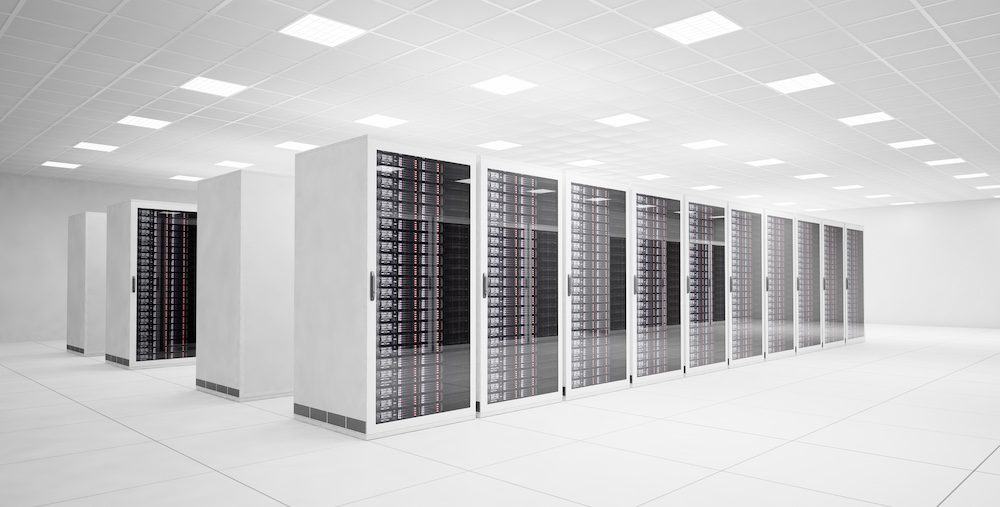
AI’s computational needs are growing more than twice as fast as Moore’s Law, pushing toward 100 gigawatts of new demand in the U.S. by 2030. Long-time partners Anderson Power and JPCPT, the U.S.-based division of JPC Connectivity (JPC), have teamed up to develop connectivity solutions that specifically address the unique challenges created by AI’s rapid development.
“The roots of this relationship go back many, many years to our work with JPCPT, formerly PacTech, a cable assembly manufacturer in the Bay Area,” said Peter Resca, director of product management and marketing at Anderson Power. “From that location, JPCPT was uniquely positioned to serve a lot of the data center build-out and the hardware and software development that was going along with it.”
The two companies now work together to address the needs of those vertical markets as they evolve from data center to AI infrastructure. Demand for high-current and high-density interconnect solutions, Anderson Power’s area of expertise, is increasing due to the proliferation of hyperscalers supporting AI. “JPCPT integrates those connectors into customized cable assemblies tailored to specific customer configurations, compliance requirements, form-factor constraints, and manufacturing strategies across Vietnam, Taiwan, and the USA. The collaboration delivers end-to-end interconnect solutions optimized for next-generation AI workloads,” said JC Chang, JPCPT’s CEO.
Power and size
“Because of the computational transactions that happen, AI consumes orders of magnitude more power. The challenge that the market faces is how to fit more power in the same footprint, in the same structure and location,” Resca said. “The collaboration really is to ensure that we can be, basically, the highway for the current that’s required, and transfer it through the cables and the connectors. If we think about the different configurations of the customer set—different lengths, different cable types, different compliance requirements, there’s a wide variety of SKU proliferation to support all the different needs within a data center.”
Resca explained that uniform rack sizing and configuration sizing allows for an increase in power that the chips can handle without having to significantly change the architecture of the entire rack or layout. “Eventually, you run into some physics, but what’s fascinating to watch is how the solution sets are adapted for a wide variety of concerns. For instance, we attended the OCP (Open Compute Project) conference in October and learned that the concrete foundations of data centers, and the actual exoskeleton of the racks has to be considered because of the amount of power and the amount of weight. And when we go to liquid cooling, it adds a whole element of weight that wasn’t in initial designs because it wasn’t required years ago.”
“This requires much closer collaboration with customers early in the design process, along with a higher degree of customization and systems-level thinking than in earlier data center builds,” Chang said.
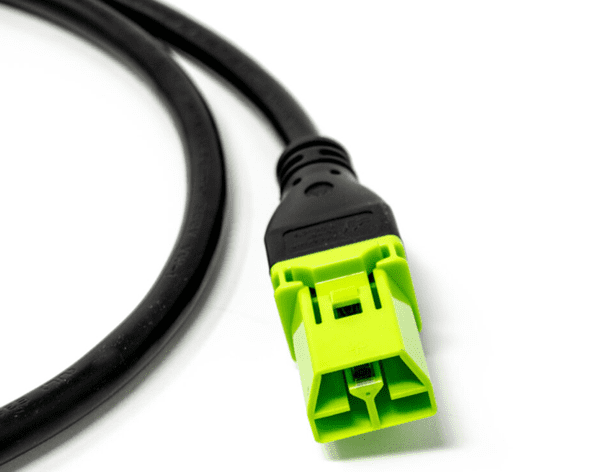
JPC and Anderson Power have collaborated to provide solutions which look and perform as a natural part of the tech ecosystem.
Power and heat
The end users are looking to get the most power they can in the smallest size, so another potential limiting factor is thermal transfer. For Anderson Power and JPCPT, this means considering those different solution sets in terms of cooling methods. “Immersion, using liquid-cooled to completely immerse the systems, requires cables and connectors that can withstand the fluid that’s transferring the energy. If the method is conductive cooling through other materials, we have to think about how we can affix or attach in a way that effectively removes the heat. For air cooling, we’ve got to think about creating paths to get air where it needs to go and ensure that the exhaust is not overheating something else,” said Resca.
Power and safety
Another factor to consider in connector and cable design is compliance with safety regulations. “We’re working with the standards agencies to ensure we can continue to provide reliable, safe interconnects. In addition to material and heat transfer, this includes the ability of the physical hardware to conduct that rate of current or to provide the isolation and insulation when we go up in voltage so that we can transmit the power in a way that’s safe for the user and compliant with all the relevant standards,” said Resca.

Anderson Power’s Saf-D-Grid line delivers maximum power in minimal space. Power data center busways, uninterruptible power supplies, power distribution units, and power supply units with a compact connector built to handle impressive voltage and current. JPC and Anderson Power have collaborated to provide solutions which look and perform as a natural part of the tech ecosystem.
“This emphasis on safety, combined with innovation in materials, thermal management, and power architecture, is critical. Traditional solutions simply cannot scale to meet AI’s demands, making collaborative development between connector manufacturers and cable assembly experts more important than ever,” said Chang.
Power and sustainability
Other configuration differences are due to how companies choose to utilize the power architecture to achieve the required high power. “Some go to higher voltage, some go to higher current, some go to three-phase. This determines what solutions we provide to them,” said Resca. Another issue is how to achieve that power sustainably. “One of the potential limiting factors is the grid, the ability to provide the amount of power that they’re looking for and what compromises are made in a local community to support that. There’s lots of investigation and research, lots of activity around different ways to solve that problem, and every month this changes. We’re seeing large-scale investments in small nuclear reactors to provide more localized power and activity around microgrids that can be supported with alternative energy.”
The characteristics of the interconnect and cable solutions are influenced by these factors.
“A microgrid might need a 1000 Volt DC bus voltage to transfer across because the higher voltage has less resistance and can more efficiently transition that voltage across longer spans. But the conventional interconnect solutions we’ve used for many years are not rated for that. New innovative solutions are required,” said Resca. “That’s one solution set. A different solution set might suggest a three-phase opportunity. And so now we need a completely different solution to achieve the same power levels, but a different architecture requires a completely different cable and connector solution.”
These competing priorities of connectivity are driving innovation at the connector and cable level, said Chang. “Innovation is essential to enable more efficient and sustainable power delivery.”
Visit the Preferred Supplier pages for Anderson Power and JPC.
Like this article? Check out our other Data Centers and Artificial Intelligence articles, our Datacom-Telecom Market Page, and our 2025 and 2026 Article Archive.
Subscribe to our weekly e-newsletters, follow us on LinkedIn, Twitter, and Facebook, and check out our eBook archives for more applicable, expert-informed connectivity content.

- Custom Cable Assemblies: A Value-Add Solution - October 13, 2026
- Fiber Optics Product Roundup - October 13, 2026
- October 2026 Connector Industry News - October 13, 2026