Automated Vehicle Manufacturing Accelerates with AI
Robotics, AI, automated production, and simulation technologies are transforming the automotive production line with new implications for connector selection, wire harness design, and vehicle architectures.

Even engineers deeply embedded in vehicle manufacturing can’t believe how quickly artificial intelligence and automation are changing the assembly line. When Dr. Nick Liu, TE Connectivity’s senior director of systems engineering for transportation solutions, attended Hannover Messe 2026 he saw demonstrations and discussions that made it clear that AI is bringing even more profound change to an industry that has already been transformed by automation.
“These technologies are developing at a very fast pace. At this year’s trade show, I saw how AI is being used to design the future of automation logistics; helping the assembly line become leaner, take up less space, and getting even quicker at assembly. Of course, this means more automation and a lot of robots. It’s changing manufacturing so quickly that I cannot even imagine what things will be like in a few years,” he said. Discussions around ethics, responsibility, and the human role in automation are a critical part of the transformation process, he noted, as AI becomes fully integrated into vehicle design and the manufacturing process.
“All the automation processes we have used in the past, such as using automation for pick-and-place, putting the connector in the assembly line, and sorting — different terminals, different sizes, different weights, different spaces — these have been used for 10 years or more. In the last two or three years, the automation of wire harness assembly has been becoming a reality too, beginning with lower voltage cable and moving into high voltage and quality inspection processes,” said Liu. “AI is driving that process.”
AI is being used in planning, production, and future design, including reliability modeling, supply chain risk assessment, and design optimization. Virtual assembly lines with digital twins are being used to optimize the physical assembly lines, predict maintenance, and improve quality. When a line needs to change to accommodate a new make or model, AI can create a new “recipe” to facilitate a fast changeover. Now AI is moving into one of the most hands-on and complex aspects of vehicle manufacturing.
Automating wire harness production
Harness production is a very labor-intensive hands-on process, involving miles of wire and cable and uniting multiple vehicle functions, including sensor and safety systems, lighting, monitoring and maintenance systems, drivetrain, and battery management. The complexity involved in producing and installing wire harnesses has made it a more difficult process to automate; it’s more than just making connections. Liu said TE has been approaching the automation of harness production by using the company’s existing knowledge, testing and perfecting it with AI to develop new assembly processes.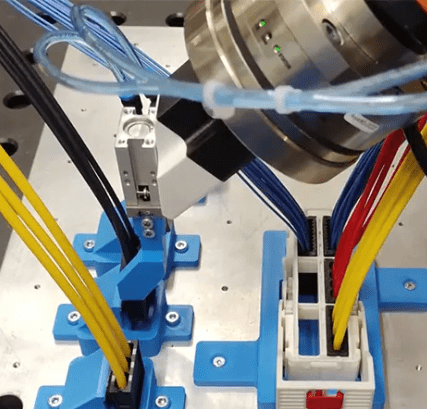
“At TE, one of our know-hows is crimping technology and termination, and we have been doing many projects in the past five years to learn how to use this knowledge with AI,’ said Liu. “AI can monitor position space, different sizes, different lengths, all the combinations and variations that are part of harness automation. After assembly, AI can also be used to inspect every connection to ensure it is properly routed and terminated.”
Zonal architectures change assembly processes
An important development that has helped facilitate automated production and faster vehicle assembly is the move to zonal architectures. “This has been a game changer for OEMs. If we’re looking at a traditional wire harness that is assembled into the vehicle, some are inside of the underbody, some are under the roof, some are within the door panel itself, and these separate systems were all connected. The new zonal architecture developments make it easier to pre-assemble sections and then put those together,” said Liu. “When you’re looking at the whole vehicle, zonal architecture divides it into three pieces: the front-end piece, back-end piece, and a central piece.”
It’s easier for automated assembly lines to manage smaller, specific sections of a vehicle. “Traditionally, the white auto body would come in as one piece to the paint shop, and then the wire harness would go in right after that, before the final assembly. That was a lot of labor-intensive assembly happening late in the manufacturing process,” said Liu. “Now with zonal architecture, the wire harness is pre-assembled into the roof panel, for example, pre-assembled in the body, and in the underbody – very organized and centralized by zone, and then the zones are put together, like building with LEGO. The prework is done and it’s very quick to assemble.”
Designing interconnects for AI

Many automotive connectors have been modified for easy and accurate handling by robotic assembly systems. Now suppliers are also developing new or modified interconnect products to improve the accuracy of vision-based AI systems that handled complex assembly tasks and conduct quality inspections. Colored wire insulation, keyed connector housings, and special markings help AI identify and differentiate these components. But the role of AI goes even deeper into the development process. Liu says the next generation of automotive interconnects will be designed to work with AI – and AI is being used to design these products.
At TE, AI and digital twins (virtual models) are used to design and test new designs, refine systems architectures, reduce weight, evaluate new materials, and design form factors for ideal use in automated assembly lines. “We have to redesign our connectors to be automation ready. AI modeling is heavily involved in the day-to-day design. Before physical testing, we use AI modeling to give us direction on things like what type of material we should use, what is the thickness, what is the size, what to expect in terms of thermal or electrical performance. Digital simulation, digital twins, digital data, modeling, and analysis — pretty much all the components, all the material selection, all the design feature, the interface, the standardization, the modularization, every aspect of component design is now being guided by AI tools.”
Intense cost pressures are driving the automation industry to find ways to manufacture cars faster and cheaper, even while adding new features and technologies to these vehicles. Pressing issues relating to driverless technologies, electrification and fuel usage, batteries, and the limits of copper-based architectures in an era of intensive computing are adding more pressure. “I think AI and the digital transformation can help us even more down the road, including helping us find solutions to questions like copper. Actually, we have already started doing that, but we will rely even more on AI simulation to solve these challenges.”
Learn more about automation and automotive solutions at TE Connectivity.
Like this article? Check out our other articles on Artificial Intelligence and Manufacturing, our Automotive Market Page, and our 2026 Article Archive.
Subscribe to our weekly e-newsletters, follow us on LinkedIn, Twitter, and Facebook, and check out our eBook archives for more applicable, expert-informed connectivity content.

- Connectivity Is Reshaping Police and Security Vehicle Fleets - September 8, 2026
- Thermal Management Strategies with Liquid Cooling Connectors - August 11, 2026
- Rodent-Resistant Electronics - July 28, 2026