Consumers Connect with Plug-In Solar Arrays and DERs
Low-cost plug in or balcony solar panels and distributed energy resources are poised to help consumers lower their energy bills in the next grid revolution.
Despite fluctuating government policies and tariffs, photovoltaic installations are growing exponentially around the world, from utility scale arrays to innovative small residential formats. In 2025, solar generation grew by 636 terawatt-hours (TWh) to supply about 75% of new global electricity demand growth for the year. Dramatically improving cell and battery technologies are making solar energy more economical, and rising energy costs and geopolitical conflicts are making it an imperative to manage demand and increase energy independence.
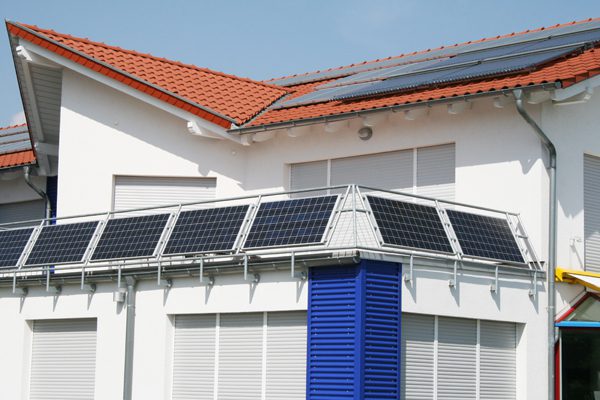
A growing part of the solar equation is residential-scale plug-in solar units, also called balcony solar. While traditional rooftop solar arrays harvest more energy, they have expensive initial installation costs; in the U.S., expiring incentives have led to a dramatic decline in the residential rooftop market. In Europe, however, plug-in or balcony solar is massively popular and demonstrate a new technology that offers a meaningful amount of energy at an affordable price. Connector companies are innovating new photovoltaic products to bring energy from the sun to homes and businesses.
Amphenol Industrial Operations showcases new solar connectors at the 19th International Photovoltaic Power Generation and Smart Energy Conference & Exhibition (SNEC PV Power Expo 2026) in Shanghai, China.
Independent energy generation
Balcony or plug-in units are small arrays — one to four panels — that can be hung on a balcony railing or other fixed location. They plug directly into a standard 120V wall unit and use a specialized microinverter to synchronize with grid voltage and frequency. Appliances automatically draw from the panels first, reducing the need to buy energy from the utility.
These small arrays are extremely popular in Europe, with more than a million in use in Germany alone, and they are quickly spreading around the world. In the U.S., more than 20 states have advanced legislation to permit plug-in units, and Utah, Maine, Colorado, and Virginia have already approved them. Many variations of these systems already exist, and as the market expands, they can be purchased for $300-600 in locations as accessible as Costco, IKEA, or Lidl. The break-even point for purchase is two to five years, depending on the unit and utility energy costs.
Integrating a battery expands the usefulness of plug-in solar. The arrays can be used to directly change a small battery for off grid use or to be used in blackout situations. Larger battery systems like the Tesla Powerwall charge from solar panels or the grid at cheap overnight rates, and discharge energy during peak hours or outages. Battery storage forms the foundation of the distributed energy resources (DER) ecosystem.
Connectors that offer installers fast, safe, and easy assembly offer speedy installation for both the larger arrays and the smaller residential units. Phoenix Contact’s Sunclix DC connectors can connect panels, combiner boxes, and inverters with a simple spring connection. They can be quickly disconnected with a release function activated with a screwdriver. This ease of use helps make solar energy accessible to a wider group of users.
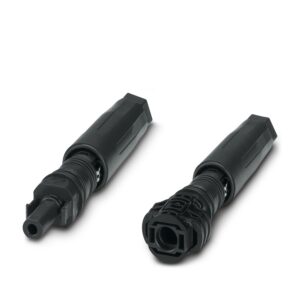
Phoenix Contact DC connectors with SUNCLIX spring connection.
Connectivity and safety
An assortment of specialized connectors serves the photovoltaic market. The MC4 connector (multi-contact 4 mm), developed by Stäubli, has become the global solar industry standard. MC4 connectors feature a locking mechanism that prevents accidental disconnection and are waterproof with an IP67 rating, resistant to dust and capable of withstanding water immersion up to 1 m. They’re rated to 30A DC and typically 1000V, making them suitable for stringing panels together. It is widely used on residential panels and is favored for its reliability, compliance with NEC safety requirements, and compatibility with most solar equipment. However, they are not always compatible with other types of solar connectors.
“The testing standards describe the minimum requirements for the safety of PV connectors, provided they have been developed and manufactured under the same quality management system, the same production processes and manufacturing tolerances, and sufficient knowledge of the materials and technologies used,” said Guido Volberg, Senior Consultant Product Regulatory Affairs at Stäubli Renewable Energy. “Among other things, a chemical incompatibility or also different thermal expansion parameters of the metal contact can lead to contact corrosion after some time. Under such circumstances, not only the project and the PV system are at risk, but also people and nature. The question then arises as to who is responsible for such damage.”
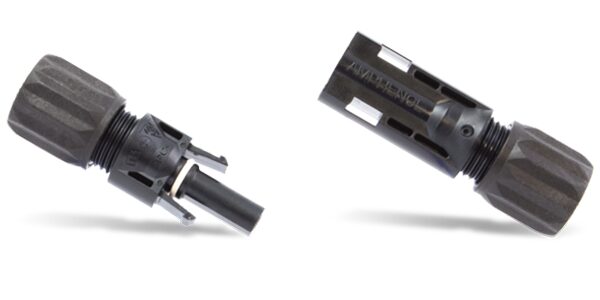
New connectors are rapidly emerging in this category to offer distinct capabilities or regional features. Amphenol’s H4 RADSOK connector is a quick, easy, and safe NEC 2008-compliant locking system with secure snap-lock mating. TE Connectivity’s SolarLok connectors feature a distinctive gender-neutral design. With a 12V output and easy plug-in capability, Anderson Powerpole connectors are suited for solar chargers. T4 connectors, developed by Tlian, offer more ruggedization features and are gaining in popularity, especially in Canada.
Safety is a key issue that is addressed at the inverter level. The microinverter converts panel DC to household AC and feeds it back to the building wiring. Incoming energy in the system could pose a risk for utility workers working on an outage if it’s not managed properly. Microinverters now automatically manage this energy, but earlier iterations required updates to Europe’s Schuko wall sockets, although a dedicated feed-in socket is needed to manage output of 960W or more. UL has launched a dedicated testing and certification program for plug-in solar systems, creating a clear safety framework to support their installation and use across the United States. This will result in the creation of the new UL 3700 standard. The first U.S. safety standard written specifically for plug-in solar, published in December 2025, covers electrical shock, fire, and structural safety.
“UL 3700 marks a major step forward, helping remove regulatory uncertainty and making plug-in solar a potential choice for consumers across the U.S.,” said Robert Slone, chief scientist and senior vice president at UL Solutions. “By addressing key safety gaps that could slow adoption, we are helping to make plug-in solar a viable option that complements larger rooftop systems and supports a stronger, more reliable energy future.”
To learn more about the companies mentioned in this article, visit the Preferred Supplier pages for Amphenol Industrial Operations, Anderson Power Products, Phoenix Contact, and TE Connectivity.
Like this article? Check out our other Standards articles, our Industrial Market Page, and our 2026 Article Archives.
Subscribe to our weekly e-newsletters, follow us on LinkedIn, Twitter, and Facebook, and check out our eBook archives for more applicable, expert-informed connectivity content.

- Connectivity Is Reshaping Police and Security Vehicle Fleets - September 8, 2026
- Thermal Management Strategies with Liquid Cooling Connectors - August 11, 2026
- Rodent-Resistant Electronics - July 28, 2026