Thermal Management Strategies with Liquid Cooling Connectors
As circuits run faster and hotter, keeping components cool becomes a more urgent challenge. Liquid cooling systems are an important strategy to help cool down data centers, industrial equipment, electric vehicles, and other high-speed, high-power applications.
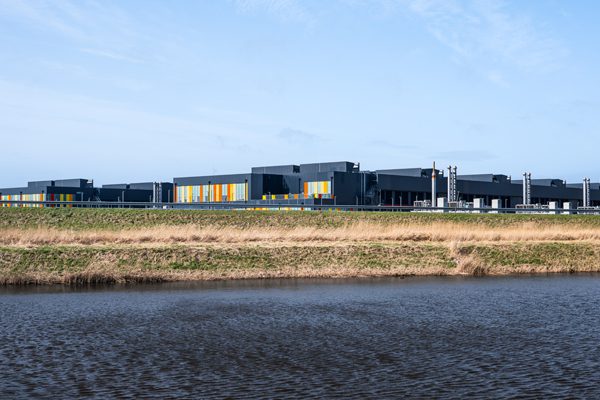
Thermal management is one of the most pressing challenges in today’s high-speed electronics systems. As transistors per chip continue to double, data speeds increase, and equipment sizes shrink or systems become more densely packed, heat increases in tandem. This heat contributes to early deterioration of other components in the system, posing a risk to performance, and it necessitates the addition of secondary systems designed expressly to cool down the operating environment, such as heatsinks and fans. Another solution is gaining momentum: a liquid cooling system, in which specialized connectors help move coolant — typically deionized water, a water-glycol mix, or a dielectric fluid — through a closed loop that carries heat away from a CPU, GPU, battery pack, or power electronics module to a radiator, heat exchanger, or cooling distribution unit (CDU) where it dissipates. Liquid cooling connectors are used at every junction in that loop.
Liquid’s thermal advantage over air is substantial: Water conducts heat far more efficiently than air, which helps liquid cooling support power densities that would overwhelm a fan-based system. It also tends to be quieter and more energy efficient. However, liquid cooling introduces the possibility of leaks, a serious threat to nearby electronics. Liquid cooling infrastructure also carries higher upfront capital costs, and it adds mechanical complexity with more connection points and components that need to be maintained.
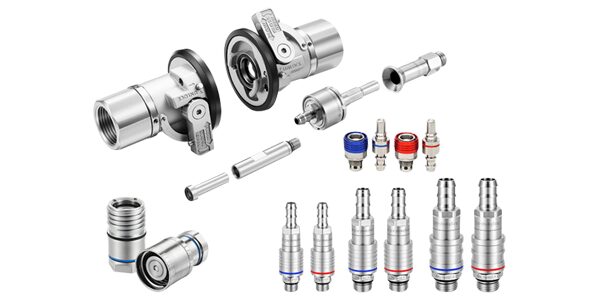
Amphenol Industrial Liquid Cooling Connectors (UQD/UQDB/BMQC/LQC/MQD/SHQD) are constructed with aerospace-grade sealing materials and a bidirectional shut-off valve and dry break to protect against accidental spillage or drips.
“Data is throttling through high-compute AI data centers and other demanding energy environments around the clock. These systems require integrated liquid cooling methods that can handle high levels of heat constantly being generated,” said Ty Yesensky, Sr. Product Manager – Americas, Amphenol Industrial Operations. Liquid cooling connectors cannot impede the flow of coolant. Amphenol’s liquid cooling connectors address the thermal needs of AI data centers, high-performance computing environments, energy storage systems, and electric vehicle (EV) charging systems.
Alan Sundo, global FA leader of Amphenol LTW, said that the intense power needs of data centers are a key driver in the development of new cooling strategies. “AI is really pulling a lot of power — like three times higher than in the past,” he said. ALTW’s Snap QD connector solution helps dissipate as heat as the fluid flows through the device or the connector. “If you’re not going to dissipate that heat or you’re not going to transfer that heat as much as possible, then a lot of downtime will happen because the GPU will burn out and that that is really costly. With the liquid cooling you’re preventing that because you’re drawing a lot of heat in a given time frame.”
Beyond data centers
The need to manage heat is not limited to data centers. “As rack densities climb, the industry is arriving at a conclusion industrial machine builders reached some time ago: beyond a certain power density, air is no longer an efficient way to move heat. The engineering that went into this platform transfers directly into that conversation,” said David Bessonen, Director of Business Development at Bel Fuse Inc. “The broader point is that the underlying thermal argument is the same one now driving liquid cooling adoption across the data center industry.”
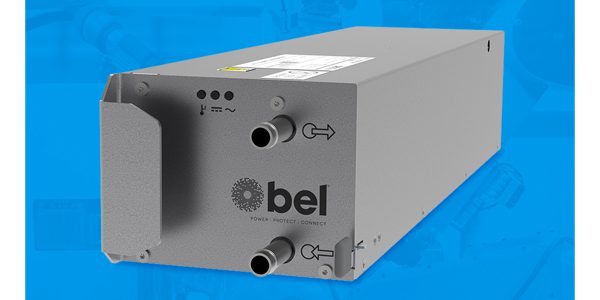
Bel Fuse’s TLP5000 Series integrates the liquid cooling plate into the converter itself, so the thermal interface is part of the product rather than something the machine builder has to design around it,” said Bessonen. “That is the substantive advance: not an incremental power increase, but the removal of a mechanical engineering task from the customer’s design cycle.” It has adjustable output voltage, facilitates parallel operation with active sharing, and CAN bus communication.
To address the needs of the industrial applications, Bel introduced the TLP5000 Series, a liquid-cooled, high-power 3-phase AC-DC converter designed for industrial applications operating in extreme environments. The TLP5000 Series was developed for manufacturing equipment broadly rather than for any single sector, said Bessonen. “The target applications include CO2 and optical laser cutting, welding, additive manufacturing, bulk power for heavy industrial applications, and any 19″ rack installation that requires a large amount of power. What those applications have in common is the reason the platform exists: in high-power industrial machinery, the cooling method rather than the power conversion is usually what limits reliability.”
“These are environments full of airborne particulate, including metal fume and spatter from welding, fines from cutting, powder from additive processes, and lint and fiber dust in textile machinery. A forced-air power supply pulls that environment directly through itself. The supply either derates or fails, usually at the least convenient point in a production run. The fan is also the only significant moving part in an otherwise solid-state system, which makes it the most likely component to fail.”
The TLP5000 Series is designed to be installed inside a machine cabinet or a 19-inch rack, where the enclosure provides environmental protection for the unit. “This distinction is worth drawing out, because the advantage of eliminating fans is sometimes misread. The benefit is not that the converter itself is sealed against the environment. It is that removing the air path allows the enclosure around it to be sealed, so the machine builder can close up a cabinet that would otherwise need vents, filters, and forced airflow to keep a power supply alive,” said Bessonen. The series includes CAN bus communication for real-time monitoring, control, and diagnostics. It uses hot-plug connectors to protect system uptime. Maintenance or replacement can be managed without requiring a full system shutdown because the connectors include ruggedized sealing to keep fluid within the system. “
Taken together, the platform is a scalable building block rather than a fixed-output supply, and the direct liquid cooling is what allows that scalability without a corresponding increase in air handling.”
A changing connector profile
Liquid cooling connectors have existed for decades in industrial and hydraulic applications, but their profile has changed dramatically in the last few years due to accelerating computing density and AI integration in applications like industrial automation, data centers, and electric vehicles. Retrofitting liquid cooling into a facility built for air cooling is more disruptive and costly than designing it in from the start. In future data centers, new rack architectures are being designed around liquid, although the latest iteration of connectors does make it possible to upgrade or replace connectors in systems in hot-swap scenarios.
Liquid cooling connectors almost always use quick-disconnect couplings to let technicians quickly and easily connect and disconnect lines while preventing coolant from spilling or air from entering the loop. Many use a valve mechanism that seals automatically when the connection is broken, so a technician can swap a server or cold plate without draining the system or dripping fluid onto nearby electronics.
The growing use of liquid cooling connectors in these systems has pushed standardization efforts to the forefront. The Open Compute Project’s Universal Quick Disconnect (UQD) specification, along with the blind-mate connector requirements defined for OCP’s Open Rack V3 architecture, have given data center operators a common interface through multiple manufacturers. However, despite standardization efforts like UQD, the liquid cooling connector market remains fragmented, with several competing designs in circulation.
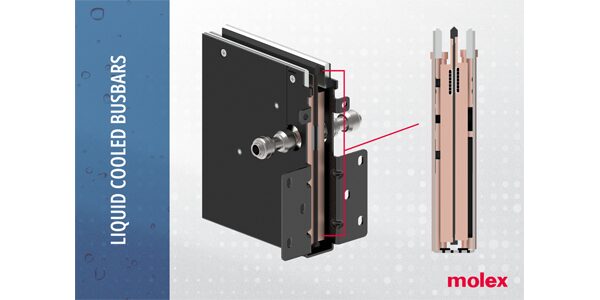
Molex Multi-Channel Liquid Cooled Busbars extend liquid cooling into the power backbone to support higher-current AI racks with more uniform heat.
“Direct-to-chip cooling is now standard for compute, but for AI to truly scale, we must also address the thermal challenges of the power path,” said Kevin Alberts, VP and GM of the Power and Signal Business Unit (PSBU), Molex. The company’s Multi-Channel Liquid Cooled Busbars can help maintain stable electrical performance and cool down systems without significant increase to the footprint of the rack.
While liquid cooling designs typically use a single channel, the Molex busbars feature a multi-channel fluid path that divides the coolant into up to seven discrete channels. This approach reduces hot spots and thermal stress and improves electrical performance stability at high currents. The product is designed to meet OCP ORv3 standards.
To learn more about the companies mentioned in this article, visit the Preferred Supplier pages for Amphenol Industrial Operations, Amphenol LTW, Bel Magnetic Solutions, and Molex.
Like this article? Check out our other High Reliability, High-Speed and Connected Vehicles articles, our Industrial Market Page, and our 2026 Article Archives.
Subscribe to our weekly e-newsletters, follow us on LinkedIn, Twitter, and Facebook, and check out our eBook archives for more applicable, expert-informed connectivity content.

- Connectivity Is Reshaping Police and Security Vehicle Fleets - September 8, 2026
- Thermal Management Strategies with Liquid Cooling Connectors - August 11, 2026
- Rodent-Resistant Electronics - July 28, 2026