Four Ways Flat-Wiping Contacts Benefit Battery Systems
Flat-wiping contacts are an important design feature in many battery connectors. Learn how they lead to better power transmission and improved connector lifespan.
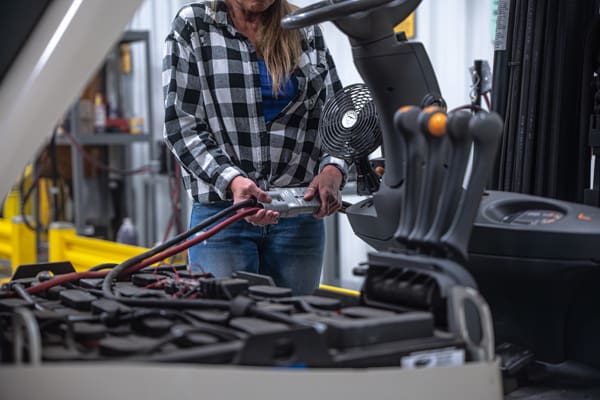
Article Contributed by Peter Resca, Director of Product Management and Marketing, Anderson Power
Invented by Anderson Power in 1954, flat-wiping contacts are self-cleaning, self-securing, and deliver many other key advantages for equipment battery connectors. In summary, flat-wiping contacts:
- offer more efficient power transmission
- facilitate higher power transmission
- prevent dust buildup on contacts
- reduce the potential for arc damage and contact pitting
What are the key types of battery connector contacts?
Before examining the benefits in more detail, it’s important to first recognize the differences between battery connectors and how flat-wiping designs stand out. Two of the most relevant types of connectors for equipment requiring a high-power interconnect are flat-wiping style and pin-and-socket style.
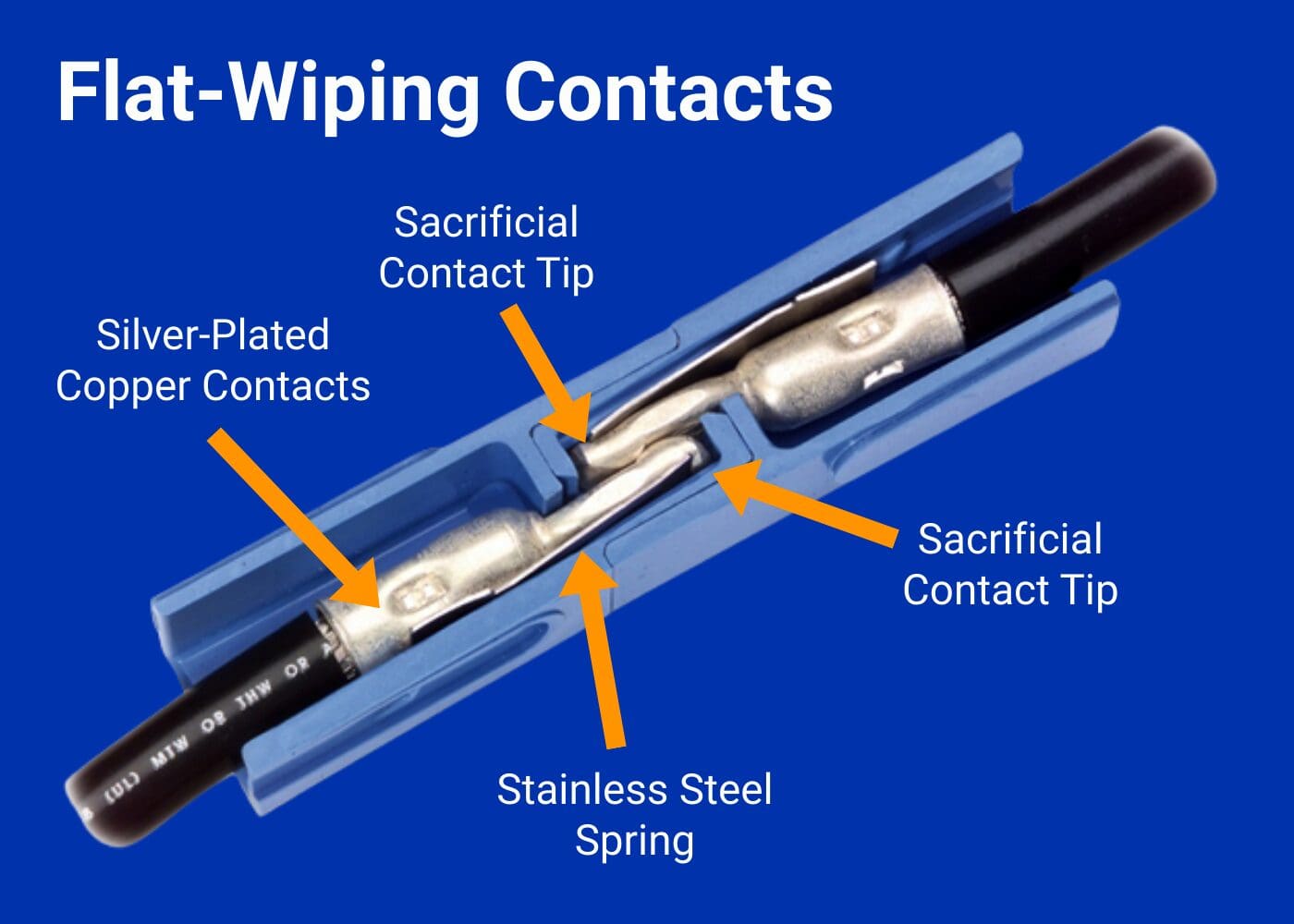
Flat-wiping contacts are genderless (lacking distinct male and female ends), meaning they can be installed and connected to one another from either end. The contacts are typically composed of pure copper that is plated with a silver coating. Copper offers excellent conductivity, while silver interacts well with copper, and the plating prevents the copper from being exposed to air and oxidized.
Pin-and-socket style contacts are gendered with recognizable male (pin) and female (socket) ends. Their design often follows the German DIN standard 43589-1, EN 1175-1, and DIN VDE 0623-589. Pin-and-socket designs typically require less force to mate and unmate. Due to their multiple points of contact, they can more reliably prevent discontinuity during high vibration. This capability is most relevant for signal contacts to prevent data loss.
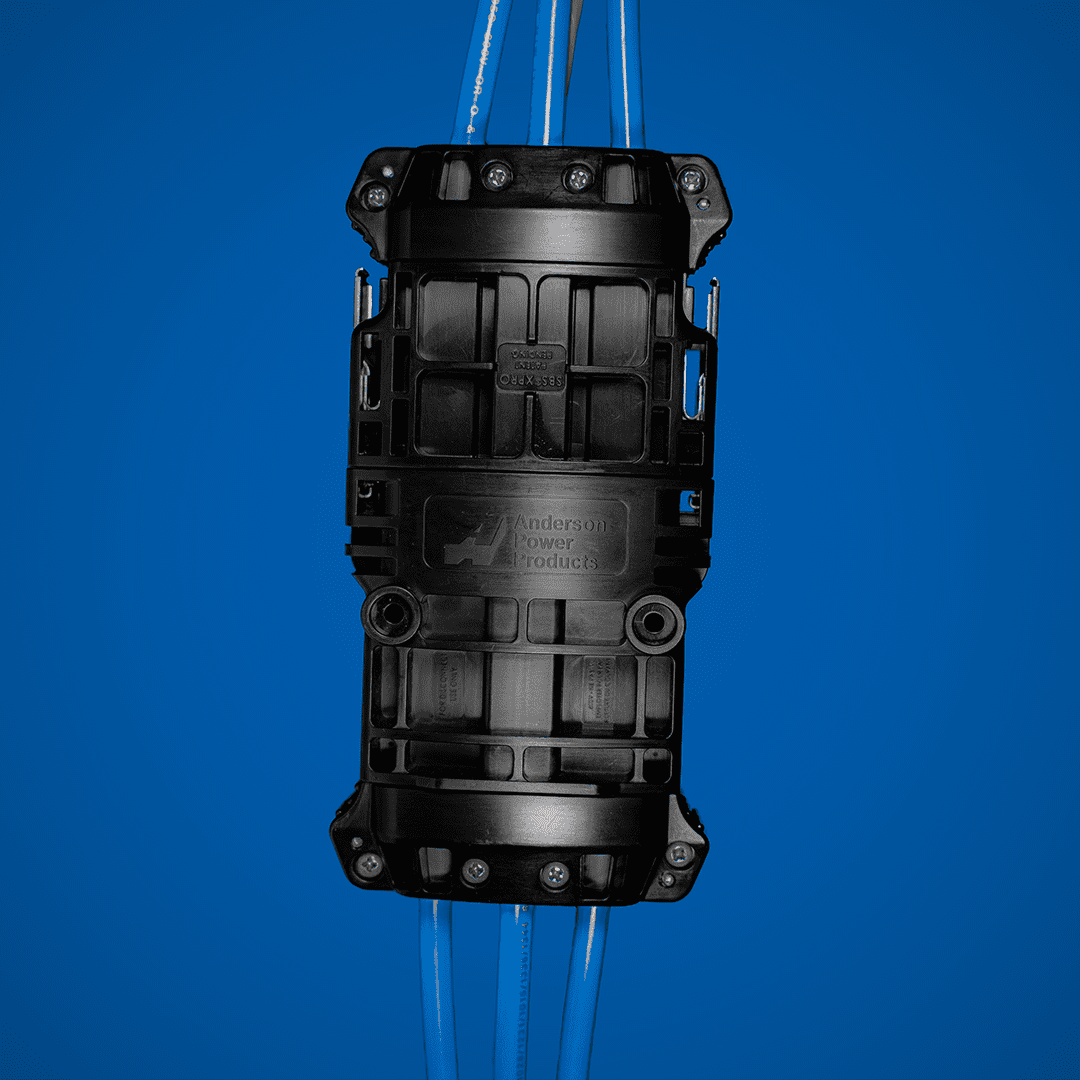
The SBSX PRO Sealed Connector from Anderson Power uses a flat-wiping design for its three power contacts.
Not all battery connectors fall neatly into one category or the other. For example, the SBSX PRO connector from Anderson Power uses a flat-wiping design for its three power contacts and a pin-and-socket design for its eight auxiliary signals.
Why do flat-wiping contacts benefit battery systems?
- More efficient power transmission with contact design
Flat-wiping contacts deliver better power transmission than many conventional connectors. With their large, smooth mating surface, flat-wiping contacts experience less resistance and thus more power and current can be transferred while mated. Lower resistance also contributes to enhanced efficiency. Because more power is transferred, less energy escapes and is wasted as heat. For companies that track their cumulative total resistance, adopting flat-wiping contacts can lead to a positive improvement in their energy footprint.
Another factor that impacts connector efficiency is the quality of the engineering behind a manufacturer’s flat-wiping design. To ensure efficient power transfer, reputable manufacturers will opt for high-grade copper, a thick silver coating, and a professional plating method that guarantees the materials underneath the plating adhere properly. Rigorous lab testing — including life-cycle tests and UL 1977 standard tests — are another important factor that indicates long-term contact durability. Selecting a connector with high-quality flat-wiping contacts increases the overall efficiency, durability, and performance of its connector.
- Higher power transmission with spring design
Flat-wiping contacts also deliver better power transfer through the design of their spring. Composed of stainless steel, the internal spring is located behind the contact surface. Its job is to ensure the mating area of the two connectors remains secure, providing constant force to guard against an errant bump or vibration that could cause disconnection.
A flat-wiping connector’s spring is a separate piece from the contact surface itself. Because of this separation, the contact can transfer power without simultaneously needing the flexibility to apply force and engage the spring. The contact can be made thicker to carry more current and the spring is free to apply as much force as required.
In contrast, the internal spring of pin-and-socket designs is typically connected directly to the socket. The contact must apply force to the spring as well as transmit power, which limits the contact thickness and therefore the amount of power that pin-and-socket connectors can transfer.
- Prevent dust buildup on contacts
Flat-wiping contacts include the ability to self-clean, an important feature that removes dust buildup and extends contact lifespan. Contacts experience dirt and grime buildup when charging in outdoor locations, but they also get dirty over time simply by sitting indoors on a dusty factory floor.
Dust buildup should be avoided because it can erode a contact’s silver plating, causing the copper underneath to become exposed to air. This leads to charging performance issues, including poor conductivity and electrical arcing. Flat-wiping helps prevent this buildup. Whenever this type of connector is mated, the two contacts over-wipe the connection surface, or wipe silver plating material across each other. The transference of silver smooths the mating area of any lumps and removes accumulated dust, grime, and silver tarnishes. As a result, flat-wiping contacts reduce maintenance needs and extend connector lifespan. In addition, the smooth design of flat-wiping connectors helps prevent unwelcome debris from getting trapped inside. Without an indented socket, there is less room for dust to accumulate.
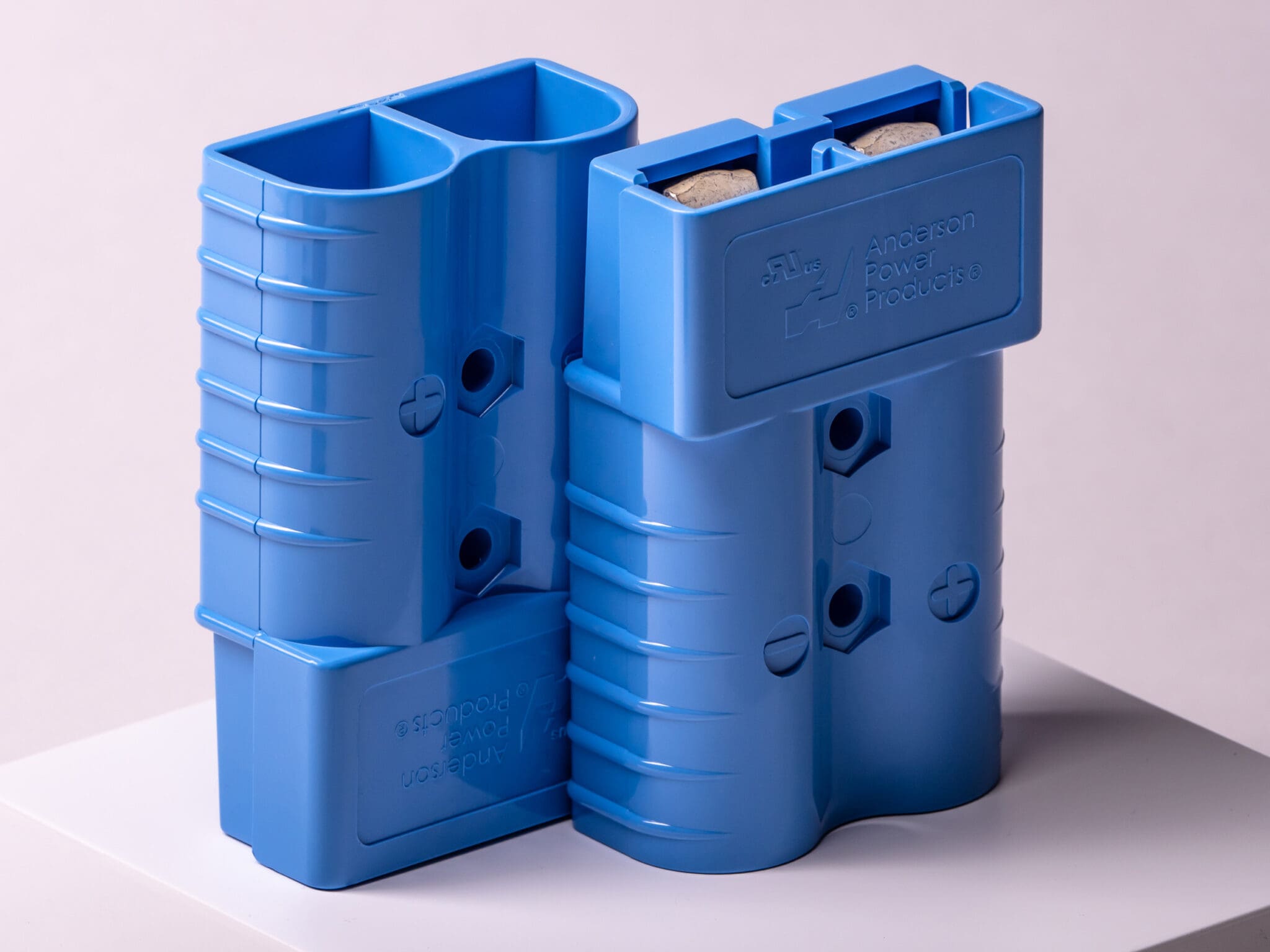
Invented in the 1950s, the SB Connector Series from Anderson Power was the first connector to feature flat-wiping contacts.
- Reduces potential for arc damage and contact pitting
Flat-wiping contacts also extend connector lifespan by reducing the potential for pitting damage. Contact pitting occurs when the contact surface becomes too dirty or when a connector is frequently disconnected while charging, creating an electrical arc. Both situations cause pits in the silver plating that can eventually expose the copper underneath, requiring the contact to be repaired or removed. While disconnections under load should never be standard practice, it can occur by accident. Flat-wiping connectors are designed to minimize damage from arcing in this situation. A humped crest at the front of the contact constrains the arc and the pits it causes into a tiny area. Since the actual power transfer occurs on the contact surface past this crest, pitting damage to the sacrificial tip does not normally affect charging performance. This built-in safety net keeps a connector in service for longer, even if it is accidentally disconnected under load.
The constant, smooth surface of flat-wiping contacts also helps extend connector lifespan. As their name suggests, flat-wiping contacts feature a stamped front end with a uniform surface, and their over-wipe function keeps the mating surface free of cuts over time. In contrast, pin-and-socket designs are more susceptible to cuts. When mated and unmated, the pin may inadvertently scrape the side of the socket. This is particularly true for larger, high-power connectors that require more force to connect by hand. Over time, these scrapes can deepen into cuts that eventually require the connector to be replaced. Flat-wiping’s smooth, self-cleaning design avoids this issue. This is one reason many flat-wiping connectors are rated for up to 10,000 mating cycles, while many high-power pin-and-socket connectors are rated for 5,000 mating cycles.
What’s next for flat-wiping contacts and battery systems?
Flat-wiping contacts will clearly remain the go-to industry standard for powerful, efficient, and durable equipment battery connectors. By self-cleaning to remove dust buildup, these contacts help extend connector lifespans in demanding industrial environments. Their sacrificial tip reduces the risk of pitting damage from electrical arcs, while their larger surface area and separate spring enable higher and more efficient power transfers.
For more information, visit Anderson Power.
Like this article? Check out our other Artificial Intelligence, High-Speed articles, our Connector & Cable Special Topics Market Page and our 2025 and 2026 Article Archives.
Subscribe to our weekly e-newsletters, follow us on LinkedIn, Twitter, and Facebook, and check out our eBook archives for more applicable, expert-informed connectivity content.

- Printing at the Edge of Possibility: How TE Connectivity Leverages Micro-3D Printing - October 13, 2026
- A Five-Layer Clad Solution for High-Performance Battery Interconnects - October 6, 2026
- High Voltage Interlock for Commercial Vehicles: A Must-Have or a Nice to Have? - September 29, 2026