What are GNSS Antennas?
Meet the Antenna: GNSS Antennas
GNSS antennas receive signals containing positioning and timing data from satellite constellations. They are used in a wide variety of applications from smart transportation and navigation to surveying and infrastructure inspections.
GNSS (global navigation satellite system) antennas receive signals from satellite systems: GPS in the United States, Galileo in the European Union, BeiDou in China, and GLONASS in Russia. GNSS antennas convert the satellites’ electromagnetic waves into electrical signals, filters extraneous noise, then amplifies them to a level that can be processed by a receiver. The receiver uses the timing data from these signals to calculate the distance to each satellite. With a method called trilateration, the receiver combines information from at least four satellites to determine the user’s precise position (latitude, longitude, and altitude).
To maximize their performance, GNSS antennas are optimized for receiving signals from multiple satellite systems at different frequencies and with different modulation schemes. Typically, the antenna has a radiating element to capture the signals, connected to a feedline and a ground plane, which direct and shape the signal.
The proper placement and orientation of the antenna so that it is unimpeded by trees, buildings, or other obstructions is critical to its performance. Any such barriers can cause signal reflections and multipath interference.
Common GNSS antenna types
Patch antennas consist of a metal conductive patch over a dielectric substrate with a ground plane on the bottom. It offers good performance in a compact size with a low profile and is cost-effective. Patch antennas are used in handheld and wearable devices.

Helical antennas have a coil of wire shaped like a helix, which provides high gain and circular polarization to mitigate the effects of multipath interference, where signals bounce off surfaces before reaching the antenna. Higher gain allows for better signal reception than a patch antenna. Small and lightweight, helical antennas don’t require a ground plane. They are used in UAV/drones, unmanned ground vehicles (UGV), unmanned systems, high precision navigation, military and security, smart agriculture, and handheld GNSS Devices.
Choke-ring antennas consist of concentric conductive cylinders around a central antenna and when used outside often has a protective cover to shield it from the elements. Choke ring antennas have excellent phase center stability, polarization purity, suppression of radiation below the horizon, and multipath rejection. They are used for satellite navigation and for surveying and geological measurements.
Active or passive
Active GNSS antennas require external power to operate. They have built-in electronics that amplify the GNSS signal to overcome signal loss from cable attenuation or long cable runs.
Passive GNSS antennas are simpler and less expensive than active antennas. They have no built-in electronics and require a GNSS receiver to amplify the received signal. As a result, they may have higher signal losses due to cable attenuation or long cable runs. Passive antennas are used in applications where cost is a primary consideration, such as in consumer GPS devices.
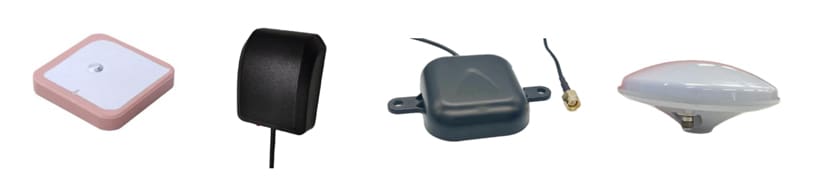
Adam Tech’s antennas ensure compatibility with all major global navigation systems and support a wide range of frequencies—including GPS (L1/L2/L5), GLONASS (G1/G2/G3), Galileo (E1/E5a/E5b/E6), and BeiDou (B1I/B2I/B3I/B1C/B2a). With high gain performance, 50 Ohm impedance, and ceramic patch structures, they deliver stable reception and reliable signal transmission. Available in both compact and large formats (e.g., 25 x 25 x 4.0 mm to Ø150.8 mm), they are suitable for diverse integration needs.
Supported frequency bands
For the greatest positioning accuracy and reliability, GNSS antennas gather signals from multiple bands.
L1 Band (~1575.42 MHz). The main frequency for civilian applications, provides broad compatibility with most GNSS receivers; primarily used by GPS, Galileo, and BeiDou.
L2 Band (~1227.6 MHz). Mainly used for military applications in GPS; also improves signal robustness in certain civilian applications when combined with L1 in dual-frequency systems.
L5 Band (~1176.45 MHz). Known as the “Safety of Life” band, designed for aviation and other high-reliability applications; offers enhanced resistance to interference.
E6 Band (1260-1300 MHz) and B3 Band. Enable multi-frequency accuracy and enhanced integrity for specialized applications; used by Galileo (E6) and BeiDou (B3)
Additional bands. L6 for GPS; E1, E6, and E5 Bands for Galileo; G1, G2, and G3 bands for GLONASS; and B1, B2, and B3 Bands for BeiDou.
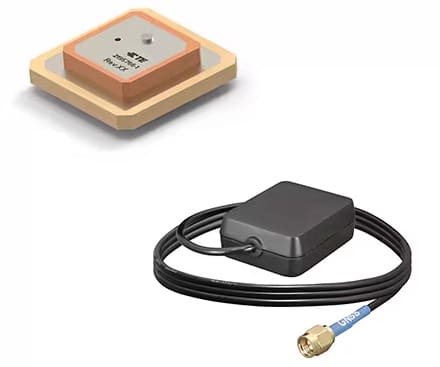
TE Connectivity’s GNSS antennas comprise all common global satellite services such as GPS, GALILEO and BeiDou. Equipped with powerful, low-profile antennas, most of the systems can be tailored, from cables and connectors to rugged housing.
Design Notes
General performance requirements:
Impedance. 50 Ω impedance is standard for antennas and cabling.
VSWR (voltage standing wave ratio). Typically, less than 3:1 for good impedance matching.
Return loss (RL). Greater than 6.0 dB indicates minimal reflected power.
Efficiency. Above 50% for effective signal reception.
LNA (low noise amplifier) gain. An integrated or external LNA should typically have a gain greater than 15 dB.
LNA noise figure (NF). Ideally less than 1.0 dB to minimize added noise.
Antenna gain. A measurement of how well it converts signal at its terminals to radiated power; higher gain generally provides better reception.
Axial ratio. A measure of the purity of circular polarization, with a perfect circle having a 0 dB axial ratio.
Phase center offset/phase center variation (PCO and PCV). Indicates the precise electrical point of reception on the antenna and how it varies with signal angle. Important for high-precision applications.
Group delay. Instrumental error in the receiver and antenna that affects signal timing.
Standards:
ETSI EN 303 413 is a European standard and CE RED requirement that ensures GNSS functionality meets minimum interference tolerance requirements, especially from adjacent frequency bands.
RTCA/DO-228 & RTCA DO-373A defines minimum operational performance standards (MOPS) for airborne GNSS antenna equipment, particularly for aviation applications, ensuring reliability and addressing spoofing risks.
Connectors: Multiple connector types are used in conjunction with GNSS antennas, including: TNC, N, SMA, BNC, U.FL, and MMCX.
Markets and Applications
Automotive, Transportation, Military, Aerospace, Consumer
Smart transportation, vehicle testing, autonomous driving, navigation, surveying and GIS, geospatial mapping, bridge and infrastructure inspections, and time synchronization.
Suppliers
Adam Tech, KYOCERA AVX, Molex, Radiall, TE Connectivity, Taoglas (available from Mouser Electronics)
Related products
GPS antenna
Like this article? Check out our other Meet the Connector and Connector Basics articles, our Industrial Market Page, and our 2025 Article Archives.
Subscribe to our weekly e-newsletters, follow us on LinkedIn, Twitter, and Facebook, and check out our eBook archives for more applicable, expert-informed connectivity content.

- ODVA Embraces ix Industrial - September 22, 2026
- PCB Connectors Product Roundup - September 22, 2026
- Safety First: Preventing EMI in Medical Devices - September 15, 2026