What is a Speed Sensor?
A speed sensor is an interconnect device that detects the rotational or linear velocity of a moving component and converts that motion into an electrical signal with a frequency or pulse rate that is proportional to speed. The two dominant speed sensor types are variable reluctance (VR) sensors, which generate a self-powered analog signal as a ferrous target passes a magnetic coil, and Hall-effect sensors, which use a powered semiconductor to output a digital pulse and can sense down to zero speed.
Speed sensors are used throughout vehicle powertrains, robotics, and industrial systems to monitor wheel speed, gears, crankshafts, camshafts, and transmission output. They provide rotational or linear velocity information that is used for control or diagnostics.
Origin & Development
Variable reluctance speed sensing dates back to early automotive ignition and anti-lock braking system (ABS) development in the 1970s. Hall-effect speed sensors emerged as the magnetically biased Hall IC matured through the 1980s–1990s, led by manufacturers such as Honeywell, Infineon, and Allegro MicroSystems, and have steadily displaced VR sensors in applications requiring true zero-speed detection and a clean digital output. Both approaches remain in widespread use today and are considered de facto industry standards for gear-tooth speed sensing, with Hall-effect designs now dominant in new automotive and industrial platforms.
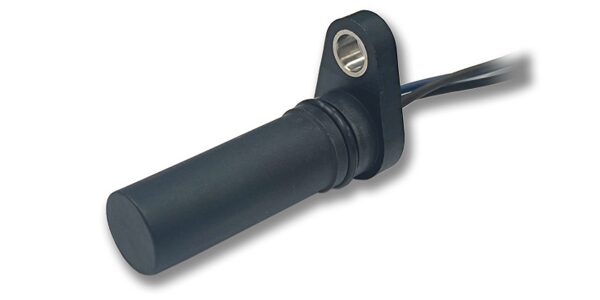
The flange mount gear tooth speed and direction sensors of Piher Sensing Systems from Amphenol Sensors are designed to precisely calculate speed and direction of ferrous gears. The hall-effect sensor measures the variation in flux found in the airgap between the magnet and the passing teeth.
Design Highlights
Engineers select VR sensors for their simplicity, ruggedness, and zero external power requirement. The sensor itself generates the signal, which makes it ideal for remote or harsh-environment installations. Hall-effect sensors are chosen when true zero-speed detection, a clean digital pulse, longer sensing air gaps, or immunity to signal degradation at low speed are required. Both speed sensor families are mechanically simple, with a probe-style housing with a magnet and sensing element. They are largely interchangeable across manufacturers in terms of mounting and electrical interface, though pinout and connector style vary by series.
Other types of speed sensors include optical and capacitive/eddy-current speed sensors. These are used for niche applications. Optical encoders are used where very high resolution position feedback is needed, and eddy-current types are specified for use with non-ferrous or non-metallic targets.
Markets & Applications
Speed sensors are used across automotive and heavy-vehicle powertrains, aerospace engine and landing gear monitoring, industrial automation and motor control, agricultural and construction equipment, wind turbines, and HVAC fan and pump monitoring.
Technical Specifications
The table below reflects typical values across common Hall-effect and variable reluctance speed sensor product families; exact values vary.
| IDENTIFICATION | |
| Product / Series Name | Speed sensors (Hall-effect digital and variable reluctance/passive analog families) |
| Manufacturer(s) | Honeywell, Allegro MicroSystems, Infineon, Bosch, Cherry/ZF, Bourns, TE Connectivity |
| Sensor Type / Category | Speed/Velocity (rotational and linear) |
| SENSING PERFORMANCE | |
| Sensing Principle | Hall-effect (active, magnetically biased IC) or Variable Reluctance / VR (passive, magnetic coil and pole piece); some designs use eddy current or optical encoding |
| Measurement Range | 0 Hz (zero speed, Hall-effect only) up to approximately 20 kHz pulse frequency; typical rotational range 0–10,000 RPM |
| Accuracy / Tolerance | Frequency/pulse-count output is inherently accurate (no signal drift); accuracy of derived speed depends on target wheel tolerance and air gap stability, typically ±1% of reading |
| Sensitivity | Not applicable in the traditional sense; sensitivity is expressed as magnetic operate/release points (Hall-effect, in Gauss) or output voltage amplitude vs. air gap (VR) |
| Repeatability / Hysteresis | Hall-effect sensors exhibit magnetic hysteresis between operate (B_op) and release (B_rp) points, typically tens of Gauss, to prevent output chatter; VR sensors have negligible hysteresis but are sensitive to noise at low speed |
| Response Time | Hall-effect: rise/fall times of 400 ns–1 μs typical; VR: limited primarily by signal frequency at very low speed |
| Linearity | Output frequency is linear with rotational speed by design (frequency = teeth × RPM / 60); deviation arises mainly from target wheel runout or eccentricity |
| ELECTRICAL CHARACTERISTICS | |
| Output Signal Type | Hall-effect: digital open-collector pulse (current sinking) or push-pull square wave; VR: analog AC sine wave with amplitude proportional to speed |
| Supply Voltage | 4 Vdc to 24 Vdc typical (some variants to 60 Vdc); VR sensors are self-generating and require no supply voltage |
| Current Draw | 6–15 mA maximum supply current for Hall-effect types; VR sensors draw no supply current |
| Update Rate / Sampling Frequency | Continuous frequency output up to approximately 20 kHz; effective update rate depends on downstream signal processing (e.g., one reading per tooth passage) |
| Electrical Connections | 2-wire (VR, twisted shielded pair) or 3-wire (Hall-effect: supply, ground, signal); connector styles include Deutsch DT, Packard Metri-Pack, AMP Junior Timer, or flying leads |
| MECHANICAL & ENVIRONMENTAL | |
| IP Rating | IP67 typical; IP69K available on ruggedized automotive/industrial variants |
| Housing Material & Mounting | Stainless steel or glass-filled thermoplastic probe-style housing; threaded barrel (M12, M18) or bracket/flange mount, positioned at a fixed air gap from the target |
| Operating Temperature Range | -40 °C to 150 °C; some automotive-grade variants rated to 170°C; magnetic operate points can shift slightly at temperature extremes |
| Shock & Vibration Rating | Typically rated for 50–100 g shock and broadband random vibration |
| OUTPUT & INTEGRATION | |
| Calibration | Factory-set magnetic operate/release thresholds (Hall-effect); no field calibration required for either type. Air gap setting at installation affects signal amplitude (VR) or detection reliability (Hall-effect) |
| Expected Lifetime / MTBF | Typically rated for the operational life of the host system (10+ years / hundreds of millions of cycles) under specified environmental conditions; no moving parts to wear |
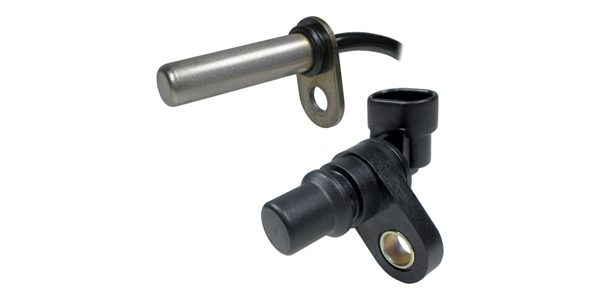
Honeywell SNDH-H Series Hall-Effect Speed Sensors from TTI Inc. use a Hall-effect IC and a permanent magnet to detect ferrous metal targets, providing a digital pulse output proportional to target speed.
SUPPLIERS
Molex, TE Connectivity, Honeywell SNDH-H and SNG-S Series (Hall-effect), Honeywell LCZ Series (Hall-effect zero-speed), and comparable variable reluctance sensors from Bosch, Cherry/ZF, and Bourns.
Distributors: DigiKey, Heilind, Mouser Electronics, Powell Electronics, TTI Inc.
RELATED PRODUCTS
Variable reluctance (VR) sensors
Hall-effect sensors
Position Sensors
Proximity Sensors
Encoders
Like this article? Check out our other Meet the Connector and Connector Basics articles, our Military and Aerospace Market Page, and our 2026 Article Archives.
Subscribe to our weekly e-newsletters, follow us on LinkedIn, Twitter, and Facebook, and check out our eBook archives for more applicable, expert-informed connectivity content.

- Connectivity Is Reshaping Police and Security Vehicle Fleets - September 8, 2026
- Thermal Management Strategies with Liquid Cooling Connectors - August 11, 2026
- Rodent-Resistant Electronics - July 28, 2026