What is D-Sub Hardware?
Meet the Connector: D-Sub Hardware
Versatile D-Sub (subminiature) connectors are widely used in military, industrial, and other applications in harsh and rugged environments. For many of these applications, reliability and security are paramount, and they require permanent, secure, shielded connections.
Securing and protecting D-Sub and Micro-D connectors requires additional hardware. Many accessories are available for this purpose.
Backshells
Ruggedized backshells provide resistance to heavy shock and vibration for control systems in rail, heavy duty equipment, and industrial applications. Full metal shells provide 360° EMI shielding and simplify compliance with smoke and fire requirements. Shells are available with multiple cable exit options and with screw lock or quick lock pins, which can be used to easily retrofit existing designs. Strain relief options include the crimped strain relief, which enhances EMI shielding and prevents individual wires from breaking, and a two-piece cable compression clamp for fast installation and effective wire retention.
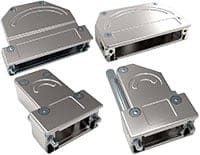
Aluminum D-Sub backshells are a lightweight, high-performance solution providing over 50% weight reduction on standard D-Sub backshells without compromising performance, EMI shielding, maximum wire termination space, and protection.
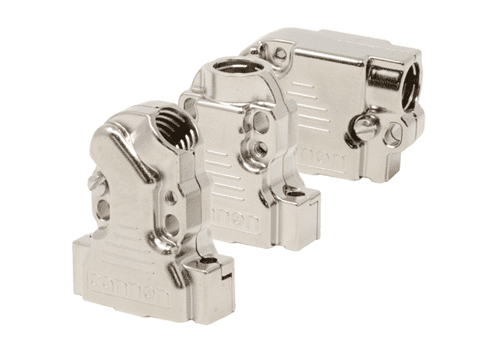
Plastic or plastic metal backshells for D-Sub connectors provide connector protection, strain relief, and organized cable routing. In less demanding applications, they protect against abrasions.
Backshells finished with steel/zinc are durable options often used for industrial applications.
Snap together backshells
One-piece snap-together D-Sub backshells allow for fast, tool-less, or low-cost assembly by snapping together around a terminated connector. They are commonly used to provide strain relief, mechanical protection, and, in some cases, EMI/RFI shielding to wire-to-connector joints. They are typically made of thermoplastic.
Locking backshells
Locking backshells are protective, rear-connector housings that secure cable-to-connector interfaces. They provide locked connections using screw locks (jack screws), slide locks, or quick-lock pins to prevent accidental disconnection due to vibrations or mechanical stress. They include clamps that grip the cable, reducing stress on the soldered or crimped wire-to-connector interface for strain relief. 360-degree EMI/RFI shielding, and environmental protection, make them ideal for high-vibration, industrial, or space applications. They are often metallic.
Straight or Angled Exit
Backshells are designed with a straight or angled exit, the direction the cable takes as it leaves the back of the connector. This is critical for managing space, cable strain, and cable routing when space is limited. The choice depends on available clearance behind the panel and the direction the cable needs to go.
A straight exit allows the cable to come out of the backshell perpendicular to the mating panel (180° or 0°). This is the simplest design. It offers easier assembly and better strain relief for cables that are thick or rigid.
An angled exit, typically 90° or 45°, forces the cable to turn immediately. This greatly reduces the amount of clearance needed directly behind the connector. It is often used in tight spaces, such as tight cabinets or where the cable must lie flat.
Guide Pin Plates
Guide pin plates for D-Sub connectors act as a mounting plate or hardware guide to ensure proper alignment and prevent pin damage during insertion, particularly in complex or ruggedized applications. They often come as a kit or plate assembly with pins (male) and guide sockets (female).
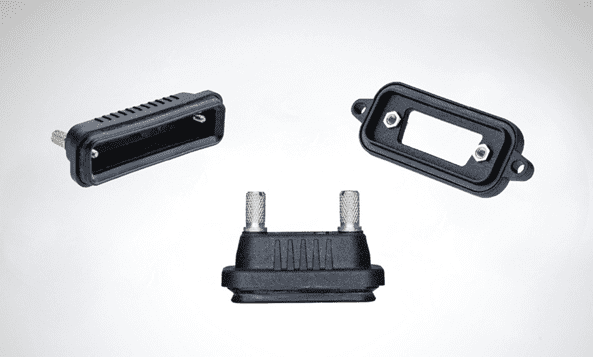
Amphenol LTW’s waterproof & dustproof accessories for D-Sub connectors upgrade existing standard D-Sub systems for use in harsh and outdoor environments. With options for dustproof protection and full IP67 waterproof sealing, these accessories reduce corrosion, signal instability, and mechanical loosening by preventing contaminants and water from reaching the contact area.
Interfacial Seals
D-Sub interfacial seals are specialized, often one-piece molded silicone or rubber gaskets. They are placed on the mating face of the connector, between the male and female shells, to provide IP67/IP68-rated water and dust protection. They prevent leakage between mated plugs and receptacles, enhancing durability in harsh, wash-down, or submerged environments. When paired with rear grommets, they provide a complete sealed solution.
Dust caps
These protective covers shield unused I/O ports from dust, debris, moisture, and physical damage. Specialized ESD (electrostatic discharge) caps are available for sensitive electronic environments.
Jack screws and standoffs
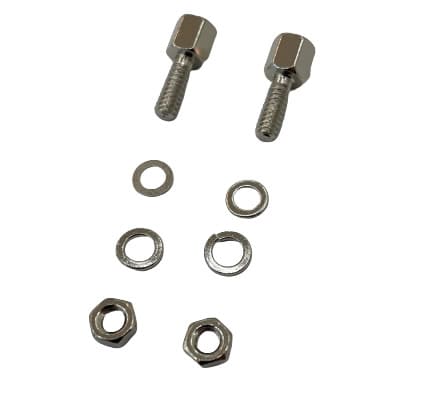
Jack screws, or screw lock assemblies, solidify the connection between D-Sub connectors by physically screwing the male and female connectors together. Jack screws are corrosion resistant, often made of steel, with zinc or nickel plating, or stainless steel and are made to have excellent structural integrity. 4-40 UNC (0.112 inches diameter, 40 threads per inch) is the dominant standard.
Like jack screws, standoffs are used to secure D-Sub components. Standoffs are threaded, typically hexagonal, hardware used to securely mount D-Sub connectors to panels, chassis, or circuit boards, or to lock mating pairs together. They feature 4-40 threads and provide secure, grounded, or insulated mounting, preventing strain on the connection. They may be metal or plastic. A hex nut (female-female) is used to mount a connector to a panel, acting as a secure mounting post for mating cable screws. A hex standoff (male-female) is used to convert a standard mounting hole to a threaded post, or to stack components. Nickel-plated brass offers durability and electrical conductivity. When insulation is required, nylon versions are used.
Quick release hardware
Traditional threaded jack screws can be replaced with spring-loaded clips or sliding latches to enable tool-free, rapid connection and disconnection, saving time in applications with frequent mating cycles. Options with a “snap-lock” hood provide secure, vibration-resistant locking with specialized locking bolts mounted on the mating connector. They often connect with an audible “click” to confirm engagement. Alternatively, sliding latches save space. Quick release hardware is a good solution for applications with restricted access, poor visibility, or frequent maintenance needs.
Markets and Applications
Military and Aerospace, Space, Industrial, Datacom, 3C, Medical
D-sub connectors and accessories are commonly used in military and aerospace systems; computer hardware (VGA or DVI monitors, serial and parallel ports, and various other peripherals); industrial automation (to facilitate communication between control systems, sensors, instrumentation, and actuators); audio/video equipment; telecommunications equipment; gaming consoles; medical devices and equipment; automotive electronics; and robotics.
Suppliers
Adam Tech, Amphenol Communications Solutions, Amphenol LTW, Cinch Connectivity, EDAC, HARTING, ITT Cannon, Molex, Positronic, TE Connectivity, DigiKey
Related Products
Like this article? Check out our other Meet the Connector and Connector Basics articles, our Transportation Market Page, and our 2025 and 2026 Article Archive.
Subscribe to our weekly e-newsletters, follow us on LinkedIn, Twitter, and Facebook, and check out our eBook archives for more applicable, expert-informed connectivity content.

- Ceramics in Space: BME X7R MLCC - October 20, 2026
- Test & Measurement Product Roundup - October 20, 2026
- Advanced Connectivity-Automation, Robotics, AI, and Machine Learning - October 20, 2026