Ensuring RF Reliability and Performance for Wireless Communication
Wireless communication has become woven into every aspect of our daily lives, making it crucial to design systems with reliable components — and to keep counterfeits out of the equation.

From transportation logistics networks and Smart Cities to emergency services and air traffic control, wireless communication continues to transform every industry and aspect of life as trillions of megabytes of data move over mobile networks. In 2024, the global volume of data created and consumed was 149 zettabytes. By the end of 2025, that volume will exceed 181, driven by IoT devices, real-time data processing, and cloud-based storage. Radio frequency (RF) solutions are at the center of these systems.
The growing integration of wireless devices into critical communications, including first responders, connected transportation infrastructure, vehicle-to-vehicle technologies, and other connected systems means the components specified for their designs must perform with utmost reliability. Cable selection is especially critical. In modern RF systems, RF devices use allocated frequency bands from 3 kilohertz (kHz) to 300 gigahertz (GHz) to efficiently transmit wireless signals up to 30 miles without complex wire setups. Land Mobile Radio (LMR) systems, a subset of RF technology, operate in higher frequency bands of up to 8,000 MHz. Using the correct cables can improve speed, reliability, and performance.
Understanding modern RF technology
RF refers to the electromagnetic waves used to transfer data in wireless communication systems. These waves operate in the 3 kHz to 300 GHz spectrum range and are at the center of radio and broadcast systems. The International Telecommunication Union (ITU) and other global bodies regulate these bands alongside regional management, such as the Federal Communications Commission (FCC) in the U.S. or Ofcom in the UK. From our smartphones’ 5G networks to air traffic control radar, the radio frequencies that enable critical systems are modulated to fit specific frequency bands to avoid interference. For instance, extremely low frequency (ELF) at 3 Hz-30 Hz is used for underwater communication, particularly pipeline transportation.
Reliable RF transmission depends on high-performance cables. Quality begins with materials that enhance performance and durability, like composites or copper alloys. Poor quality cables with design flaws like single braiding or low-quality materials can increase signal loss, leaving the passing signal vulnerable to external signal interference from other wireless communication systems, compromising transmission efficacy.
Cable solutions
Higher frequency bands have a greater sensitivity to signal losses. For instance, a traditional RG-8 cable operating at 50 MHz typically experiences attenuation of 1.3 dB per 100 ft, but this increases to 7.6 dB per 100 ft at 900 MHz. To meet the needs of the next generation of applications, cable suppliers are designing cables and connectors that can make up for these losses.
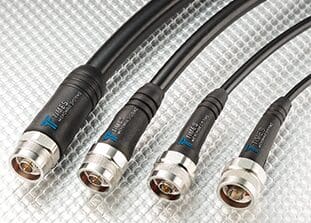
Time Microwave Solutions’ LMR-400 operates at 900 MHz, or 3.94 dB per 100 ft, which is 3.6 dB less than alternative cable solutions.
LMR-based systems operating in ultra-high frequency (UHF) bands cover a frequency range of 300 MHz – 8000 MHz. The reduced attenuation rates in LMR-based systems facilitates reliable push-to-talk (PTT) communication, especially for personnel in remote or high-risk environments like deserts and space. In these challenging environments, specifying a cable with additional ruggedization, such as Times’ LMRs with polyethylene jacketing, provides additional UV resistance. Ensuring rugged performance across public safety and defense applications, like military radios or satellite comms, is essential. High quality materials, like polyethylene, also reduces external interference in extreme conditions adding a layer of resistance to heat, shock, or dust.
LMR cable reliability comes from its power handling and signal integrity. Minimal loss coaxial cables allow RF signals to maintain their strength. This signal integrity enables the cable to maintain RF signal performance over longer distances.
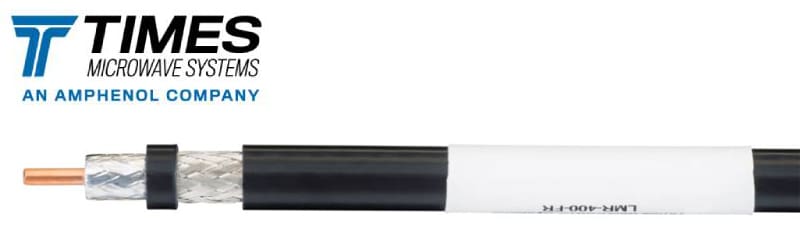
Times Microwave LMR-400 cables have shielding effectiveness of dB >90 and uniform conductor construction for optimized performance and quality. This drives the low attenuation rates of 3.9 dB per 100 ft seen in such cables, and specifying LMR connectors means stronger signals and coverage across applications, as well as less transmissional errors.
LMR or RG Cables?
Historically, RG cables were developed for military wireless communications in World War II, and remain a staple of today’s RF applications. They are integrated into applications as diverse as MRI systems and Air Force One. Typically, they feature a single shielded design with a solid or stranded center conductor. While still effective for RF transmission, advancing technology has overcome the limitations with these designs. LMR cables and connectors offer a robust alternative. Multi-layer shielding amps up durability, with most LMR components rating IP68, significantly higher than RG cables at IP40-54. Multi-layer shielding also extends lifespans to 20-plus years, as opposed to 3-15 years in other RG components and mitigates high frequency signal losses due to the cable’s higher electromagnetic interference (EMI) resistance.
Other technical features that contribute to LMR’s durability and performance include polyethylene jackets, closed cell foam poly dielectrics for flexibility, and bonded tape conductors to reduce attenuation and heighten EMI resistance. Standardized connectors make LMR cables significantly easier to use and install, and specialized connectors minimize compatibility failures. RG cables often require soldered connectors, and not all RG connectors are standardized, making compatibility issues more likely.
Foam dielectric in Times Microwave LMR makes the cable flexible. A unique quality for coaxial cables, this flexibility enables consistent handling without damage and is easily installed in confined spaces. This is a notable difference compared to RG cables which use stiffer solid dielectrics making them prone to damage.
Counterfeit FR components add risk
Counterfeit RF components increase the risk of failure across high-reliability systems. These products may be marked as genuine but fail to meet performance and durability standards set by industry bodies. For example, if a fake low-smoke cable fails to meet UL standards and doesn’t perform a crucial operation, it endangers individuals and produces harmful smoke and gases.
Counterfeit components also compromise durability with low-quality design and materials, such as cable-like plastic over composites. They fail to meet standards like UL 1581 for dielectric strength or IEC 61196, which defines electrical, mechanical, and environmental performance requirements for RF cables used in telecommunications and LMR-based systems.
Counterfeit components are a growing problem that compromises systems reliability and performance. On average, there is a 25% cost difference between fake cables and genuine products; however, a project using counterfeit cables could result in losses up to 75% due to the cable’s lack of longevity. Counterfeit cables commonly fail after three years of operational use, while genuine cables last 20+ years. They also fail safety evaluations due to UV deterioration, jacket failure, water ingress and cracking of the outer conductor tape due to moisture migration down to the center conductor, and electrical instability caused by poor dimensional tolerance.
Look for the company name and trademark printed across the cable and the reel, verify the product name itself (fakes may use another name), check the Cage Code, and place of manufacturing. The best way to ensure that you are receiving the genuine product is to source it directly from the manufacturer or an authorized distributor.
Learn more about RF solutions at PEI Genesis and Times Microwave Systems.
Article contributed by PEI Genesis and Times Microwave Solutions.
Like this article? Check out our other Ruggedization and RF and Coax articles, our Transportation Market Page, and our 2024 and 2025 Article Archives.
Subscribe to our weekly e-newsletters, follow us on LinkedIn, Twitter, and Facebook, and check out our eBook archives for more applicable, expert-informed connectivity content.

- The Challenges of Electric Flight: How Engineers Are Rethinking Power - October 20, 2026
- Printing at the Edge of Possibility: How TE Connectivity Leverages Micro-3D Printing - October 13, 2026
- A Five-Layer Clad Solution for High-Performance Battery Interconnects - October 6, 2026