What are Panel Feedthrough Connectors?
Meet the Connector: Panel Feedthrough Connectors
Panel feedthrough connectors allow electrical signals, data, or power to pass through a panel, enclosure, or bulkhead — in essence providing a connection between the inside and the outside of the system. In harsh environments, they create a secure, sealed passageway to prevent any type of disruption to the connection, such as electromagnetic interference (EMI)/electromagnetic pulse protection (EMP), or exposure to dust and water. They provide a robust connection and electrical isolation to prevent unintended current flow between the inside and outside of the enclosure.

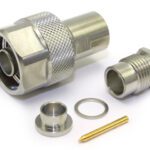
N Type straight bulkhead jack to jack 11 ghz adaptor (left) and SMA 1/2″ sq 4-hole flange bulkhead jack-to-jack adaptor (black plated) (right) from COAX Connectors Ltd. Many COAX panel feedthrough RF coaxial connectors are available in IP68 rated versions to provide resistance to liquid and dirt ingress.
Feedthrough or panel mount connectors can be found for virtually every fiber or copper connector type that incorporates a shell, insulator, and contact. They can be used to connect devices, connectors, or cables from the outside of a system to the inside or vice versa.
Purpose of panel feedthroughs
Panel feedthroughs provide seamless connectivity through a clean, efficient pathway as cables pass from the outside to the inside of a control cabinet. Electrical isolation ensures that the signals passing through the panel do not interfere with each other or compromise the integrity of the enclosure. Sensitive data and power signals are protected from EMI and other environmental factors with robust shielding. Diverse application needs are met; various types of cables for power, signal, and data are accommodated; and different data protocols and power requirements are supported.
Types of panel feedthroughs
Bulkhead mounting adaptor
Bulkhead mounting adaptors, which normally feature a female connector on each end, are fitted directly to the bulkhead or panel. A cable assembly with a male connector is fitted to both sides completing the cable run. “This also creates a more stable passage through the bulkhead,” said Brian Tea, sales manager at COAX Connectors Ltd. “This method allows termination of cables in situ and, should damage occur, only the section that has been damaged needs to be replaced.”
Feedthrough terminal blocks
“On a terminal block, feedthrough literally means to feed a current through the terminal block, from one connection point to the other via the current bar. Feedthrough terminal blocks are the most commonly used terminal block when wiring control panels to connect different devices in an electrical system in an organized fashion,” said Hannah Witopil, product manager for terminal blocks at Weidmuller USA.
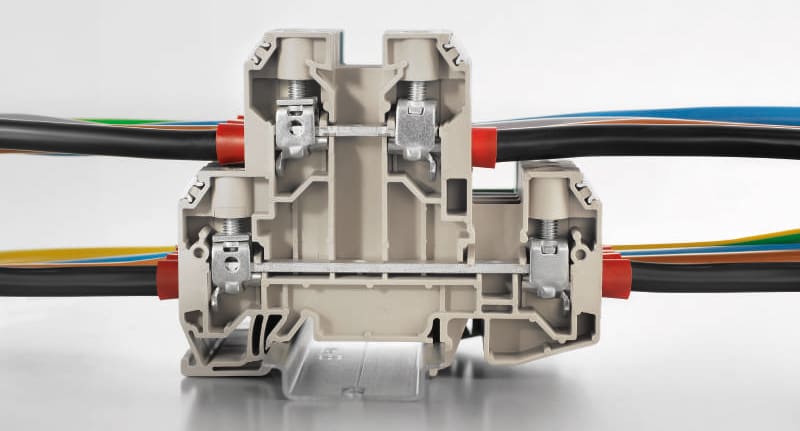
Close-up of a wired feed-through terminal block from Weidmuller.
Witopil explained that feedthrough terminal blocks have several important features. Most are designed to snap onto a DIN rail for easy installation, but direct mount options are also available. They are made from insulating materials to prevent short circuits and ensure safety. Marking channels for terminal markers provide easy identification of the connected wires. Similarly, color-coding options provide clear identification of circuits; for example, blue for neutral or green/yellow for ground.
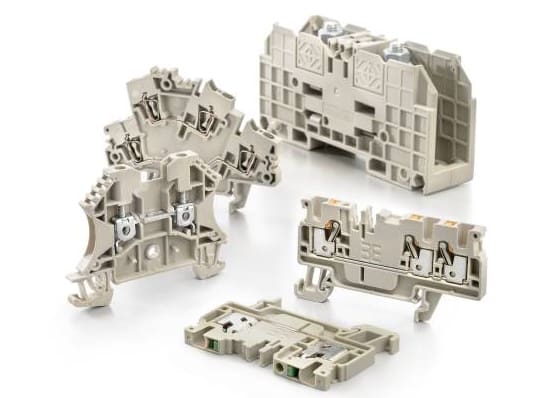
Accessories like jumpers, end plates and brackets, markers, and test plugs are key features. Jumpers are used to electrically connect multiple terminal blocks together. End plates are needed to insulate the exposed sides of terminal blocks. End brackets secure terminal blocks in place on the DIN rail. Markers are used for circuit identification and troubleshooting. Test plugs or sockets allow for easy circuit testing without disconnecting wires.
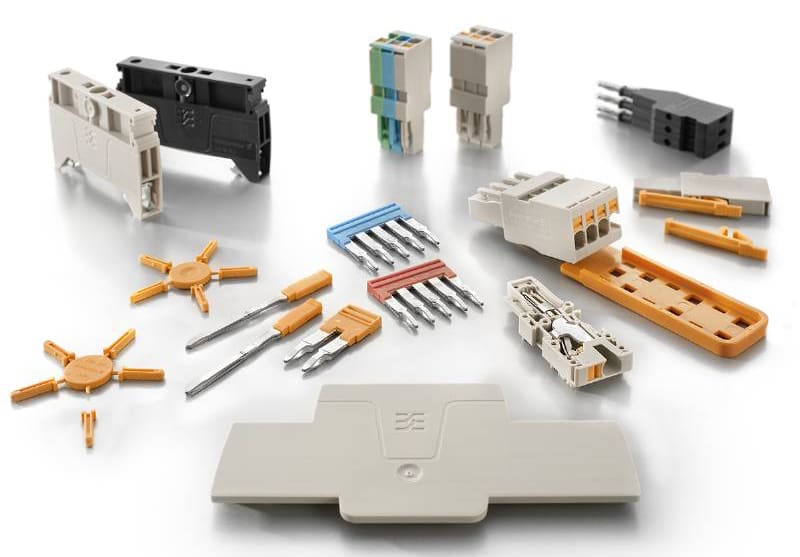
Weidmuller offers many accessories for feed-through terminal blocks.
“Termination technologies are important in terms of wiring preferences but also installation efficiency. Weidmuller was already pioneering that realm back in 1948. We were the first company to offer plastic insulated terminal blocks, moving away from ceramic, which was rather fragile and can break easily,” said Witopil. “Screw clamp and tension clamp are still the most used technologies. People are most comfortable with these because they have been around the longest, but they’re not the most efficient way to terminate wires.”
“Weidmuller was one of the pioneering providers to offer a PUSH IN style terminal block back in 1978 with our DSK series. PUSH IN technology paved the way for tool-free wiring when used with solid or ferruled wires and is becoming increasingly popular for its ease of use and time savings. The newest connection technology, a Weidmuller invention, is called SNAP IN, which lets you wire terminal blocks in absolute record time even with just a stranded wire. Compared to screw technology, that can save up to 85% of wiring time, which is a tremendous cost saver when it comes to labor,” Witopil said.
Data panel feedthroughs
Industrial Ethernet panel feedthroughs may be front-mounted or rear-mounted and facilitate connectivity for data cables. Fiber optic panel feedthroughs are essential for high-speed data transmission in critical applications and allow optical fibers to pass through panels while maintaining hermetic sealing. Single-pair Ethernet (SPE) feedthroughs enable connectivity for smart factories and IIoT applications with real-time data transfer, reduced system costs, and simplified installation.
Hybrid panel feedthroughs
Hybrid panel feedthroughs provide versatility and space-saving by allowing multiple cables serving different purposes to pass through a single panel cutout. Hybrid feedthroughs efficiently combine power, data, and signal connections in control cabinets. Their compact form factor is useful in medical devices where space is limited. Hybrid feedthroughs simplify cable management by seamlessly accommodating both power and data cables, which is a benefit in Test & Measurement setups. Hybrid panel feedthroughs are customizable and often equipped with IP-rated sealing.
Power and signal panel feedthroughs
Power and signal panel feedthroughs allow signal cables and power cables (AC and DC) to pass through panels simply and securely. Isolated power and signal conductors, various termination options, and compatibility across voltage levels ensure efficiency and reliability.
Design Notes
Material specifications:
Note: Materials are based on the type of connector, the cable being used, and the environment it will operate in.
“Feedthrough terminal blocks are made from a combination of electrically conductive and insulating materials chosen for durability, safety, and performance in various environments,” said Witopil.
Conductive components for electrical contact can be copper, tin- or nickel-plated copper, or brass. Copper is often used for the internal terminals due to its excellent electrical conductivity. Tin-plated copper enhances corrosion resistance and solderability. Brass is sometimes used for terminal screws or clamps for strength and conductivity. Nickel plating improves contact reliability and reduces oxidation.
The insulated housing is usually made from polyamide, a high-performance thermoplastic. It offers high dielectric strength, a high flammability rating (often UL 94 V-0 rated), and resistance to chemicals and temperature extremes. Polycarbonate is used in some designs for transparency and impact resistance.
The clamping mechanism is usually made from steel for durability to ensure a secure wire connection. Sometimes it is even stainless steel, for corrosion-resistant screws and clamps, especially in harsh environments.
Markets and Applications
Industrial: Manufacturing and industrial automation; PLCs, sensors, actuators; motor control centers; factory automation systems
Energy/Utilities & Process Industry: Renewable energy and smart grid projects; power distribution in switchgear and control panels; renewable energy systems (solar, wind); smart grid infrastructure; power supplies (UPS systems, battery management systems); instrumentation (measurement and monitoring devices); DCS systems and signal marshalling in process industry (oil & gas, pharmaceuticals, chemical, and water/wastewater)
Transportation: Rail, automotive, and aerospace; transportation equipment (railway systems, automotive, and aerospace electrical systems)
Commercial Buildings: Building automation (electrical distribution and HVAC control, thermostats); business equipment (office machinery, data centers, and server racks); intralogistics (warehousing and material handling); automated storage and retrieval systems, conveyor systems, sorting and packaging equipment, robotic picking systems
Telecommunications: Network equipment, signal distribution systems
Suppliers
Panel feedthrough connectors are manufactured in many forms by many suppliers, including COAX Connectors Ltd., Weidmuller, HARTING, and TE Connectivity.
Like this article? Check out our other Meet the Connector and Connector Basics articles, our Transportation Market Page, and our 2025 Article Archives.
Subscribe to our weekly e-newsletters, follow us on LinkedIn, Twitter, and Facebook, and check out our eBook archives for more applicable, expert-informed connectivity content.

- Ceramics in Space: BME X7R MLCC - October 20, 2026
- Test & Measurement Product Roundup - October 20, 2026
- Advanced Connectivity-Automation, Robotics, AI, and Machine Learning - October 20, 2026