What are Crimp Terminals?
Crimp terminals, a solderless connection option, enable the rapid, consistent, and reliable connections that are essential for mass production and high-vibration environments.
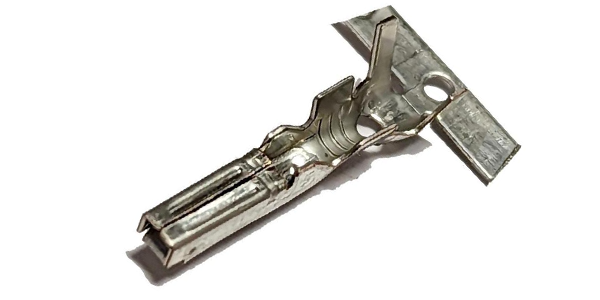
A crimp terminal is a solderless electrical connector for terminating stranded wire used to join wires and components. The crimp terminal has a metal barrel that, with the use of a crimping tool, gets compressed around a wire to create a secure, gas-tight, and vibration-resistant connection. Common uses include automotive wiring, appliance connections, terminal blocks, and industrial control panels.
Uncas A. Whitaker, the founder of AMP Inc. (now TE Connectivity), is credited with the development of crimped termination as a more reliable method of termination than soldering. Soldering was known to be slow and fragile, particularly in aircraft and marine applications. Crimp terminals were fast and reliable in comparison. The speed and consistency of the solderless connections were quickly recognized as crucial for mass production and high-vibration environments.
The F-crimp or open-barrel design allows the terminal to be crushed onto a wire mechanically. This solderless connection technology innovation, finalized in the early 1950s, revolutionized industrial wire harnessing. Other companies, such as ABB Installation Products (Sta-Kon) also developed tool-applied terminals around the same time.
Crimp terminals come in several shapes and types.
- Ring terminals have a circular end that is designed to be secured under a bolt or screw for vibration resistance.
- Spade or fork terminals have a U-shaped fork that slides under a screw head and allows for quick connection and disconnection without having to completely remove the screw.
- Butt splice connectors are cylindrical and join two wires end-to-end; available as heat-shrinkable for environmental sealing.
- Blade terminals (quick-disconnects) are flat, blade and receptacle pairs for rapid assembly/disassembly, often found in automotive applications and household appliances.
- Bullet connectors are round, pin/socket connectors used for in-line splicing in automotive or motorcycle wiring.
- Pin terminals act like a solid conductor and fit into terminal blocks or are crimped onto stranded wire.
- Piggyback terminals are a type of blade connector that features a secondary inlet in a tab connected to the back.
- Wire ferrules are used to terminate stranded wire with a clean, secure connection in screw terminals that prevents fraying.
In addition to the various shapes, crimp terminals can be insulated or uninsulated.
- Insulated terminals feature color-coded PVC or nylon sleeve that also provides strain relief. The colors correspond to the wire gauge to make it easy to choose the correct terminal for the wire size. Red fits 22-18 AWG wire. Blue fits 16-14 AWG wire. Yellow fits 12-10 AWG wire.
- Uninsulated terminals are bare metal, often used where space is limited or temperatures are high.
Materials & Construction
The conductive part of the connector is often made from high-grade tin-plated copper due to its excellent electrical conductivity and corrosion resistance. Another common choice is brass, a harder material that maintains contact tension, particularly in smaller, high-frequency mating applications. Phosphor bronze, a more robust option, is used for superior, long-lasting tension in high-vibration scenarios. In applications that require lightweight components, aluminum can be used.
The insulation (sleeve) material is most commonly PVC, a cost-effective insulation for indoor use. Nylon has higher resistance to chemicals and abrasion for heavy industrial use. Heat shrink provides protection by creating a waterproof, corrosion-proof, environmentally sealed connection.
Tin and gold are used for plating. Tin is standard for corrosion resistance and cost-effectiveness. Gold is used for high-reliability, low-voltage signals and high long-term connection quality.
Crimp terminals have a simple design that allows secure, reliable connections to be made quickly and efficiently. The rugged design makes crimp terminals ideal for high vibration environments.
TECHNICAL SPECIFICATIONS
| IDENTIFICATION | |
| Product / Series Name | Crimp terminals, crimp connectors, terminal lugs, wire terminals, crimp-on terminals, and electrical splices |
| Manufacturer(s) | TE Connectivity, Molex, Amphenol, Phoenix Contact, Samtec, 3M, Tonful Electric, Ideal Industries, King Innovation, ABB, JST |
| Relevant Standards | IPC/WHMA-A-620 (general cable assembly), UL 486A-B (electrical safety), and SAE AS7928 (aerospace/automotive), dictate wire preparation, crimp height, and pull-force testing. |
| Mechanical Specifications | |
| Shell Material(s) | Tin-plated copper, brass |
| Shell Finish / Plating | Tin, gold |
| Overall Dimensions | Varies according to AWG wire size |
| Sealing & Environmental | |
| Vibration Resistance | By design, these connectors are vibration resistant |
| Shock Resistance | By design, these connectors are vibration resistant |
| Corrosion Resistance | May be corrosion resistant |
| EMI / RFI Shielding | May be shielded or unshielded |
| Materials | |
| Insulator Material | PVC, nylon |
| RoHS / REACH Compliance | Many are RoHS/REACH compliant |
| Halogen Free | Many are halogen free |
| UL Flammability Rating | Crimp terminals with plastic insulators are often rated according to the UL 94 standard, which classifies plastics by their flame-retardant properties. |
SUPPLIERS
Adam Tech, Amphenol LTW, Molex, Phoenix Contact, TE Connectivity, Samtec
MARKETS & APPLICATIONS
Automotive, Consumer, Industrial, Aerospace, Marine, Datacom/Telecom
Automotive wiring harnesses, lighting, switches; consumer appliance connections; connecting cables and wires in networking infrastructure; terminal blocks, sensors; industrial control panels, machinery, power distribution systems, and motor connections; consumer electronics and device terminals, often using IDC (Insulation-Displacement Contact) connectors for efficiency; solar panel installations and wind turbines. Crimp terminals are often used in harsh environment applications, particularly where high vibration is a concern.
RELATED PRODUCTS

Amphenol LTW crimp and field installable connectors feature field assembly without specialized tools or processes, secure crimp contacts for stable power and signal transmission, robust locking and vibration resistance, IP-rated sealing for harsh environments, and reduced installation time and operational downtime. Available across X-Lok, Metric Circular, Ceres, RBL, and Power Series to ensure secure electrical contact, mechanical reliability, and consistent performance. X-Lok Quick Lock Connector for Fast and Reliable Connections | Amphenol LTW Explore X-Lok connectors by Amphenol LTW. Push lock design, UL certified, for power, signal, and hybrid applications. Perfect for outdoor use with quick installation.
Adam Tech’s Secur-Seal Wire-to-Wire Connectors provide sealed waterproof protection to a variety of harsh environment applications. This series is composed of securely latched connector housings ranging from two to six positions, various AWG terminal sets (male and female), and wire seals. They provide sealed IP67 waterproof protection and accommodate various current ratings and wire gauge ranges. Their compact size further enhances their application compatibility. Custom connector and cable assembly options are welcomed.

Phoenix Contact’s comprehensive range of crimp connectors includes various insulated and uninsulated connectors that meet industry and trade requirements and guarantee long-term stable, high-quality electrical connections.
Like this article? Check out our other Meet the Connector and Connector Basics articles, our Transportation Market Page, and our 2025 and 2026 Article Archives.
Subscribe to our weekly e-newsletters, follow us on LinkedIn, Twitter, and Facebook, and check out our eBook archives for more applicable, expert-informed connectivity content.

- Custom Cable Assemblies: A Value-Add Solution - October 13, 2026
- Fiber Optics Product Roundup - October 13, 2026
- October 2026 Connector Industry News - October 13, 2026