What are Terminals?
Meet the Connector: Terminals
A terminal is the conductive element that provides an electrical contact point that enables electricity to flow through an electrical circuit. At its most basic level, a terminal is simply a conductive bare wire that is secured through crimping or soldering, often to a terminal block.
However, the word terminal is also used to refer to a specific category of simple interconnects that consists mainly of a shaped conductive element. This element can take the form of a ring (ring terminals), a two-pronged fork (spade terminals), an open half circle (hook terminal), or be a formed metal part with rolled or winged sides. Terminals can consist of bare metal or they may include a section of insulation.

From left to right: 3M spade terminal from Waytek, Molex ring terminal from Mouser, Molex hook terminal from DigiKey
One of the earliest examples of a terminal is the binding post, a central threaded metal rod terminal with a cap that screws down onto the rod, capping the metal end. Early caps were metal, then as Bakelite and other plastics were invented, red and black caps made it possible to identify negative and positive terminals via color coding. This device came into use in the 19th century and was used in telegraph keys and blasting machines. In the 20th century, binding posts began to be integrated into various simple connectors. Integrating a terminal into a connector housing creates a more powerful and multifunctional passive device. Terminals form the basis of all interconnect products. In most connectors, the terminal is now called a pin (multiple pins, usually). However, basic terminals are still widely used, especially in the automotive industry, where they are used to connect fuses, battery terminals, and even sensors. Terminals provide a secure connection that is able to withstand shock, vibration, and temperature extremes.
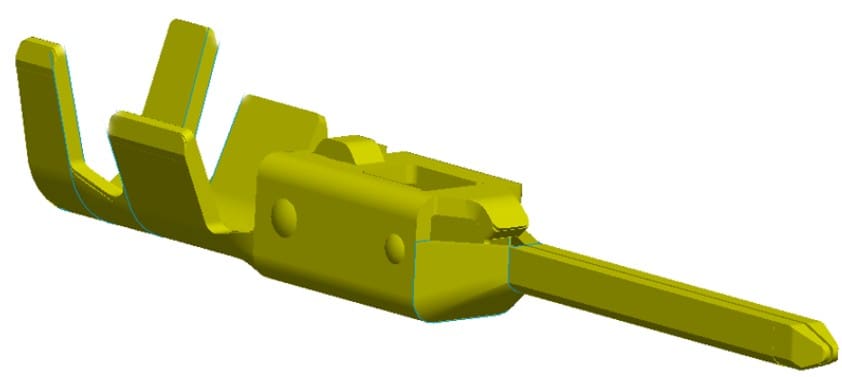
Greenconn’s automotive terminal in phosphor bronze.
Design Notes
Material specifications:
A terminal must possess specific attributes, conferred by material selection. According to the text, Electrical Contacts: Principles and Applications, edited by Paul Slade, those attributes are low electrical resistance, appropriate spring constant, good structural strength, resistance to surface film growth, and low hardness to provide low constant resistance. The use of copper alloys that retain 75% or more copper is the most commonly specified material used for terminals. If a spring is part of the design, bronze is commonly used. Plating on a terminal improves its performance and longevity. Terminals may be plated with another noble metal (silver, gold, palladium, tin and others) to improve resistance to film growth and keep contact resistance low.
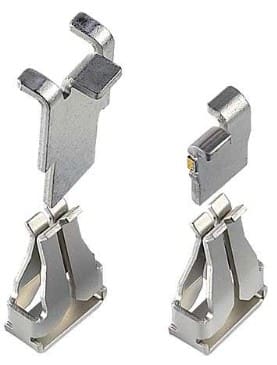
I-PEX’s AP-10 is a board-to-board power terminal, engineered to deliver up to 30A in a compact form factor. With one-action mating, AP-10 simplifies installation and replaces traditional screw-fastened busbars. The space-saving design supports PCB miniaturization.
Markets and Applications
Automotive, Transportation, Consumer
Terminals are widely used in vehicles, consumer appliances (white goods), small electrical devices.
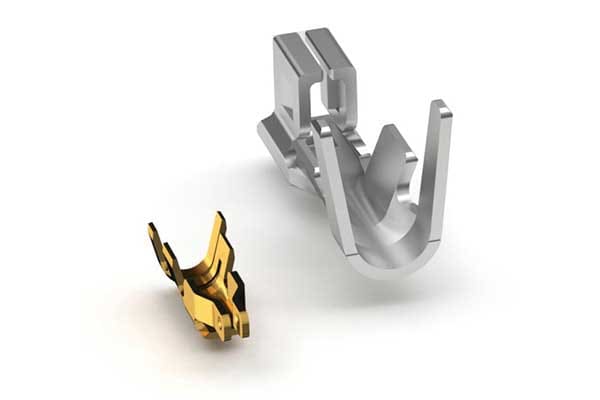
Crimp Terminals for Miniature Disconnecting Systems from Adam Tech.
Suppliers
Terminals are available in many variations from many suppliers, including Adam Tech, DigiKey, Greenconn, I-PEX, Molex, Mouser, TE Connectivity, Waytek
Like this article? Check out our other Meet the Connector and Connector Basics articles, our Automotive Market Page, and our 2025 Article Archives.
Subscribe to our weekly e-newsletters, follow us on LinkedIn, Twitter, and Facebook, and check out our eBook archives for more applicable, expert-informed connectivity content.

- Connectivity Is Reshaping Police and Security Vehicle Fleets - September 8, 2026
- Thermal Management Strategies with Liquid Cooling Connectors - August 11, 2026
- Rodent-Resistant Electronics - July 28, 2026