What is a Manual Service Disconnect (MSD) Connector?
A manual service disconnect (MSD) connector is a removable, touch-safe high-voltage connector used to manually break the electrical circuit of an electric or hybrid vehicle’s battery pack. It meets the performance requirements of SAE/USCAR-2 and its high-voltage supplement, USCAR-37. Technicians, first responders, and tow operators pull the MSD before servicing a 60–800V system so that stored energy is isolated from the rest of the vehicle. It typically integrates a high-voltage interlock (HVIL) circuit and, often, a service fuse, and is sometimes called the “fourth safety device” on a battery pack, alongside the contactors, pyro-fuse, and crash sensors.
MSDs emerged alongside the first mass-produced hybrid and battery-electric vehicles in the early 2000s, as automakers needed a standardized, tool-less way to de-energize packs that could reach 400–800V. Suppliers offer MSD product lines built around a two-stage lever or pull-handle mechanism.
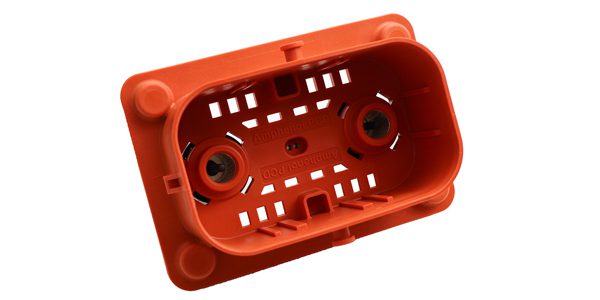
Chief Enterprises custom builds MSD cable assemblies using a combination of Amphenol Sine or PCD housings, high-voltage cable, and protective labeling, heat shrink, sealing, and potting features.
Technical Standard
MSD connectors are typically qualified against two layered SAE/USCAR documents rather than one dedicated MSD standard. SAE/USCAR-2, “Performance Specification for Automotive Electrical Connector Systems,” is issued by USCAR and covers low-voltage (0–20 VDC) and coaxial automotive connectors. “High Voltage Connector Performance Supplement to SAE/USCAR-2,” issued in August 2008, adds test methods specific to 60–600V connection systems. Sealing and ingress protection are additionally verified against IEC 60529.
Design Highlights
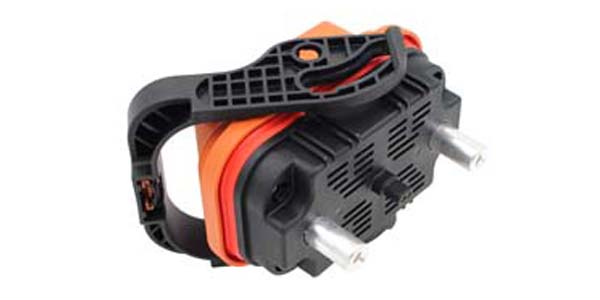
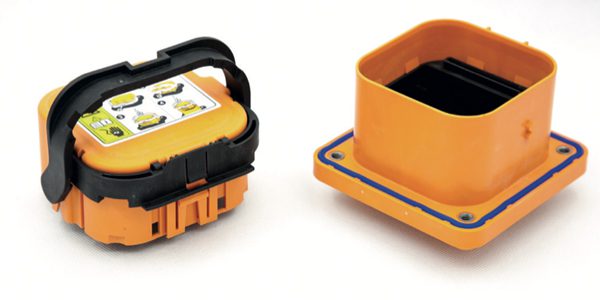
MSDs provides vehicle platforms with a common, tool-free, safe way to isolate voltage. Without that, each OEM would improvise its own isolation hardware, creating complications for service and first-responder training. The defining design elements of MSGs are a two-stage lever or pull-handle that opens the HVIL circuit before the high-current contacts separate (so no load is ever broken live), touch-safe shrouding on all HV surfaces, and, on many designs, an integral high-current fuse carried inside the removable plug itself.
Multiple manufacturers build to the same USCAR-2/USCAR-37 base, giving OEMs second-source options. As battery pack voltages trend toward 800V and beyond, and stationary battery energy storage systems (BESS) scale up, MSD designs are being pushed toward higher voltage and current ratings and larger-format, multi-module disconnects.
Markets & Applications
Automotive, Transportation
MSDs are used wherever a high-voltage battery pack needs a manual, tool-free isolation point, including battery-electric, plug-in hybrid, and hybrid-electric passenger vehicles; electric trucks and buses; off-highway and construction electrification; and stationary battery energy storage systems (BESS).
Reading the Part Number
MSD part numbers are largely supplier specific. A typical string generally encodes connector series, current rating (e.g., 500A), and pin/way count, but the logic varies by manufacturer, so datasheets should be consulted.
| IDENTIFICATION | |
| Governing Standard(s) | SAE/USCAR-2; SAE/USCAR-37 (HV supplement); IEC 60529 (sealing/IP) |
| Standard Issuing Body | USCAR / SAE International; IEC |
| Common Name / Series | MSD, Manual Service Disconnect, “service plug” |
| Industry Category | High-voltage automotive/EV connector, rectangular or specialty circular |
| MECHANICAL SPECIFICATIONS | |
| Shell / Housing Shape | Rectangular or circular, application-specific |
| Shell Material & Finish | Glass-filled thermoplastic (e.g., PA, PBT); metal-shielded variants available |
| Size / Shell Size Codes | Supplier-specific; scalable by current rating |
| Mounting Type(s) | Panel/pack mount; front-install or back-install |
| Plug / Receptacle Styles | Removable plug (disconnect header) with mating receptacle mounted to pack |
| Mating Cycles (rated) | Commonly ~50 cycles (low-cycle by design — intended for service events, not daily use) |
| Locking Mechanism | Two-stage finger-actuated lever, secondary lock/buckle, or pull-handle |
| Keying / Polarization | Orientation-keyed housings; orange coloring is the industry convention for HV |
| CONTACT SPECIFICATIONS | |
| Contact Arrangements | Commonly 2-pin (HV) up to multi-pin with integrated HVIL sense circuit |
| Contact Size(s) / AWG | Application-specific, sized to current rating |
| Contact Material & Plating | Copper alloy; silver or tin plating common |
| Termination Method(s) | Crimp; bolted/bus-bar lug; cable assembly |
| Current Rating (per contact) | Commonly 100A–500A+ depending on product line |
| Voltage Rating | 60–800 VDC class (per USCAR-37 scope of 60–600V, with newer designs extending higher) |
| Insulation Resistance | Per USCAR-37 test method |
| Contact Resistance | Per USCAR-37 test method |
| SEALING & ENVIRONMENTAL | |
| IP / Sealing Rating | Commonly IP67 per IEC 60529 |
| Sealing Type & Material | Interfacial or peripheral elastomeric seals (e.g., silicone) |
| Operating Temperature Range | Typically −40 °C to +125 °C class, application-specific |
| EMI / RFI Shielding | Shielded variants available for noise-sensitive HV runs |
| Vibration & Shock (rated) | Per USCAR-2/USCAR-37 automotive test methods |
| MATERIALS & COMPLIANCE | |
| Insulator Material | Glass-filled thermoplastics; potting compounds in cable assemblies |
| RoHS / REACH | Commonly RoHS compliant (confirm by supplier/part) |
| Qualification / QPL | No central QPL; qualification is per-OEM and per-supplier against USCAR-2/USCAR-37 |
| Applicable Test Standards | SAE/USCAR-2, SAE/USCAR-37, IEC 60529 |
Suppliers
Manufacturers: Amphenol Industrial, Amphenol LTW, Amphenol Pcd, ITT Cannon, Molex, Phoenix Contact, Positronic, Samtec, TE Connectivity
Distributors: Chief Enterprises, DigiKey, Mouser, Powell Electronics, Sager, TTI Inc.
Related Products
Like this article? Check out our other Meet the Connector and Connector Basics articles, our Military and Aerospace Market Page, and our 2026 Article Archives.
Subscribe to our weekly e-newsletters, follow us on LinkedIn, Twitter, and Facebook, and check out our eBook archives for more applicable, expert-informed connectivity content.

- Ceramics in Space: BME X7R MLCC - October 20, 2026
- Test & Measurement Product Roundup - October 20, 2026
- Advanced Connectivity-Automation, Robotics, AI, and Machine Learning - October 20, 2026