Protecting Interconnect Components in Aerospace and Space Applications
The harsh environment of space exposes spacecraft to extreme temperatures, radiation, atomic oxygen (ATOX), and shocks or vibration due to debris impact. These risks must be considered right from the design phase of electronic devices to ensure that the materials and technologies used in space perform as intended. Faced with rapid changes and ever-increasing technological challenges, the space industry needs, now more than ever, state-of-the-art technologies, able to cope with the challenges of this extreme environment.

Article Contributed by: Laetitia Fournier-Grivot, Project Engineer; Camille Saugey, Marketing Project Assistant; Sandrine Hermant, Marketing Manager – Axon’ Cable
Managing the temperature of components
In space, satellites are subjected to extreme temperatures. These can be negative or positive several hundred degrees depending on the exposure to the sun. Electronic equipment and batteries can also generate heat between -50 °C and +125 °C. Spacecraft must be equipped with thermal control systems, such as heaters and thermistors, to regulate this temperature. They are generally wired with AWG 24 to 28 power wires (2 to 4 wires). Megaconstellations are made up of hundreds of small satellites, each equipped with a thermal control system.
With the temperature extremes experienced by spacecraft, electronic components, as well as cables and connectors, must be resistant to thermal shock and vibration. A reliable connection system is needed. For space applications, weight saving is also a determining factor in the choice of connection. Manufacturing satellites in volume means using faster and therefore more cost-effective integration solutions. Integrating as many components as possible upstream, such as cables and connectors, rather than assembling them directly on the satellite, saves a significant amount of time. Splices can be used to connect the power wires to the heaters, but the assembly time can be 20 times longer. The quick-lock system makes integration much easier.

SnapLite connectors, designed by Axon’ for wiring satellite heaters, connect in five seconds. Their shape makes them easy to fix to the satellite structure. The composite connector makes the connection lighter. They can be offered with dismountable lines which can be easily replaced if needed. The non-dismountable version has been approved by the European Space Agency according to ESCC3401/100. Other SnapLite versions are currently undergoing ESA qualification.
Protecting against electromagnetic interference
Space communications use electromagnetic waves to process and transmit data from space probes to Earth, or to issue operational or trajectory commands from Earth to space.
Electromagnetic interference (EMI) is therefore problematic, since it can degrade the signal and cause digital interpretation errors, leading to malfunctions or even complete failure of the equipment. For this reason, EMI requirements increase in spacecraft computer networks. An appropriate shielding will limit EMI, protecting electronic devices and limiting spying in complex systems.
Plastic connectors do not offer adequate protection against electromagnetic interference. Thus, metal shields are added to attenuate, protect, and block electromagnetic waves. This is why a metal connector with a backshell is an effective alternative for protecting links against EMI and enhancing the reception quality of transmitted signals.
Backshells, true allies against interferences, are directly placed behind the connector and allow for a 360° shield termination, limiting EMI.
While monobloc backshells improve EMI protection by design, backshells in modular format (two half-shells) offer great flexibility of use. They can be mounted at the end of harness cabling or afterwards to correct an inappropriate EMI performance measurement.
Combined with backshells, stainless steel clamping termination bands ensure the continuity of shielding efficiency at the junction between the cable and the connector.
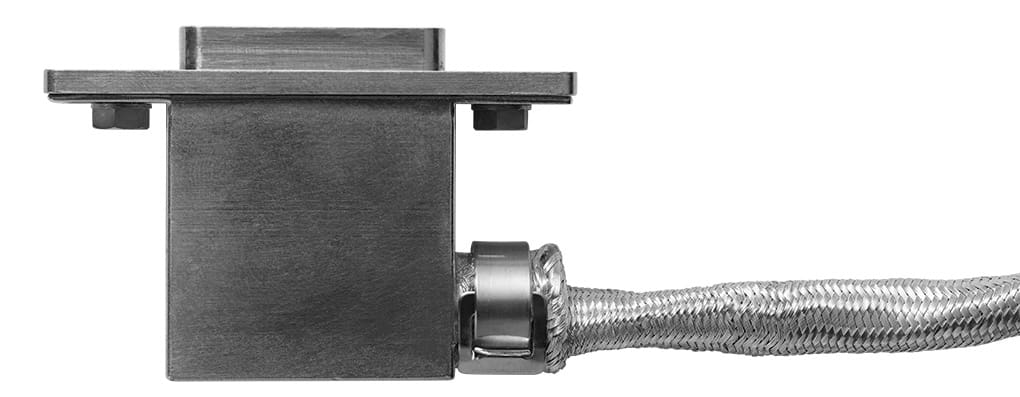
Micro-D backshell designed by Axon’ protects the link against EMI. Axon’ offers custom-designed solutions with a large choice of funnels, surface treatments, accessories, materials, sizes, and plating. At the rear of connectors, the clamping termination band Axoclamp allows for 360° shield termination. Thanks to the Axon’ Axotress braid, the EMC performances are improved.
Some metal connectors, such as Micro-D or D-Sub connectors, have not been designed to ensure a great continuity between male and female connectors. When mating, a slight gap remains between the connectors and no contact is guaranteed. This connection zone can be the source of EMI leakage. To ensure a 360° contact between the male and female connectors, and thus reinforce EMI protection, a metal clip can be integrated into the contact zone. The clip gives a good continuity between the mated connectors by creating a metal contact.
For Micro-D connectors, this clip can be installed either on the male or inside the female connector. The connector equipped with the clip remains compatible with a standard Micro-D connector.

Axon’ EMI Clip for eliminating Micro-D EMI leakage at the front of the connector. Available for male or female connectors. The clip is integrated in a specific shell, compatible with any Micro-D connector on the market. With the EMI backshell, the EMI clip ensures a fully EMI-protected connection.
Protecting electronic components
Preserving the integrity of components is not just a matter for space applications. Avionics systems are also concerned. For these applications, reduced weight and size is important. The use of Micro-D connectors is particularly popular, given their robustness, resistance to shock and vibration, and reliability. But adapting these connectors to customer requirements can be essential. In a combat aircraft, for example, the effect of condensation on electronic housings can be harmful to the integrity of printed circuit boards.
In addition, in the event of outgassing of materials, the gas emitted can create a haze on the optical equipment and can therefore deprive the equipment of its functions. A hermetically sealed connector fitted to the electronics box will provide a barrier against gases, while allowing electrical signals to pass through. Electrical insulation is essential, which is why insulating materials such as glass, ceramics, or polymers are used in conjunction with conductive metals. The hermetically sealed connector should be designed to withstand an airborne environment that will undergo vacuum cycles corresponding to take-off and landing, for as long as 15 years. Thermal cycling and hermeticity tests will be used to validate the solution.
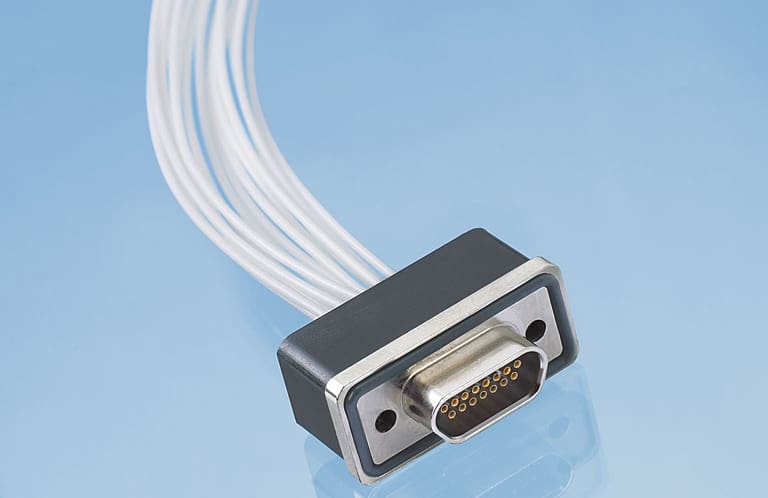
Hermetically sealed Micro-D connector manufactured by Axon’ Cable. This resin solution is cost-effective and suitable for leakage rates of less than 10-8 mbar·l/s. For lower leakage rates, the Hermax range with glass or glass-ceramic is recommended.
Visit Axon’ Cable to learn more.
Like this article? Check out our other Harsh Environment articles, our Connector & Cable Special Topics Market Page and our 2025 Article Archives.
Subscribe to our weekly e-newsletters, follow us on LinkedIn, Twitter, and Facebook, and check out our eBook archives for more applicable, expert-informed connectivity content.

- Printing at the Edge of Possibility: How TE Connectivity Leverages Micro-3D Printing - October 13, 2026
- A Five-Layer Clad Solution for High-Performance Battery Interconnects - October 6, 2026
- High Voltage Interlock for Commercial Vehicles: A Must-Have or a Nice to Have? - September 29, 2026