Key Connector Considerations for Air-Cooled and Liquid-Cooled Data Centers
Data centers use many methods to keep their information and communication technology equipment cool, including traditional air-cooling and newer immersion cooling methods.

Article Contributed By David Beach, Market Segment Manager, Anderson Power
Air-based cooling systems have been the go-to method for keeping information and communication technology (ICT) equipment cool. Often configured with hot/cold aisles for extra efficiency, air-cooled systems remain a straightforward, cost-effective choice for data centers utilizing conventional air cooling. However, air cooling is not the optimal choice for many newer applications in the hyperscale and data center facilities of the future.

Generative AI and GPU-accelerated servers in HPC applications generate far more heat than traditional computational loads. Air cooling simply cannot keep up. In light of this, more data centers are turning to liquid-based cooling methods such as direct-to-chip liquid cooling and immersion cooling.
Data center engineers need reliable power delivery regardless of their thermal approach. Air-cooled systems demand power supply unit (PSU) and power distribution unit (PDU) connectors that can withstand elevated ambient temperatures in hot-aisle environments, while immersion cooling requires components that can operate safely when submerged in dielectric fluids.
What is traditional air cooling in data centers?
Air cooling remains the most common thermal management method for small to midsize data centers with rack densities under around 25 kW. This method uses conventional air conditioning technology and airflow management strategies to regulate ICT equipment temperatures and prevent overheating. One approach to improve the energy efficiency of air-cooled data centers involves implementing hot aisle /cold aisle configurations with aisle containment systems.
First introduced by IBM in 1992, the hot/cold aisle configuration is one of the oldest ways to conserve energy within a data center. In this setup, server racks are arranged in alternating rows. Cold aisles are the server rows facing the rack fronts, while hot aisles align with the back of the servers. Cold air from the computer room air conditioner (CRAC) system is delivered via raised floors into the cold aisles, where it is drawn through the front of the servers to cool them. The hot exhaust is then expelled into the hot aisles before returning to the CRAC unit along the ceiling vents to complete the cycle.
What connectors are best for air-cooled data centers?
Power distribution unit (PDU) and power supply unit (PSU) connectors are important foundational components within ICT design, and engineers working within air-cooled hot/cold aisle data centers should weigh unique considerations when selecting their connectors. These connectors and power cords are critical for connecting the PDU to the switch, the PDU to the server, the PDU to storage, and more.
For air-cooled environments with hot/cold aisles, design engineers must consider connector performance in high-temperature conditions. Hot-aisle environments can reach up to 40-50 °C, and the heat of the flowing electrical current and contact resistance can bring connector temperatures above 70 °C. However, standard IEC C13/C14-sized appliance couplers usually offer a maximum rating of 70 °C.

Engineers can seek interconnect solutions with higher thermal ratings than the standard 70 °C to provide greater headroom for conducting current in high ambient temperature environments. Some connectors even offer a thermal rating of up to 105 °C, ensuring dependable power delivery under load.
Liquid & immersion cooling: a growing solution for higher data center workloads
As data center workloads intensify, more hyperscale and data center facilities are turning toward immersion cooling as a high-efficiency alternative to traditional air cooling. In summary, liquid cooling involves submerging ICT equipment into a specialized dielectric fluid that absorbs and removes the heat via convection. The heat is transferred from the equipment to the fluid, which is then moved away from the equipment and extracted through various methods like heat exchangers or direct liquid-to-liquid cooling. Then, the cooled fluid returns to the immersion enclosure, completing the cycle.
Types of liquid cooling in data centers
There are several types of liquid cooling approaches:
- Single-phase immersion cooling. In this method, the ICT equipment is partially or fully submerged in a dielectric fluid that remains in the liquid phase throughout its cycle. The simple tank designs, compatibility with off-the-shelf plumbing hardware, and adaptability for many types of dielectric fluids make single-phase systems a popular choice, particularly for HPC data centers.
- Two-phase immersion cooling. Two-phase immersion cooling is a more advanced approach that also involves submerging equipment into a dielectric fluid. However, the fluid undergoes a phase change as it boils into a gaseous state, then condenses back into a liquid. Two-phase systems can support greater power densities of even up to 250-500 KW per tank.
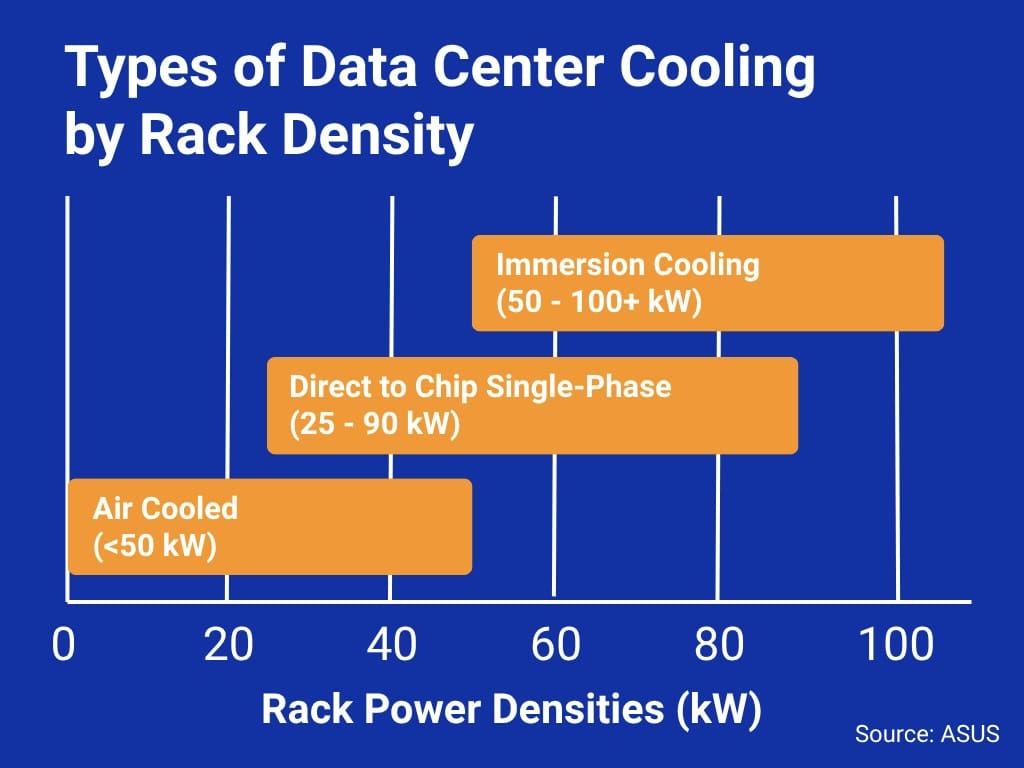
One additional liquid cooling method is direct-to-chip cooling, where coolant is delivered directly to hotter components, such as GPUs, via cold plates. This method places the cold plate directly on high-heat areas for efficient thermal management. Direct-to-chip systems may be designed as either single-phase or two-phase systems.
The best PDU/PSU connectors for liquid-cooled data centers
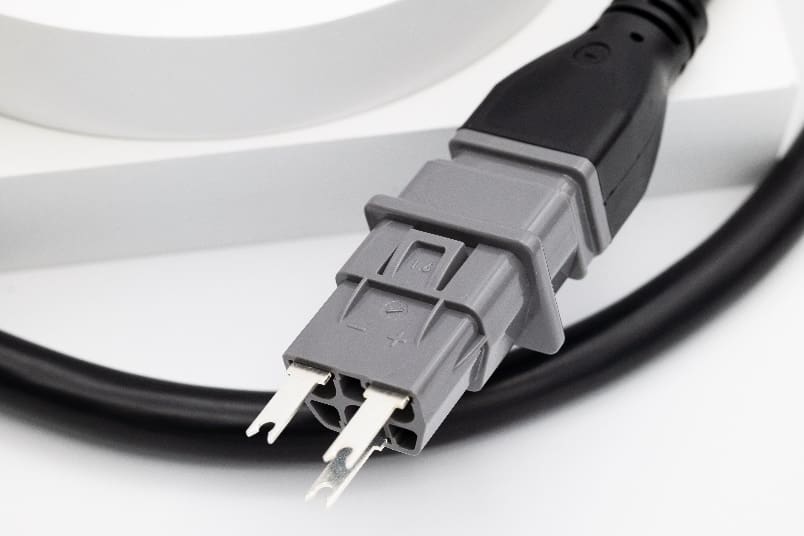
The evolution of immersion and liquid cooling is introducing new demands for connector materials and durability. In addition to withstanding electrical and thermal stress, connectors in immersion applications must also be chemically compatible with the dielectric fluids used. The connector housing must resist degradation from the dielectric fluid, ensuring long-term integrity and reliability even when fully or partially immersed.
As liquid cooling technologies continue to advance and potential liquid cooling standards emerge from Open Compute Project industry efforts, connector designs will continue to evolve to support the data centers of the future.
The future of data center cooling
No matter the cooling strategy – air-cooled or liquid-cooled – PDU/PSU connectors play an important role in maintaining reliable and efficient power delivery. Engineers with liquid-cooled data centers should select durable connectors that will withstand dielectric fluid exposure. Those with hot aisle environments would be best served by connectors with higher temperature ratings to provide extra headroom to ensure consistent performance.
For more information, visit Anderson Power.
Like this article? Check out our Datacom Market Page, and our 2025 Article Archive.
Subscribe to our weekly e-newsletters, follow us on LinkedIn, Twitter, and Facebook, and check out our eBook archives for more applicable, expert-informed connectivity content.

- Printing at the Edge of Possibility: How TE Connectivity Leverages Micro-3D Printing - October 13, 2026
- A Five-Layer Clad Solution for High-Performance Battery Interconnects - October 6, 2026
- High Voltage Interlock for Commercial Vehicles: A Must-Have or a Nice to Have? - September 29, 2026