DC Motor Power Helps Electrify Industrial and Commercial Equipment
The industrial and commercial equipment market is undergoing a fundamental transformation as electrification moves from the automotive sector into construction, landscaping, logistics, and maintenance equipment.
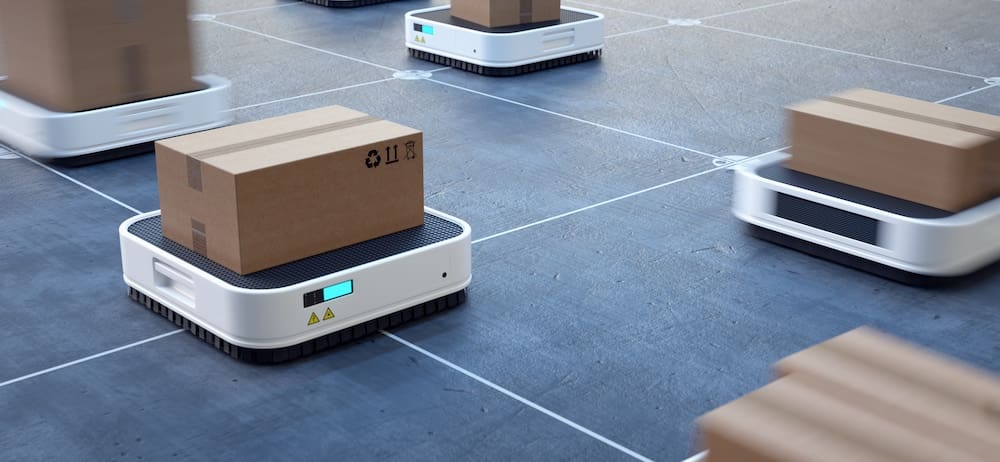
Small, engine-powered equipment is transitioning to electric power. While the electric vehicle transition is progressing unevenly, with some countries pulling back and others moving forward, the same technology is finding widespread adoption in smaller equipment types across the industrial and commercial markets. High-performance automated or portable industrial equipment such as lifts and utility carts are moving to electric power, along with portable small engine machinery such as fans, compressors, and landscaping and building maintenance tools.
They also offer several key advantages: better operator control, lower energy and operational costs, and less mechanical wear. In worksites such as construction or groundskeeping, the worksite for both neighbors and employees is also improved by reducing noise and exhaust emissions. Automated equipment can even return to its charging dock and engage a recharge without operator intervention, saving labor.
These systems utilize battery packs or external electricity instead of traditional internal combustion engines. The power is delivered in DC current and regulated by controllers and converters to activate the system in DC motors or brushless DC motors (BLDC). DC systems require more electronics, including connectors, sensors, and control electronics, than gas engines, but they are not just scaled down components from the electric vehicle world
Anderson Power Products (APP) created the SBSXPRO specifically for the needs of small electric industrial equipment. Joe Ferris, market segment manager at APP, said, “This connector is 100% specific for outdoor power equipment and other similar markets, as its designed power capabilities are specific to a motor size range commonly found on professional-grade commercial mowers. In addition, one variation of the product was designed specifically for seamless assembly in the manufacturing environment of a lawnmower factory and for specific use while connecting controllers to deck motors.”
Ferris said APP consulted with its customers to shape the connector’s key specifications as well as form and function. By consulting with future users, APP was able to narrow down power contact size by evaluating their component performance requirements. Additionally, the connector’s designers considered assembly methods to choose a form that would best interact with assembly machines at the OEM level. The goal was to design a connector that would serve customers now, as they transition equipment to electric, as well as into the future, when equipment will expand in capabilities enabled by incoming technologies.
“Our SBSXPRO is designed to meet both current and future needs. By incorporating up to eight auxiliary wires, it addresses today’s requirements, where only a few auxiliaries are typically used. This feature allows for flexibility and scalability as technology, sensors, and IoT evolve,” said Ferris. “A personal favorite subject for me is the quality of the cut [in mowing equipment], which is significantly enhanced by offering eight auxiliaries. This enables the integration of blade speed, load, and location sensors into a system that optimizes power usage, ultimately improving the quality of the cut and productivity compared to today’s gas-powered mowers.”
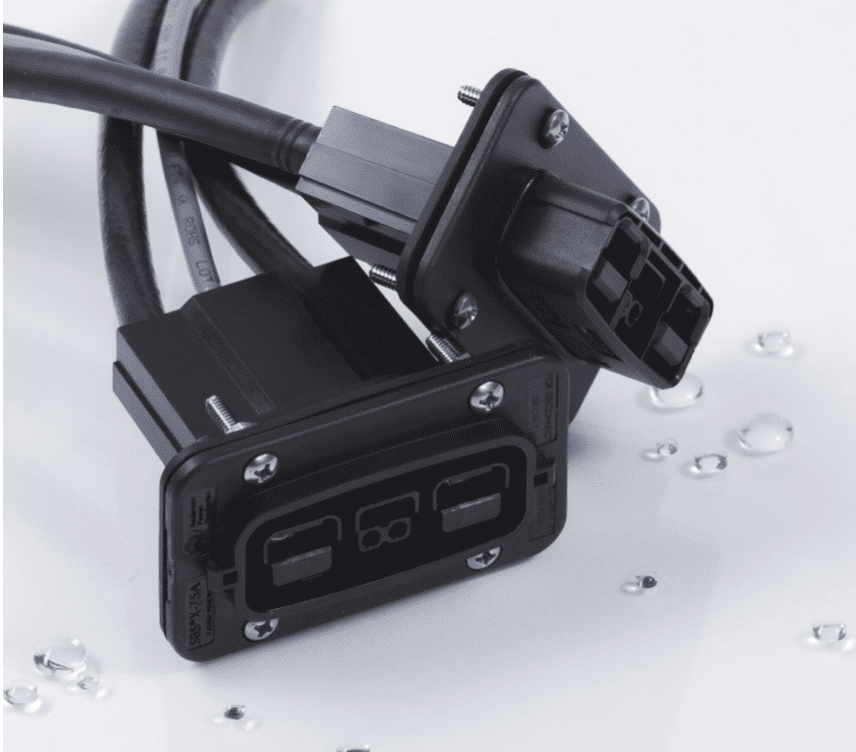
Anderson Power’s SBSXPRO connector delivers industry-leading performance with three power contacts and eight signal contacts, an improvement over standard connectors, which offer only two power contacts and up to six signals.
As manufacturers electrify traditionally gas-powered platforms, interconnect designs must evolve to meet higher voltage and current demands while maintaining compactness and operator safety. This shift is driving demand for ruggedized, high-power connectors and cable assemblies tailored to DC motor architectures and battery management systems. These electric systems rely on a network of power, signal, and control connectors that support high current flow, precise voltage regulation, and protection against harsh environmental hazards such as dust, moisture, and vibration. Lightweight, small form factors also extend battery life.
Jeremy Wellburn, Eaton’s Industrial Sales Lead Americas, says that versatile industrial interconnects like Eaton’s Trim Trio Series can be suitable for electric DC/brushless DC (BLDC) industrial applications (robotics, small electric equipment) when the current and voltage recommendations are followed.
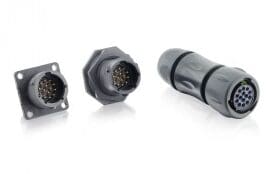
Souriau’s Trim Trio UTSX Series from Heilind Electronics can serve a wide variety of small industrial applications that require ruggedness, waterproof, space-saving performance.
Ruggedization is very important for this type of equipment. IP rated and sealed construction are essential to protect the connection from industrial environments, which can include moisture, debris, and vibration, and may operate outdoors. Anderson Power’s SBSXPRO 3 Power/8 Signal sealed connectors were specifically designed for outdoor operating conditions. This rugged connector has positive metal latches to safeguard against accidental disconnects, while its IP68 rating provides protection from water.
As industrial automation continues to expand, the connectors in some of these systems must also support the integration of advanced sensors and embedded controllers. Current, temperature, and position sensors feed data to onboard control units that manage torque output, protect the motor from overload, and optimize battery usage. This data also supports predictive maintenance, reducing unplanned downtime. Some equipment also integrates telematics, GPS, and IoT connectivity.
Batteries and controls
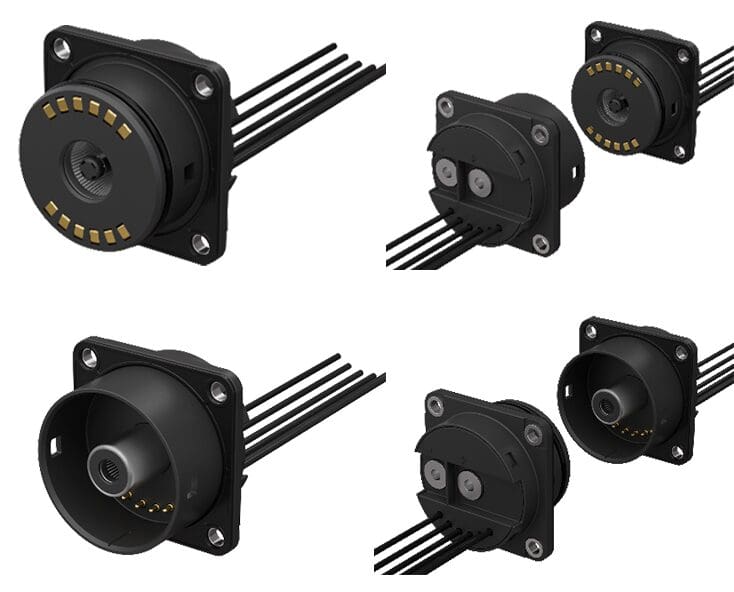
Amphenol Communication Systems’ DuraSwap Concentric docking connector with cable assemblies are offered in 2 power & 6 signal configurations. These connectors can carry a continuous current up to 100A with 10,000 mating cycles. They are IP67-rated in mated condition.
Amphenol’s DuraSwap connector is designed for swappable battery packs and products that dock to recharge. This includes drones and robotics as well as warehouse equipment. The connector features specific mating features that make it easier for automated machinery to return to the dock and initiate a recharge without human intervention, such as guide pins to help settle the battery into mating position and a concentric or reversible face design that enables the battery to recharge regardless of which side is facing up.
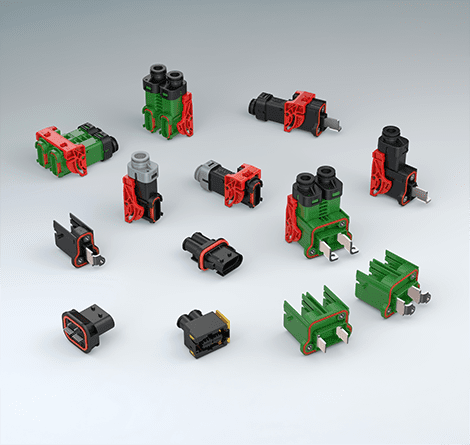
TE’s Halvonox series also addresses robust, high-current/low-voltage harsh environment applications. These connectors are designed for up to 100V applications up to 400 amps, including off-highway machines, forklifts, and industrial equipment. They feature clamping and sealing systems to ensure a reliable connection in high-vibration industrial environments. This connector comes in two variations: HALVONEX Max Connector is for currents up to 400A, and is ideal for EV batteries, eFans, chassis power, and compressors. The HALVONEX Pro connector is for moderate current up to 78A and is suitable for auxiliary circuits and subsystems such as HVAC, electro-hydraulic power steering, fuse boxes, heaters, chillers, and cabin electronics.
To learn more about the companies mentioned in this article, visit the Preferred Supplier pages for Amphenol Communications Solutions, Anderson Power, Heilind, and TE Connectivity.
Like this article? Check out our other Circular Connectors and Standards articles, our Industrial Market Page, and our 2024 and 2025 Article Archives.
Subscribe to our weekly e-newsletters, follow us on LinkedIn, Twitter, and Facebook, and check out our eBook archives for more applicable, expert-informed connectivity content.

- Connectivity Is Reshaping Police and Security Vehicle Fleets - September 8, 2026
- Thermal Management Strategies with Liquid Cooling Connectors - August 11, 2026
- Rodent-Resistant Electronics - July 28, 2026