Robots at the Limit: How Intelligent Connectors Enable Industrial and Medical Applications
Robots and automated installations play a key role in industry by performing a variety of tasks that require precision, speed, and endurance. Their main tasks include automating manufacturing processes such as welding, painting, and assembly, increasing efficiency by working faster and error-free, and increasing occupational safety as they can perform dangerous or repetitive tasks. Automated Guided Vehicles (AGVs) and Autonomous Mobile Robots (AMRs), which are now among the most important pillars of automation in modern industries, also play a central role in this context.
Article Contributed by: Tobias Günthner, Product Manager, ODU
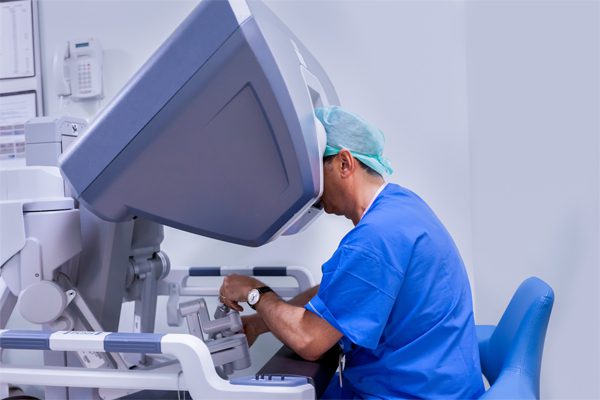
Thanks to the increasing improvement in sensor and control engineering, these technical marvels can also handle extremely delicate and challenging tasks that quickly push people to their physical limits. As a result, they have also been an integral part of critical tasks such as performing surgeries.
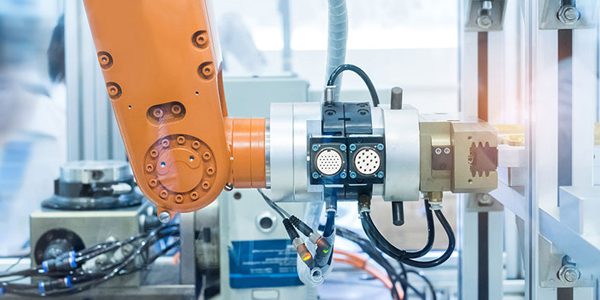
However, as the range of these applications grows, so does the complexity of the technical architecture behind each robot system. In particular, the interaction between mechanical, electrical, and data-carrying components necessitates an infrastructure that meets the increasing requirements for dynamics, precision, and reliability. It is precisely at the interfaces, where energy, signals, or data are transmitted at high speed and tools are changed, that the performance of a robot and how flexibly it can be integrated into different processes is ultimately decided. Accordingly, the selection and design of suitable connection solutions is increasingly coming into focus, as they play a fundamental role in the reliability and durability of modern robotic systems.
Connector solutions in robot systems must meet basic technical requirements:
- Mechanical load capacity. Resistance to vibrations, shocks, and high mating cycles.
- Electrical and data-related performance. Reliable transmission of power, signals, and high-speed data; low latency; high EMC immunity.
- Modularity and flexibility. Configurable interfaces for different media and variable robotic tasks.
- Space and integration requirements. Compact styles for tight installation spaces; seamless integration into existing system architectures.
- Environmental and standard requirements. Protection against industrial pollution (e.g., dust, oil, temperature) or, depending on the applications, compliance with regulatory requirements such as sterilizability or hygiene requirements.
The specific operating conditions differ significantly depending on the industry, for example, the harsh, often dirty industrial environment compared to the highly sterile operating theater. These different framework conditions require customized connection solutions that are optimally adapted to the respective mechanical, electrical, and hygienic challenges.
Industrial robot systems designed for high dynamics
Industrial robots work in environments that are mechanically demanding, often contaminated, and characterized by high cycle rates. The connection technologies used must therefore do far more than just provide reliable signal or energy transmission. They are a central function module for automation.
Typical tasks of industrial robot systems
| TASK | EXAMPLE | RELEVANT REQUIREMENTS FOR CONNECTION SOLUTIONS |
| Tool and gripper change | Automatic changeover between welding torch, milling cutter, or gripper | High mating cycles, robust docking interfaces, precise independent guiding and locking |
| Assembly and handling | Pick-and-place in electronics production and automatic docking of autonomous robots at charging stations | Safe signal and power transmission despite vibration, compact interfaces, stability and tolerance compensation |
| Welding / machining | Robot welding in car body construction | Resistance to heat, particles, EMC, stable high-current/data interfaces |
| Quality testing / sensors | Inline inspection with 3D cameras | High-resolution data rates (image, force sensors), low latency |
In addition to reliable transmission of the required medium, this environment requires a flexible, low-maintenance, and durable connection system. The continuous operation of the installations leads to an extremely high number of docking processes, which quickly pushes the reliability and durability of conventional connection solutions to their limits. ODU’s Silver-Line is a modular system that has been designed precisely for these requirements. With its special design and an innovative quick-change head system, the Silver-Line achieves an extremely long service life. Depending on the configuration 10,000 to 10 million mating cycles can be realized. The robust and contact-safe industrial connectors can be fitted with different contact inserts depending on the application.
- Low downtimes thanks to an extremely long service life of up to 10 million mating cycles.
- Flexible integration thanks to a modular design, signals, data, power, or media can be freely combined.
- Fail-safe is ensured by means of a metal housing, high IP protection classes, and vibration-resistant contact technology.
- Error-free docking supports the system thanks to floating support with tolerance compensation.
To make integration as easy as possible, the system solution is offered including a suitable cable assembly. While the focus in industrial applications is primarily on dynamics, robustness, and durability, the priorities in medical robotics are shifting significantly. Even stricter requirements apply in the operating theater—both in terms of data integrity and hygiene and safety standards. technology leads directly to the next use case.
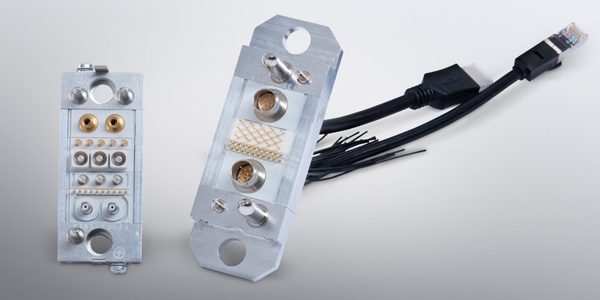
The ODU-MAC Silver-Line offers a durable connection solution that allows automatic docking and thus enables loading processes of AGVs or tool changes. This minimizes set-up and downtimes – perfect for maximum efficiency.
Medical technology robot systems: precision, automation, and integration
Medical robotic systems, such as those used in minimally invasive surgery, operate under highly sensitive conditions: a sterile operating environment, limited installation space, and zero-tolerance for errors. The connection technology plays a key role here, as image, sensor, and control data must be transmitted in real time, without interference, and fail-safe.
The special challenges: They must ensure maximum data integrity, as HD/4K image data, 3D signals, and the finest sensor data must be transmitted without packet loss and with minimal latency. At the same time, miniaturized robot joints require compact, easy-to-integrate connection technologies that enable high freedom of movement and rotation radii. All components must also allow for easy cleaning and disinfection, some of which are subject to strict requirements. Added to this is EMC safety, as numerous medical technology devices generate potential interference fields in the operating room. Despite their sensitive tasks, the connectors must also be mechanically robust to reliably withstand vibrations, movements, and other physical loads.
ODU’s fiber optic connection solutions with Expanded Beam Performance technology meet these requirements. Instead of a point glass fiber connection, the system enlarges the beam cross-section, which means that soil, dust, or slight deviations in alignment have no noticeable effect on the signal quality. The principle is based on expanded beam technology, but has been further developed and impresses with excellent loss levels and an extremely high fiber density, making it ideal for demanding systems with high data volumes and real-time transmission in a confined installation space.
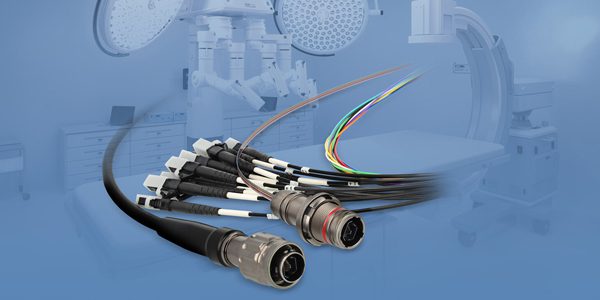
State-of-the-art fiber optic solutions such as Expanded Beam Performance provide the perfect basis for robotic systems in the operating room.
Integrated into the appropriate connector series such as the MEDI-SNAP or AMC from ODU, the system delivers key benefits:
- Higher system stability with dynamics and movement
Stable data rates despite vibrations and light contamination enable more precise, faster robot movements without the risk of failure.
- Optimum image and control quality
The very low attenuation ensures clear image and sensor data, a noticeable performance advantage for demanding procedures.
- Less maintenance, higher availability
The insensitive contact area reduces cleaning and service work and thus increases the running time and service life of the systems.
- Compact design for agile robotics
The small, robust style facilitates integration into tight joints and enables slimmer, more agile system architectures.
- Safe communication despite EMC exposure
Optical transmission remains interference-free and gives manufacturers additional planning security in the complex OR environment.
These features make expanded beam performance a key solution for modern robotic surgical systems, where freedom from error means not only efficiency but also patient safety.
Whether in harsh industrial environments or in highly sensitive operating theaters, robot systems place the highest demands on their connection technology. Modular, extremely robust solutions ensure reliable tool changes and maximum system availability, while innovative fiber optics in medical systems enable precise, interference-free data rates. The right interface increases the performance of the entire robot system, making it an indispensable factor in the success of mechatronics technicians and robotics.
Visit ODU to learn more.
This article will be featured in our upcoming eBook, Advanced Connectivity: Automation, Robotics, AI, and Machine Learning. Look for it this fall on Connector Supplier.
Like this article? Check out our other Automation and Robotics articles, our Medical Market Page, and 2026 Article Archive.
Subscribe to our weekly e-newsletters, follow us on LinkedIn, Twitter, and Facebook, and check out our eBook archives for more applicable, expert-informed connectivity content.

- Robots at the Limit: How Intelligent Connectors Enable Industrial and Medical Applications - September 15, 2026
- Designed to Survive: The Critical Role of Connectors in Harsh Environments - September 8, 2026
- Protecting Every Connection: Securing the Critical “Doors” of Solar Inverters - September 1, 2026