Connector Selection Should Be More Than an Afterthought
Engineers frequently devote significant attention to processors, sensors, and software from the outset of a project, with connector selection sidelined until the later stages. However, the importance of electrical connectors cannot be underestimated: a single compromised connection can interrupt power delivery, corrupt data transmission, or bring equipment to a standstill.
Article Contributed By Thisen Bird – Associate Product Manager, Bulgin
Connector selection is heavily influenced by environmental conditions, such as exposure to dust, moisture, condensation, and cleaning chemicals. Appropriate ingress protection plays a major role in maintaining excellent long-term performance. Choosing the right connector therefore requires careful consideration of not just the electrical specifications, but also the conditions a connection will encounter throughout its service life. It is vital that every connection is optimally suited to its operating environment; some systems function in clean, controlled indoor settings, while others must withstand harsh external influences such as dust, rain, and high humidity. The level of environmental protection required can vary significantly depending on the application, and understanding the differences between sealed electrical connectors and their unsealed counterparts ensures that performance, reliability, and cost efficiency are maximized.
The risk to electrical connections is not always obvious
Connector failures tend to develop gradually as environmental contaminants seep into the electrical contacts over time, rather than being a sudden occurrence. Moisture is a common cause of failure, leading to corrosion that damages conductive surfaces and increases electrical resistance. Another common issue is dust or other airborne particles accumulating within the connection interfaces, affecting contact integrity and signal transmission. But outdoor installations are not the only systems at risk of compromise. Electrical connectors in manufacturing facilities may be exposed to oils, cleaning agents and fine particulates as part of normal operations, and temperature changes can create condensation even in enclosed equipment, exposing connectors to moisture without any direct contact with rain or washdown procedures.
In the long term, build-up of contaminants can cause connections to become increasingly unreliable; systems may develop intermittent faults that are difficult to diagnose and resolve, functioning normally one day and displaying unexplained errors the next. Overcoming this challenge begins with careful selection of the right connector for the application and operating environment.
Protecting connections against contaminants
Connectors intended for use in harsh conditions are specifically designed to incorporate sealing features that create a barrier between electrical contacts and the surrounding environment, minimizing the likelihood of ingress of moisture, dust, and debris into critical areas where they could affect functionality.
Sealed connectors employ a variety of mechanisms to protect vulnerable interfaces, including elastomeric seals that compress between mating surfaces to create a barrier against moisture and dust, O-rings to provide consistent sealing around circular interfaces, and gaskets to maintain protection between the connector body and the enclosure in panel-mounted designs. But it’s not just the mating interface that is vulnerable to the elements; the use of molded cable entries, where the cable and connector body are bonded together to eliminate potential ingress at the termination point, can also be advantageous.
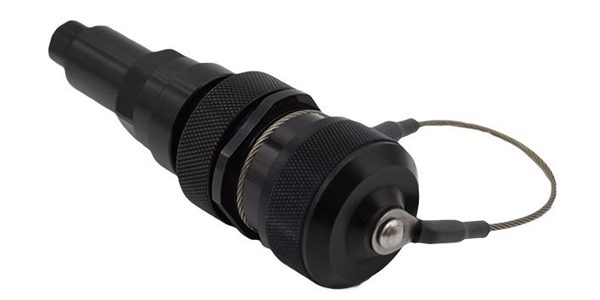
Bulgin Black Anodized Transversely Sealed Aluminium Inline Plug Ethernet Connector with protective dust cap and IP68 sealing
Ingress Protection (IP) ratings provide a useful indication of how effectively a connector resists dust and water, providing a clear framework for engineers to identify the correct level of protection for specific operating conditions. The higher the rating, the greater the level of protection against specified forms of ingress. For example, ratings such as IP67, IP68, and IP69K are commonly associated with products designed for demanding conditions.
IP ratings comprise two numbers – for example, IP66 – where the first number refers to protection against solid particles, the second to liquid ingress defined as follows:
| SOLID PARTICLE PROTECTION | |
| 0 | No special protection |
| 1 | Protection from large body parts and solids bigger than 50 mm in diameter |
| 2 | Protection from fingers or solids up to 80 mm long and 12 mm in diameter |
| 3 | Protection from tools, wires or objects larger than 2.5 mm in diameter |
| 4 | Protection against 1 mm wide solid objects, such as wires, nails, screws, larger insects or other items |
| 5 | Protection from water jets when water is projected by a 6.3 mm nozzle onto the enclosure from any direction |
| 6 | Full resistance to dust and other small particulates |
| LIQUID INGRESS PROTECTION | |
| 0 | No protection |
| 1 | Protection against dripping water onto item when mounted upright on a turntable and rotated at 1 rep per minute |
| 2 | Protection against vertically dripping water when the item is tilted at 15° from its normal position |
| 3 | Protection against water spray at any angle up to 60° from vertical, whether that spray is oscillating or has a counterbalanced shield |
| 4 | Protection against splashing water from any direction, from an oscillating fixture or one with a spray nozzle with no shield |
| 5 | Protection from water jets when water is projected by a 6.3 mm nozzle onto the enclosure from any direction |
| 6 | Protection from powerful water jets, i.e., with a 12.5 mm nozzle, projecting water from any direction |
| 6K | Protection from powerful water jets with increased pressure using a 6.3 mm nozzle, projecting water from any direction or elevated pressure |
| 7 | Protection from ingress of water in an immersion of up to 1 m depth |
| 8 | Protection from ingress of water when immersed depths are higher than 1 m of water |
| 9K | Protection from powerful high temperature water jets, at close range and at high temperatures |
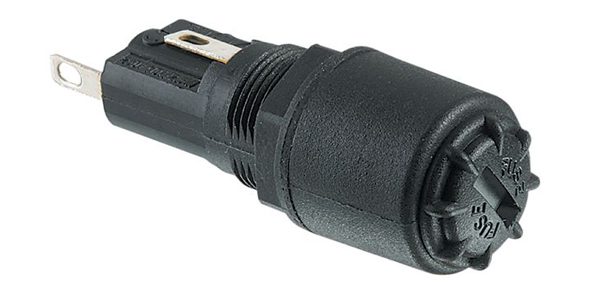
Bulgin FX0463 Fuseholder Protection Category PC2 IP68 Sealed Panel Mount Connector with Screwdriver/Hand Release
Finding the right balance of features and benefits
It can be tempting to simply choose the connector with the highest level of protection, but this is not necessarily the best way forward. Sealed connectors offer clear advantages in exposed locations, but the inclusion of additional sealing features also increases complexity, size, and cost. For applications where contamination from the elements is unlikely, sealed connectors may not offer any practical benefit; unsealed connectors may provide a more economical solution without sacrificing functionality. Selecting the appropriate connector type ensures that systems are neither under-protected nor over-engineered.
Typical sealed connectors applications:
- Renewable energy installations
- Transportation infrastructure
- Industrial automation systems
- Marine and offshore equipment
- Outdoor telecommunications
Typical unsealed connectors applications:
- Indoor electronics assemblies
- Laboratory instrumentation in environments where exposure to contaminants or chemicals is minimal
- Indoor enclosed control panels
- Office-based equipment
- Consumer devices used in dry environments
A realistic assessment delivers an informed choice of connector
The correct choice of connector is highly dependent on the application and the working environment; the most successful connector selections begin with a realistic assessment of risk. Environmental exposure, maintenance requirements and expected service life all influence which solution is most appropriate, making a structured assessment a sensible approach to determining whether sealed connectors are necessary. The assessment should consider:
- Exposure to weather – rain, snow and prolonged sunlight can all affect connector performance, particularly in outdoor installations.
- Cleaning requirements – equipment used in industrial facilities, food processing plants and laboratories is often subjected to regular washdowns, increasing the need for protection against moisture ingress.
- Dust and airborne debris – manufacturing environments, construction sites, and transportation infrastructure can expose connectors to contaminants that may enter unprotected interfaces over time.
- Accessibility – connectors installed in difficult-to-reach locations can be costly and time consuming to inspect or replace. Additional protection may help to reduce maintenance requirements and downtime.
Careful consideration of all these factors helps to ensure that the selected connector is appropriately matched to the application, without adding unnecessary complexity or cost. In short, sealed connectors provide valuable protection in situations where water, dust, or other contaminants could threaten electrical integrity. Unsealed connectors offer simplicity and cost efficiency in controlled and predictable conditions. Establishing a clear understanding of the demands that will be placed on the connections is vital to making informed decisions that avoid unnecessary complexity and enable dependable operation throughout the system’s lifetime.
Visit Bulgin to learn more about harsh environment solutions.
Like this article? Check out our other Harsh Environments articles, our Industrial Market Page, and our 2026 Article Archives.
Subscribe to our weekly e-newsletters, follow us on LinkedIn, Twitter, and Facebook, and check out our eBook archives for more applicable, expert-informed connectivity content.

- Connector Selection Should Be More Than an Afterthought - November 3, 2026
- CASE STUDY: Development of a RoHS-Compliant Ultra-High-Strength Copper-Based Alloy - October 27, 2026
- The Challenges of Electric Flight: How Engineers Are Rethinking Power - October 20, 2026