Ceramics in Space: BME X7R MLCC
Dielectric multilayer ceramic capacitors are used in payload systems and satellite launchers, as well as for many internal cockpit displays.
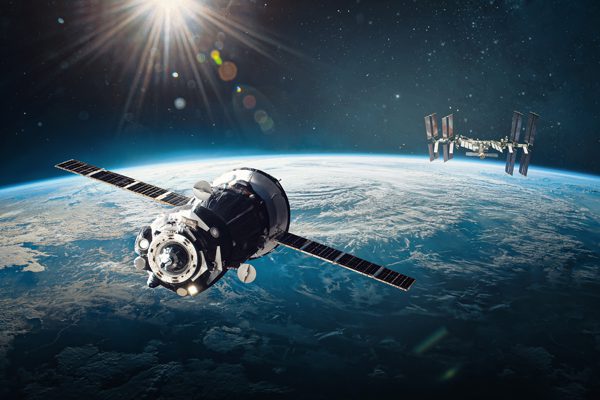
In 2015, AVX Corporation, now KYOCERA AVX, became the first company to be recognized as a qualified supplier of space-level base metal electrode (BME) X7R dielectric multilayer ceramic capacitors (MLCCs) for use in aerospace designs under the European Space Agency 3009041. Subsequently, within two years, it was approved under NASA’s S-311-P-838 and then under the U.S. MIL-Prf-32535 specifications. These specifications define the requirements for the use of these capacitors in high-reliability space applications, including I/O filtering and bulk storage in the switch mode power supplies (SMPS) in space and satellite communications and launchers, military defense and weapons systems, and radar systems, as well as the processing verification and inspections required by assemblies used in flight.
KYOCERA AVX remains the only qualified supplier of space-level BME X7R MLCCs for all three of the major authorities: NASA, ESCC and DLA.
Connector Supplier spoke with Michael Conway, Senior Product Marketing Manager-High Reliability Products, at KYOCERA AVX (KAVX).
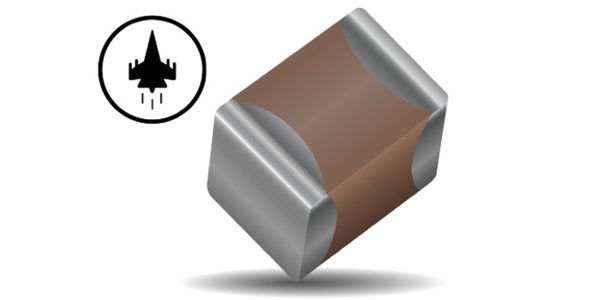
Space-level BME X7R MLCC from KYOCERA AVX
In simple terms, what are MLCCs?
MLCCs are made up of ceramic layers which have a conductive electrode layer in-between. The layers are interleaved and, when a voltage is applied, one layer will be charged with a positive charge and the other with a negative charge, like a battery. It is this energy that is stored in between these multiple layers that helps control many of the electrical circuits that help power our lives. The most important characteristic of reliability in this type of capacitor is that the layers do not break down, which prevents failure during their lifetime.
The market’s demand for more capacitance in a smaller footprint while maintaining the MIL/space-level specs is constant, but the DLA requested that manufacturers offer a solution to fulfill the market demand by using mini stacks rather than more MLCCs on the PCB. Before the first qualification, the DLA put together a specification that would meet customer requirements and that KAVX could supply. Working with the DLA over the last year, KAVX successfully completed the initial qualification of the two chip X7R BME 2220 stacks, and more recently to include a three chip stack to the controlled drawing DSCC 25007, which took the testing and the sampling from MIL-Prf-M32535 and MIL-Prf-M49470 specifications. The DSCC stacks reduce the PCB area and, in comparison to the older MIL-Prf-M49470, make further savings on the PCB area and weight as well.
How are MLCCs used in satellites and launch vehicles?
MLCCs are used in a variety of functions from the payload systems to the satellite launchers and many internal cockpit displays. They control the actuators/motors on a rocket fin or regulate the voltage supplies to various electronic equipment.
What makes base metal electrode (BME) capacitors a significant improvement over the existing precious metal electrode (PME) capacitors?
By using BME MIL-spec MLCC capacitors rather than the existing PME MIL-spec MLCC capacitors, the max capacitance typically increases (from 0.47 to 22 µF). The benefits of higher capacitance include an increase in the amount of electrical charge that can be stored at a given voltage, to keep the supply voltage steady during sudden power demand spikes and improve noise filtering.
In addition, the same capacitance can be achieved in a smaller case size, downsizing from a CDR33 (1210) 50 volt 100 nF to M3253503 (0603) 50 volt 100 nF, while still maintaining the required traceability and reliability with a tin-lead termination finish. Some cost savings come from less weight, but a more recent trend in space and MIL-type applications is that PCB areas are getting smaller. Having a higher capacitance/voltage-type technology allows customers to achieve their desired design goals by delivering more capacitance per unit of PCB area.
What role does the FLEXITERM termination play? What are the mechanical stresses to protect against?
FLEXITERM is conductive polymer with a high concentration of silver on the ends of the capacitor underneath the tin-lead termination. This allows the termination to flex under movement, giving added protection to the ceramic capacitor when the PCB is being assembled and during its lifetime. It also relieves the capacitor from thermomechanical stresses during varying temperature environments, which is of more importance for larger capacitor case sizes giving the customer more confidence and protection when using those larger sizes and larger capacitance values.
KAVX used FLEXITERM technology as standard on its newer space and MIL ranges to avoid the industry-wide issues of cracking and failures that occur at a low persistent level from thermal stresses and board flex when using lower-level products. FLEXITERM is the best reliability solution to eliminate these problems and meet customers’ needs.
Who are your main customers? On what missions or platforms have these capacitors have been used?
KAVX supplies a wide range of top space and military customers worldwide — Raytheon, Honeywell, Boeing, Moog, AIRBUS, Thales Alenia, and ISRO to name a few.
Our best and most recent example was the Artemis II mission. Working with our customers, KAVX supplied parts that went into the multipurpose crew vehicle and its life support system for the Orion space craft. Seeing the successful mission and watching the astronauts and the life support system functioning in space is as good a testament as you can get for use of these products.
What trends in space-level capacitor technology are you seeing now? What challenges are you faced with or working to overcome?
In the market, we continue to see more capacitance in smaller footprint volumes while maintaining the same space/MIL level reliability. KAVX is continuing to develop the new ranges and products to meet these challenges.
What would you want engineers who are new to this topic to understand about this technology and what it means to qualify components for space?
The main points we would like engineers to take away from KAVX’s space-level BME MIL-Prf-M32535, DSCC 25007, NASA G311P838, and ESCC 3009041 range is the potential PCB area and weight savings that they can make while increasing the functionality of their design with the higher capacitance most notably at 50 and 100 volts. Whether it is for a space or military design, there is potential to be gained by using any of KAVX’s space BME ranges while maintaining full traceability with tin-lead termination finish and MIL/space reliability testing.
Visit the Preferred Supplier page for KYOCERA AVX to learn more about the company and its products.
Like this article? Check out our Military and Aerospace Market Page and our 2026 Article Archives.
Subscribe to our weekly e-newsletters, follow us on LinkedIn, Twitter, and Facebook, and check out our eBook archives for more applicable, expert-informed connectivity content.

- Ceramics in Space: BME X7R MLCC - October 20, 2026
- Test & Measurement Product Roundup - October 20, 2026
- Advanced Connectivity-Automation, Robotics, AI, and Machine Learning - October 20, 2026