The Power of Having Options
The input/output panel of AI equipment is a prime example of how evolving demands have spawned the introduction of alternative solutions that address bandwidth demand, signal density, field serviceability, energy efficiency, thermal management, and utilization of both copper and fiber optic options.
Most people would agree that having multiple choices to solve a problem is preferable to being locked into one solution. This is especially true of design engineers who face requirements of high-speed performance, channel reach, circuit density, power consumption, manufacturability, multiple sourcing, and of course, cost.
The electronic component industry has responded by developing a spectrum of interconnects that offer alternatives allowing a designer to closely match the requirements of a specific application. The rise of open standards reflects industry demand for components and connectivity protocols that ensure electrical and mechanical compatibility as well as several competitive sources.
The input/output panel of AI equipment is a prime example of how evolving demands have spawned introduction of alternative solutions that address bandwidth demand, signal density, field serviceability, energy efficiency, thermal management, and utilization of both copper and fiber optic options.
The recent explosion of AI has created a variety of I/O interconnects that satisfy the requirements of the application at the lowest possible cost. For example, designers of copper and fiber optic cable assemblies have many choices.
Traditional passive copper cable assemblies (also known as direct attach cables or DACs) are available in the form of standard round jacket assemblies, with options of parallel or twisted pair configurations. Multiple variations of shielding improve performance by providing isolation from signal-distorting electromagnetic interference.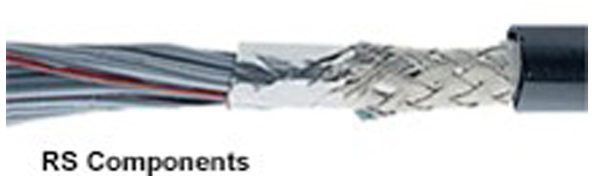
Copper cables are a thoroughly familiar, reliable, and lower-cost medium with extensive manufacturing resources available worldwide. As data transmission speeds continue to increase, attenuation and signal distortion begin to limit the length of copper conductors, spurring the search for alternatives.
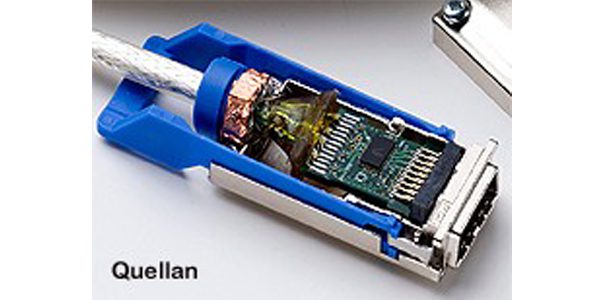
In order to compensate for the loss characteristics of copper cables at high-speed, enhanced copper cables have been introduced, including Active Copper Cables (ACC), which feature integrated signal conditioning electronic devices such as equalizers, amplifiers, or retimers located in the connector body.
The broader term, Active Electrical Cables (AEC) may add digital signal processors that enable use in higher speed/longer reach applications.
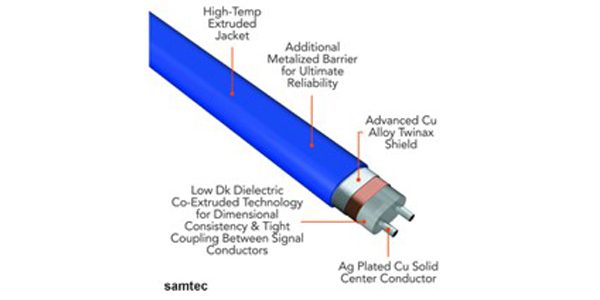
Flat or round conductor twinaxial differential pair cables offer impedance matching and are extremely flexible and space efficient. High-speed losses are significantly lower than signals sent through copper traces on a PCB, making them an attractive option for links between board mounted high-performance devices and the I/O panel. Flat differential pair cables are also available in woven and flat foil conductor configurations.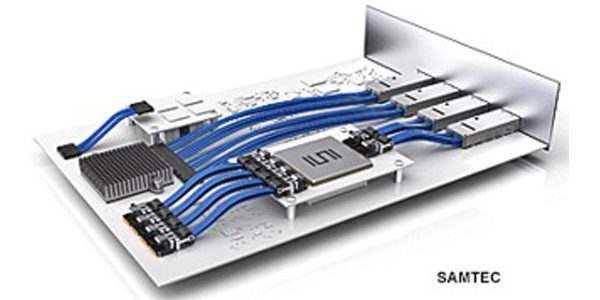
Small gauge flat differential cables can “fly” over the surface pf the PCB minimizing loss and distortion.
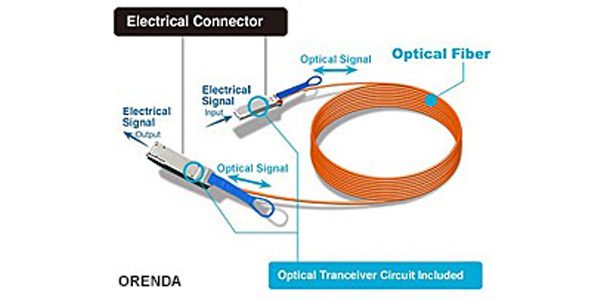
When the need to extend the length of a cable beyond the defined limits of an industry standardized interface becomes necessary, the use of Active Optical Cables (AOCs) can be a lifesaver. The specified electrical connector is modified to include components that convert the electrical signals to optical pulses which are coupled to the attached optical cable. A reverse optical-to-electrical conversion is performed at the far end of the cable.
Addressing the constraints of copper circuits is not limited to cable assemblies. Transmission of high-speed signals from a printed circuit board mounted ASIC or switch to an I/O front panel presents challenges of power consumption, signal fidelity, and I/O panel density. Traditionally, a socketed PCB device would be terminated to copper traces embedded in a PCB. These circuits terminate to a one- or two-piece I/O connector mounted on the edge of the board.
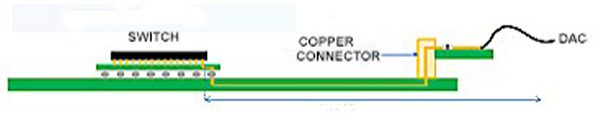
As signal speeds increased, the energy required to push these signals over several inches of copper trace and signal distortion between the switch and the edge of the PCB resulted in excessive signal loss and latency, which drove the development of alternative architectures and ultimately replaced PCB traces with fiber optic links.
Today, at least three variations of methods bring high-speed signals from the ASIC to the front I/O panel.
Near Package Copper (NPC) architecture mounts a small PCB connector on the motherboard immediately adjacent to the GPU or switch substrate. The length of the circuit conducted in copper extends only from the substrate, through a very short PCB length to the connector that links to twinaxial copper cables that “fly “over the surface of the PCB to the I/O panel and mates with an external high-performance copper cable. The result is reduced power demand and less signal degradation and latency.
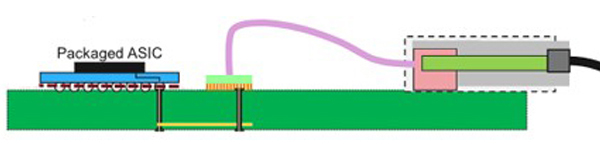
In order to increase the reach of external cables and add design flexibility, a popular variation of NPO involves the use of pluggable optical transceivers that convert electrical to optical signals.
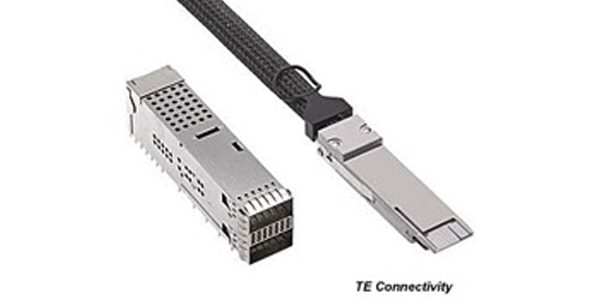
Small form factor pluggable (SFP) transceivers were developed to mate with front-panel- mounted cage assemblies enabling the choice of either copper or fiber optic external cables. Pluggable transceivers including current QSFP and OSFP models have continued to evolve in terms of bandwidth and signal density, becoming a basic workhorse of the industry.
A variation of this is Near Package Optics (NPO) that further reduces the length of the copper electrical path by mounting an optical engine immediately adjacent to the switch chip which converts the electrical signals to optical signals. Optical fiber extends over the PCB to the I/O panel to mate with high-density optical connectors.
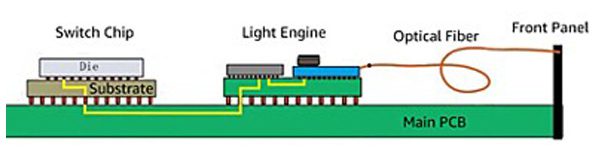
In an effort to reduce the power consumed by these transceivers, linear pluggable optics (LPO) have been introduced that eliminate the digital signal processor (DSP) and/or the retimer from one or both sides of the circuit.
Co-packaged Optics (CPO) go one step further by mounting the optical engine directly on the same substrate as the active device reducing copper signal path to a minimum. Pluggable optical fiber connectors on the I/O panel provide high performance and high-density interconnect.
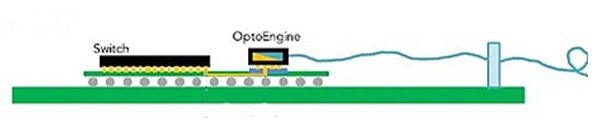
The optical engine may be soldered directly on the substrate or socketed. The new Open CPX MSA offers options by standardizing interoperable optical engines, pluggable sockets, and connectors.
Future generations of CPO will integrate the optical engine into the ASIC or switch package,likely using chip stacking technology. Optical fiber will mate directly to the chip, eliminating all signal degradation due to copper losses.
As system speeds push into the multiple terabit range, I/O requirements continue to grow. Only about 32 OSFP transceivers can physically fit on a standard 1OU front panel delivering a maximum of 51.2 Tb/s. To address this problem the XPO module was recently introduced to convert near or co-packaged copper signals from a switch or ASIC to high-density external optical connectors at the front panel. Each XPO module provides 64 differential pairs each running at 224 Gb PAM4 to deliver 12.8 Tb per module while consuming only 80 watts of power.
A fully configured front panel with 16 XPO modules can deliver a total of 204.8 terabits of switching throughput per 1OU front panel. Linear versions will also be offered.
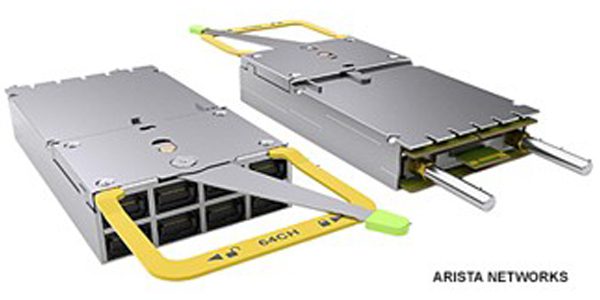
Multiple connector suppliers have committed to offering this transceiver.
Open CPX is another example of how component suppliers are responding to industry demands for choices in supporting next generation high-speed architectures.
Near package and co-packaged optics are seen as essential technologies in addressing the challenges of increasing bandwidth, reduced power, and high-density packaging.
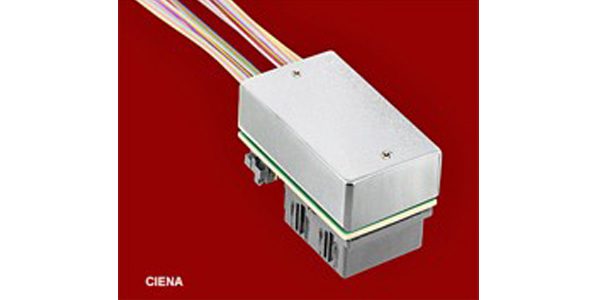
The objective of the Open CPX MSA is to create common mechanical, electrical, optical, thermal, and management specifications for pluggable modules and sockets to enable interoperability among multiple vendors. CPX compliant sockets will accept both CPO and NPO modules which can be mounted on either the substrate or the PCB for greater design flexibility. The Open CPX roadmap provides a path to 12.8 Tb performance
Even the choices of optical fiber are being expanded. In addition to traditional multimode and single mode fiber, new fiber types and constructions are becoming available including:
- Bend insensitive fiber – reduced loss from tight bends
- Large effective area fiber – designed for coherent transmission which is gaining popularity
- Ultra-low-loss silica fiber – extends reach without amplification
- Polarization-maintaining fiber – provides increased optical signal stability
- Radiation-hardened fiber – military and nuclear reactor applications
- Hollow core fiber – reduced latency and attenuation
- Multicore fiber – increased signal density
Having many options is not without challenges. For example, the performance of shielded twinaxial cables can vary significantly among manufacturers. NPO/NPC architecture is currently supported by a limited number of standards, with aspects of implementation being addressed by organizations including OIF, IEEE, as well as supporting MSAs. Additional standards are in the developmental process. Designing in linear pluggable optics is not necessarily a plug and play proposition. CPO is very early in its development stage with open questions about where the laser is best located, and device pluggability, as well as the critical issue of field serviceability. New interfaces may require specialized tooling or assembly processes that may require verification to ensure quality. Advanced optical fiber including hollow core and multicore fiber is difficult to terminate, has a limited supply base, and is costly.
Too many options can become confusing and bog down the design process, but having the ability to choose from multiple viable solutions is certainly better than being locked into a proprietary design or hardware.
Visit Bob Hult’s Connector Supplier archive for more high-speed coverage, his Tech Trends series, and reviews of industry events.
Like this article? Check out our other Artificial Intelligent articles, our Medical Market Page, and our 2026 Article Archive.
Subscribe to our weekly e-newsletters, follow us on LinkedIn, Twitter, and Facebook, and check out our eBook archives for more applicable, expert-informed connectivity content.

- The Power of Having Options - September 15, 2026
- XPO, Addressing the I/O Panel Bottleneck - June 30, 2026
- Agentic and Neuromorphic Computers Enable the Future of Digital Computing - May 26, 2026