Overmolded Cable Assemblies Ensure Optimal In-Flight Signal Integrity
Overmolded cable assemblies help ensure the integrity of mission-critical signal transmission in navigation, data, power, communication, and control systems. Learn how to specify this essential element of primary and secondary flight control designs.
Article contributed by Robert Grzib
Signal integrity, which measures the quality of an electrical signal, is inarguably the most critical factor to consider when engineering or specifying aviation cable assemblies. To ensure the integrity of mission-critical signal transmission pertaining to navigation, data, power, communication, and control, overmolded cable assemblies must comply with the Federal Aviation Administration (FAA).
Vital functions of signal integrity in overmolded aviation cable assemblies
Precision, real-time data, and signal transmission are fundamental to ensure the precise, reliable function of commercial and military aviation applications. These distinct cable assemblies comprise sensors and avionics vital flight control units. They are required to tolerate extreme temperature fluctuation, intense vibration, moisture, plus fuel vapors. Assemblies are further tasked to ensure electrical and electronic equipment neither generates nor is affected by electromagnetic disturbance from radar systems or nearby aircraft.
Overmolded aviation cable assemblies for military applications must comply with more stringent and robust standards than those specified for commercial aircraft designs. Highly specialized aviation assemblies are vital in fighter jets, transport planes, as well as surveillance drone designs. They are distinctively engineered to maintain signal integrity in combat zones where harsh weather, EMI jamming, tampering, extreme mechanical stress, plus shock from explosions are likely.
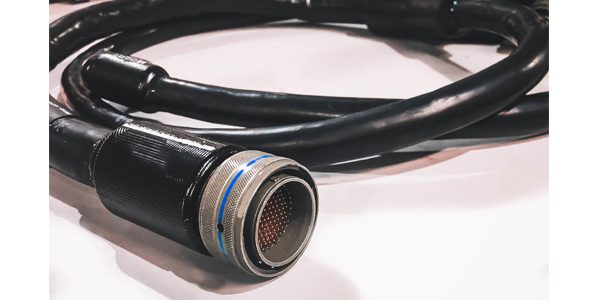
Overmolding creates an all-in-one solution for harsh environments in aerospace by encapsulating the cable-connector junction in a polymer body. CDM Inc.’s various overmolding capabilities serve numerous applications and environments.
Transmission signal integrity challenges
There are essentially three distinct factors that may compromise safe and efficient signal transmission in aviation cable, and thus aircraft safety: EMI (electromagnetic interference), EMS (electromagnetic susceptibility), together with EMC (electromagnetic capability). It is essential to address these in the design phase.
EMI pertains to electromagnetic interference or signals initiated from internal and external circuit components. Internal circuit components include clock lines along with switching regulators, whereas external sources encompass radio transmitters, proximate industrial equipment, or electrostatic emissions.
There are two fundamental categories of EMI. Radiated EMI is interference that travels through the air and impacts proximate devices. EMI refers to interference that travels along electrical conductors, which can impact devices on the same circuit. Additional types of EMI include differential, common mode, transient, continuous, harmonic, radio frequency interference (RFI), power line, and electrostatic discharge (ESD).
EMS relates to the susceptibility or immunity of electronic devices to external electromagnetic noise generated by an adjacent device or environment. Devices with low EMS are more vulnerable to disturbances, which may cause malfunctions or data errors. It is vital in environments with elevated levels of EMI.
EMC is a device’s capacity to function without interfering with other devices and is required for regulatory compliance. EMC testing evaluates devices’ capacity to minimize electromagnetic interference while resisting external EMI. EMC testing entails the evaluation of devices’ electromagnetic interference and susceptibility.
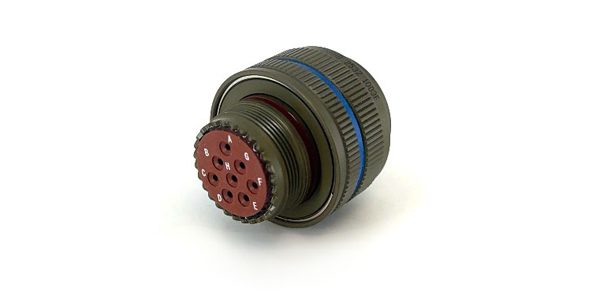
D38999 Series IV from CDM Inc. features retention and anti-decoupling capabilities. These features are increasingly viewed as fundamental performance metrics for aviation connectors.
MIL-spec components required for absolute signal performance
Multilayer EMI shielding is non-negotiable in overmolded aircraft/defense cable assembly designs as it blocks both external interference and internal signals from interfering with other electronic systems. Whereas commercial applications commonly employ multi-layer braided, aluminum foil, or combination shielding, military designs must perform regardless of proximate RF weapons, high power radar, and avionics systems. These components are required in an array of military and defense applications, including:
- Weapon systems
- Communications systems
- Shipboard/Naval cable
- Tactical equipment
- Military installation equipment
- Fixed-wing aircraft
- Helicopters
- C41SR
- Unmanned Aerial Vehicles (UAVs)
- Missiles and guided munitions
- Radar
- Ground vehicles
- Training and simulation
- Soldier systems
- Ground vehicles
- Satellite systems
- Soldier systems
Types of wires/cables mandatory for overmolded aircraft/defense cable assemblies:
– Coaxial cable (Mil-C-17)
– MIL-spec power cable (Mil-DTL-3432)
– MIL-spec wire (Mil-W-81044, Mil-W-16878, Mil-W-22759)
– Shipboard cable (Mil-C-24640, Mil-C-2463)
– Extreme environment wire/cable
Overmolding provides superior strain relief and mechanical robustness in high vibration aerospace applications as it creates a single, continuous transition from cable to connector to distribute stress while reducing concentrated loads at the termination. Moreover, it provides optimal environmental sealing plus ingress protection from moisture, dust, and chemicals, while sealing the transition between cable and connector. Conventional backshells and protective sleeves frequently fail over time.
Overmolding supports enhanced connector durability and longer life under repeated cycling as the molded polymer provides a durable, abrasion-resistant outer layer that withstands repeated mating/un-mating cycles while helping to minimize in-field maintenance. It augments environmental sealing and ingress protection as the process encapsulates the junction to enhance resistance to moisture, dust, and chemicals, together with temperature cycling. Overmolding also protects the vulnerable transition between cable and connector in applications where conventional backshells and protective sleeves often fail over time. Aircraft operating conditions with humidity/moisture exposure, hydraulic/oil splashes, fuel vapors, and frequently broad temperature ranges. A robust seal around the cable-connector interface helps resist water ingress as well as contamination that could degrade performance.
Future trends and advanced technologies
New materials and manufacturing technologies will unquestionably impact the future of connector technology. It is anticipated that AI-driven connector design and materials will optimize signal integrity by more than 20% within the next five years. The employment of advanced materials with exceptional electrical properties and embedded diagnostic capabilities, along with self-optimizing connector designs, will further enhance the integrity of overmolded cable assemblies.
Visit CDM to learn more about interconnect innovations for harsh environments.
Like this article? Check out our other Harsh Environment and Materials articles, our Military and Aerospace Market Page and our 2025 and 2026 Article Archives.
Subscribe to our weekly e-newsletters, follow us on LinkedIn, Twitter, and Facebook, and check out our eBook archives for more applicable, expert-informed connectivity content.

- Robots at the Limit: How Intelligent Connectors Enable Industrial and Medical Applications - September 15, 2026
- Designed to Survive: The Critical Role of Connectors in Harsh Environments - September 8, 2026
- Protecting Every Connection: Securing the Critical “Doors” of Solar Inverters - September 1, 2026