What are Touch Sensors?
Meet the Sensor: Touch Sensors
Touch sensors, also called tactile sensors, are part of a broad category of environmental sensors that are activated by touch. They are commonly used in consumer equipment (including touchscreens), medical devices, automotive controls, industrial equipment, and other interactive electronics. There are several types of touch sensors, but capacitive touch sensors and resistive touch sensors dominate this category today.
Capacitive touch sensors are activated by human touch or a conductive stylus. They are widely used devices ranging from device screens to appliance controls and have replaced the mechanical button in many applications. In capacitive touch surfaces, a layer of charge-storing material, such as ITO (indium tin oxide), copper, or printed ink, is layered between insulators, such as glass in touch screens or copper layered on a PCB. When a conductive material or object, such as a finger, touches the sensor surface, the sensor’s controller detects changes in the electrostatic field, which causes the electrical frequencies to fluctuate each of the oscillator circuits.
Resistive touch sensors are mechanically actuated. Placed between two conductive layers separated by an air gap, a pressing force closes the gap to make contact between the layers. This sensor type can be activated with a non-conductive object, including a point of contact activated by robotics. It is also more subject to mechanical wear than other touch sensors, due to the flexing of the top layer.
DigiKey’s video explains the difference between the two most commonly used touch sensor technologies.
Infrared or optical touch sensors respond to interruptions in light beams across a surface. Infrared emitters combined with infrared image sensors continuously scan the touchscreen. When an object comes into contact with the touchscreen, it blocks some of the infrared light being received by the sensors. The location of the contact is then mathematically calculated using information from the sensors and a corresponding action is activated.
Surface acoustic wave (SAW) touchscreens use ultrasonic waves to detect touch input on the screen’s surface. The screen is made of glass or another transparent material, with a thin layer of reflective material on the surface layer. The ultrasonic waves are generated by transducers located at the corners of the screen and sent across the surface of the glass. When a finger or other object touches the screen, it absorbs some of the ultrasonic waves, causing a disturbance in the wave pattern, which is detected by the transducers.
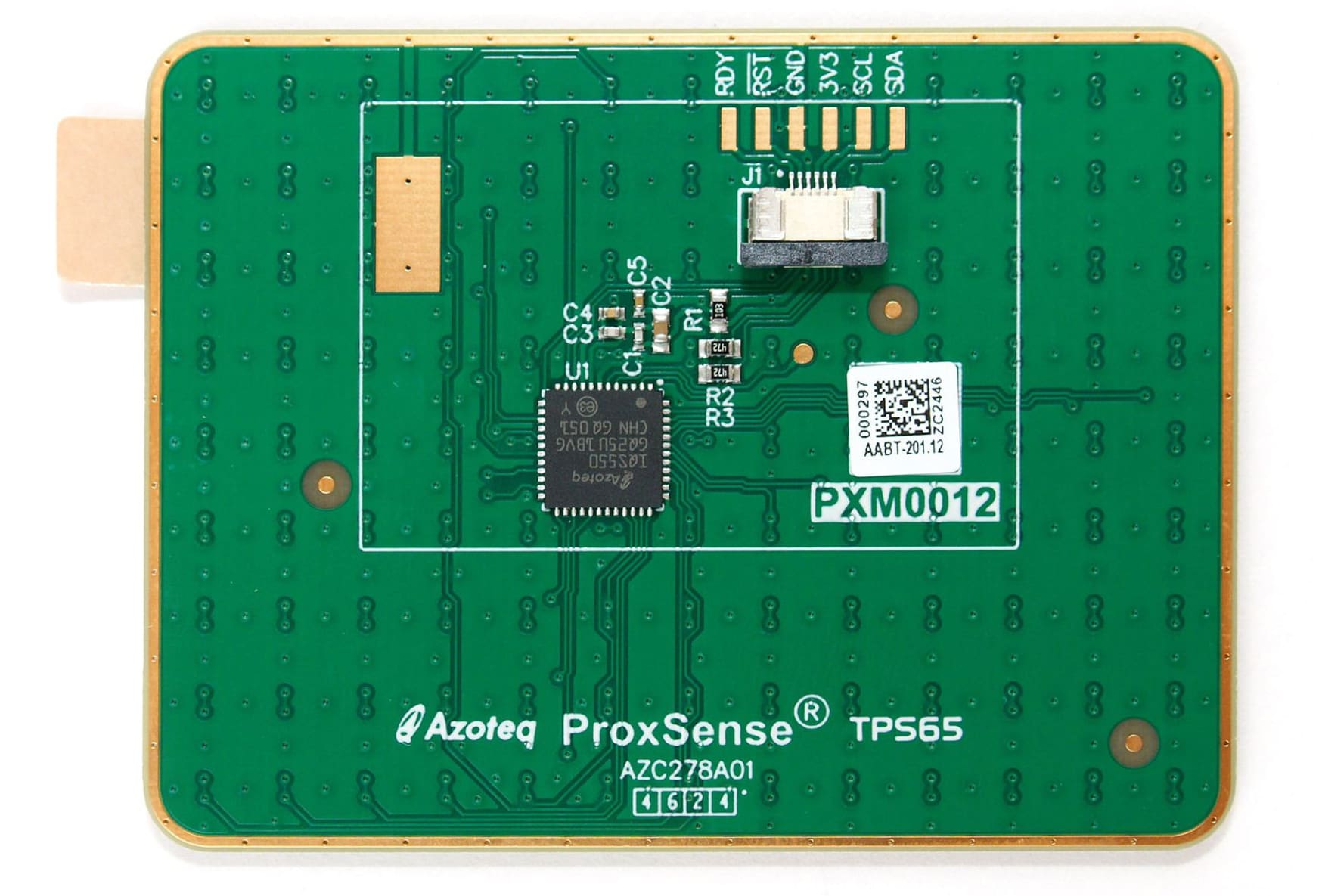
Touchscreen development
In 1965, Eric Arthur Johnson patented his concept for a capacitive touchscreen. His research originated with the UK National Air Defense; air control operators needed a solution that would accelerate response time and allow for more accurate decision making. Johnson’s design consisted of a glass-coated insulator with a transparent conductor made of indium tin oxide. Thin copper wires placed across a computer’s CRT allowed the circuits to sense when they were being touched. His idea was finally implemented for British air traffic controllers in the 1990s.
In the 1970s, Samuel G. Hurst invented the resistive touch sensor at the University of Kentucky. His research team called the device the Elograph. The invention of a curved glass screen interface a few years later led to the implementation of the sensor in a screen technology. Hurst’s invention ultimately became the center of the company Elographics, in business today.
Design Notes
Connectorization
Touch sensors are typically connectorized via flexible cables that bring signals from the sensor’s electrodes to a controller or microprocessor. The method and material depends on the sensor type (capacitive or resistive) and whether ithe application is a consumer or industrial design.
Capacitive touch sensors: Glass or polycarbonate top, ITO electrodes, optical adhesive, optional coatings. Rugged, chemically resistant, high hardness, transparent
Resistive touch sensors: PET top film, carbon/ITO electrodes, spacer dots, laminated adhesives. Softer, flexible, moderate durability, lower transparency
Physical properties
Touch sensors are typically thin laminated stacks (glass or polymer) designed for high optical clarity, surface hardness, and environmental sealing. Rugged versions add thicker cover lenses, stronger bonding, and coatings to survive vibration, impact, moisture, and UV exposure while maintaining light transmission and low surface wear. IP rating/sealing mechanisms may also be built into the application design. For instance, capacitive touch sensors behind the touchscreen are typically IP sealed to dustproof and waterproof through the sealing around the screen.
Ruggedization
Resistive touch sensors resist dust and scratches but are less ruggedized than capacitive touch sensors, which are more resistant to impact.
Temperature range: Depends on the application, but consumer grade touch sensors are typically able to handle –30 °C to +70 °C. Industrial products will have a slightly larger range.
Electrical properties
Voltage: AC/DC Most touch sensors operate on low DC voltages, typically 1.8 V–5 V for integrated circuits (ICs) and 3.3 V or 5 V for ready-made sensor modules.
Current (Amps): Capacitive sensors often draw only a few microamps to milliamps when idle but current may rise when touch activates them.
Capacitive touch sensors from Mouser Electronics include AxoTech’s Capacitive Touch Sensors Haptics LRA driver with internal H-bridge.
Markets and Applications
Touch sensors are used in every market in a wide variety of devices, primarily screen technologies in medical equipment, consumer devices, vehicles, and appliances. They are also in peripherals for gaming systems, Point-of-Sale (POS) and industrial control panels, and interactive kiosks.
Capacitive Touch Sensor from Avnet, Qtouch, 4 Channels, Serial, 1.8 V, 5.5 V, VQFN
Suppliers
Touch sensors are available from many suppliers, including Avnet, CDM, DigiKey, Heilind Electronics, iConnexion, Mouser Electronics, Sager Electronics, and TTI Inc.
Visit Connector Supplier’s Buyers Guide to source sensors from Preferred Suppliers.
Related products
Like this article? Check out our other Meet the Connector and Connector Basics articles, our Sensors/Antennas Market Page, and our 2025 Article Archives.
Subscribe to our weekly e-newsletters, follow us on LinkedIn, Twitter, and Facebook, and check out our eBook archives for more applicable, expert-informed connectivity content.

- Connectivity Is Reshaping Police and Security Vehicle Fleets - September 8, 2026
- Thermal Management Strategies with Liquid Cooling Connectors - August 11, 2026
- Rodent-Resistant Electronics - July 28, 2026