Connectivity Demo: Automotive Electronics and Embedded Systems Converge
At Embedded World 2026 in Nuremberg, ATTEND featured a FAKRA connectivity demo that illustrates the RF signal path between an automotive camera module and the vehicle ECU. Is this a preview of the future of vehicle architectures?
Article Contributed by Maxine Chien, ATTEND
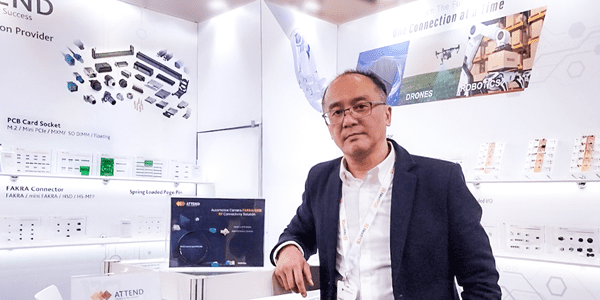
ATTEND presented an innovative automotive camera FAKRA connectivity solution at Embedded World 2026 in Nuremberg, Germany, demonstrating a complete RF signal transmission architecture between automotive camera modules and vehicle ECUs. The live demo drew engineers and procurement professionals from the automotive electronics, embedded systems, and automotive connector sectors.
Demo architecture: A complete signal chain from camera module to ECU
The demo begins at the SMB board-mount connector, which serves as the RF interface on the camera module PCB. The signal is then converted to an automotive-standard coaxial interface via a FAKRA-to-SMB adapter, transmitted through a FAKRA coaxial cable, and finally received at the FAKRA PCB connector on the ECU or IPC side — fully replicating the actual signal path found in automotive imaging systems from the camera module to the vehicle’s processing unit.
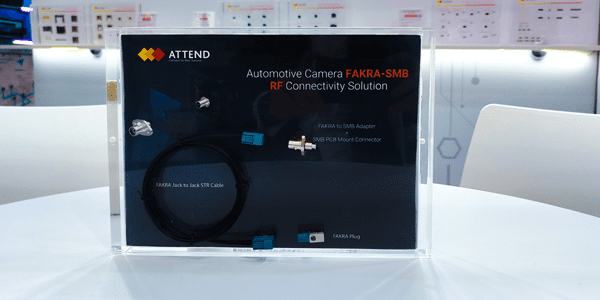
Built around SMB PCB connectors, a FAKRA-to-SMB adapter, and FAKRA coaxial cable, the demonstration shows how these components work together across a complete signal chain, and how signal integrity and automotive-grade mechanical reliability can be maintained within the spatial constraints of a real vehicle environment.
Industry trend: More cameras, higher connectivity demands
The automotive industry’s adoption of in-vehicle cameras has accelerated significantly in recent years. From a single reversing camera to today’s standard 360° surround view systems, and further to the multi-camera fusion architectures required for L2+ autonomous driving, the number of cameras in a modern vehicle has grown rapidly from one or two to six, twelve, or more.
This growth in camera count is directly driving increased demand for coaxial cables and RF connectors throughout the vehicle. As imaging resolution advances from 1080p toward 4K and synchronized multi-stream video transmission becomes standard, automotive systems face increasingly stringent requirements for high-bandwidth, low-loss, and highly reliable connectivity interfaces.
The FAKRA standard: A key connectivity interface for automotive imaging
Originally developed from German automotive industry standards, FAKRA connectors combine color-coded design, reliable high-frequency signal transmission, and structural compliance with ISO and USCAR automotive certifications. These characteristics have made FAKRA the connectivity standard of choice for vehicle cameras, radar systems, and antenna applications among global OEMs and Tier 1 suppliers.
As vehicle electrical architectures transition from traditional distributed ECU configurations toward centralized computing platforms, domain controllers and zonal controllers are increasingly required to aggregate signals from multiple cameras and sensors simultaneously. This shift raises new demands on connector density, reliability, and signal integration — further expanding the role of FAKRA-based solutions across next-generation automotive platforms.
Embedded World observations: Automotive and embedded worlds converging
This year’s Embedded World conference reflected a clear and continuing trend: the boundary between automotive electronics and traditional embedded systems is steadily dissolving. A growing number of embedded platform vendors, SoC suppliers, and connectivity component manufacturers are prioritizing automotive certification and ADAS applications as core market directions. Automotive safety standards such as ISO 26262 and the AUTOSAR architecture are no longer confined to OEM-level design requirements — they are increasingly shaping technical discussions throughout the embedded and electronics supply chain.
This shift signals that vehicle electrification and intelligence are fundamentally reshaping the technology landscape of the embedded systems industry.
ATTEND’s perspective
“As the number of cameras and sensors in vehicles continues to grow, stable and high-bandwidth RF signal connectivity has become a critical factor in system design,” said Leon Hung, ATTEND’s product manager. “By combining compact SMB board-mount connectors with automotive-grade FAKRA solutions, we help customers build reliable signal chains from the camera module to the ECU — within the spatial and performance constraints of today’s demanding automotive environments.”
He added that the demo was deliberately designed to give engineers an intuitive understanding of the complete signal path, rather than focusing on any single component: “The value of a connectivity solution lies in the stability of the entire signal chain — not just the spec sheet of one connector.”
Visit ATTEND to see more innovative connectivity solutions.
Like this article? Check out our other articles on EVs and HEVs, Standards and Trade Shows, our Automotive Market Page, and our 2025 and 2026 Article Archive.
Subscribe to our weekly e-newsletters, follow us on LinkedIn, Twitter, and Facebook, and check out our eBook archives for more applicable, expert-informed connectivity content.

- Printing at the Edge of Possibility: How TE Connectivity Leverages Micro-3D Printing - October 13, 2026
- A Five-Layer Clad Solution for High-Performance Battery Interconnects - October 6, 2026
- High Voltage Interlock for Commercial Vehicles: A Must-Have or a Nice to Have? - September 29, 2026