Built for the Mission: Engineering Interconnects for the UAV Market
Cable and connector assemblies for drones must deliver low weight, high reliability, and serve UAV platforms in both military and commercial markets.
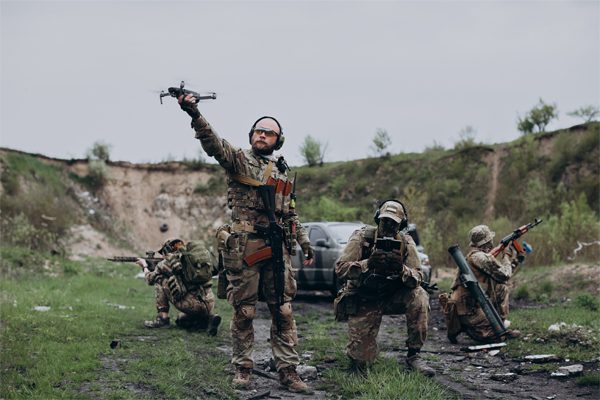
The unmanned aerial vehicle market has grown faster than the components designed to support it. For years, UAV designers reaching for high-reliability interconnects had to choose from products originally developed for conventional manned aircraft, as most commercial interconnects lacked the ruggedness needed for industrial and military equipment. However, many of these cables and connectors were engineered in an era when adding robustness meant adding mass.
Battery-powered UAVs are impacted by every ounce. Excess cable weight translates directly into shorter flight times, reduced payload capacity, and constrained mission performance. Recent component-OEM collaborations have yielded suites of high-reliability yet lighter weight components for commercial drones, such as Infineon Technologies Drone/Multicopter Solutions, available from Mouser. This portfolio of high-quality flight-ready components includes connectors, controllers, power modules, and sensors. This cost-effective solution is far more durable than the commercial components used in hobbyist equipment, yet lightweight, offering longer flying times and better safety, security, and control technologies. These components are being adopted for drones used for industrial and commercial tasks such as mapping, surveillance, and inspections.
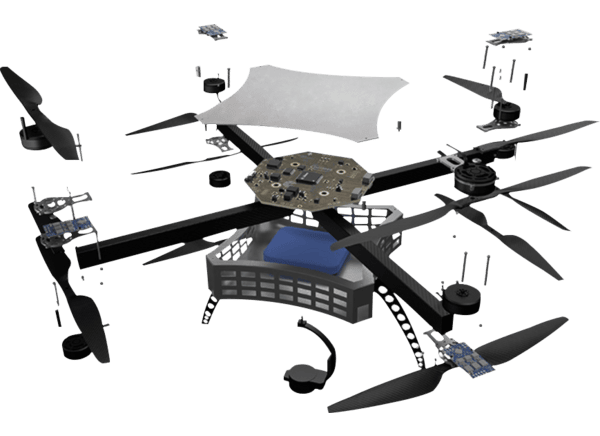
For the more demanding environmental conditions, larger payloads, and longer flight times needed in military operations, designers look for MIL-spec miniature interconnect solutions. Connector suppliers are looking at SWaP requirements to create solutions suitable for military drones and UAVs. “Designers were choosing the best interconnects available for their designs, but those cables and connectors still fell short of the requirements. We listened to the voice of the customer and realized there was a technology gap between what they wanted to achieve and what the available products allowed,” said David Slack, Director of Engineering, Times Microwave Systems.
Solving a technology gap for two markets
That gap, identified through sustained engagement with UAV platform designers, helped Times Microwave Systems develop Levitate, a new cable and connector assembly family made specifically for the UAV market.
“Times Microwave has been supplying RF and microwave interconnects for UAV airframes and rotary-wing platforms for years,” said Joana Rodrigues, marketing manager at Times Microwave Systems. The company works closely with customers in space, military, and industrial markets, learning about the challenges they encountered as UAV technologies advance. “This engineering-led approach that Dave’s team leads on gave us a very solid foundation to develop Levitate.”
The UAV segment now spans an enormous performance range. At one end are commercial quadcopters used for agricultural surveys, real estate imaging, deliveries, traffic control, and infrastructure inspection. At the other are large unpiloted military vehicles carrying full electronic warfare suites, operating at the same high altitude, extreme temperature, and vibration environments. Both ends of that spectrum share a sensitivity to weight. Times Microwave designed an interconnect product to address this challenge.
“It started for us as a peripheral to our other aerospace business,” said Slack. “We’ve split it off strategically as its own market and dedicated a product development project specifically to address it.”
Engineering a lighter solution
The Levitate development process began by assessing every design element in conventional interconnect construction. The team incorporated aerospace-grade aluminum alloys not traditionally used in cabling applications, removed material from non-load-bearing structural layers, and applied precision engineering to connector wall thicknesses to reduce mass to the minimum that structural and reliability requirements would allow.
“It’s easy to make a very robust connector by making things thick and big and massive,” Slack said. “It takes sophisticated engineering to thin those walls to the point where they’re still structurally sound and yet as light as possible.”
Electrical performance was treated as a fixed constraint throughout. Weight savings were pursued everywhere else. The Levitate 196 is 15% lighter than Times Microwave’s own Miltek Light — previously the lightest product of its kind in the industry — while delivering equivalent signal loss performance. The Levitate 156 is 25% lighter than the Miltek 160, achieves 10% lower loss, and is 30 to 50% lighter than any comparable product currently available on the market.
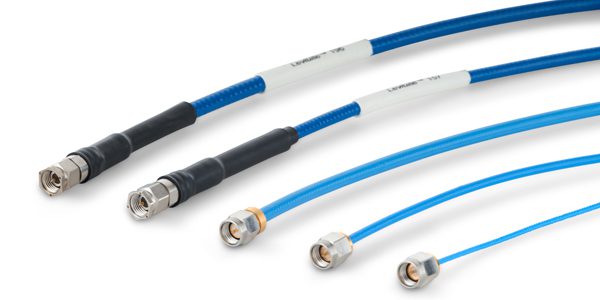
Levitate assemblies are engineered for dual use, meeting the modern demands of both military and commercial RF systems. Multiple sizes are available: The extremely flexible construction of the LVT047, LVT086, and LVT141 assemblies are ideal for in-the-box applications and the ultra-lightweight LVT157 and LVT196 support critical RF runs connecting antennas to LRUs.
Levitate comprises five product lines organized around the two dominant use cases in UAV interconnect design. The three smaller lines are engineered for tight internal routing to flex around sharp bends, maintain electrical stability under mechanical stress, and fit within avionics enclosures or route from circuit boards to enclosure panels. The two larger lines address extended-span applications in larger UAV platforms, where lower signal loss over longer cable runs is the priority and where the weight savings in heavier-gauge cable are most significant.
One product, two markets
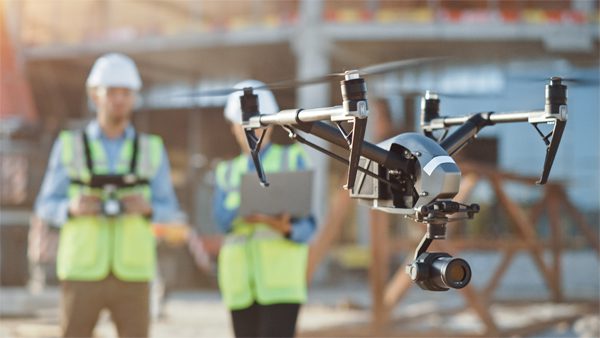
Levitate serves both military and commercial customers and is designed for availability to serve the rapid UAV development cycles. “We’re able to deliver something that is high quality — military-grade design with all of our military heritage — with quick turnaround. That’s really the sweet spot,” said Slack.
The team discovered how important availability is when the product launched in early March — right before military action began in Iran. “My email is flooding with questions,” said Rodriguez. “People are coming out of the woodwork with a lot of interest from platform designers, systems integrators, and distribution partners across both the military and commercial UAV segments.”
Drones and UAVs have proliferated in warfare across the Middle East and Ukraine, where they are delivering weapons and providing reconnaissance. “Instead of sending human beings out to scout an area, they’ll send UAVs. They are very much like commercial drones that real estate agents use to take aerial shots of houses. They can accomplish what it once took a human to do, more safely,” said Slack.
High-speed data
In the years ahead, UAVs will become essential equipment for sensitive applications like agriculture, security, and perimeter monitoring, where high-speed connectivity is essential to communicate information to a command center or process information to determine automated functions. To deliver the high reliability needed in military and commercial applications, UAVs carry on-board precision sensors that can maintain performance over time.
“UAVs are prone to vibrations occurring from propeller imbalances and degradation in motor bearings. Over time, vibrations can significantly impact the accuracy of gyroscopes, accelerometers, and cameras, regardless of the size of the UAV — whether a small drone, an urban mobility eVTOL, or a High-Altitude Long Endurance aircraft,” said Hoi-Yan Auyong, Amphenol FCI.
To solve this, typically, rubber-based passive isolation methods are employed to protect the MEMS-based sensors (Micro Electro Mechanical Systems). Active stabilization methods are less commonly used but can be implemented by transferring AI-based compensating stabilization programming to the flight controller via an Ethernet port.
“On the interconnect side, Amphenol FCI performs rigorous shock and vibration testing of its products using mechanical shaking systems that simulate drone vibrations,” said Auyong. “Whether BTB, FPC, or wire harness, such connectors feature vibration-tolerant designs like contact locks, Zero-Insertion Force (ZIF) latching, or robust outer cable protection respectively.”
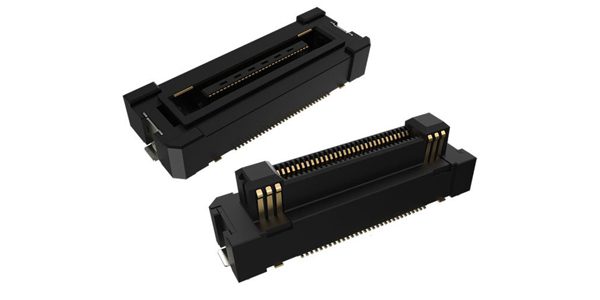
Amphenol FCI’s FloatCombo 0.50 mm BTB’s floating allowance across all three axes is stringently tested to automotive-safe USCAR-2 T3V2 standards, she said. PCB technologies like rigid-flex and best practices like using press-fit components help significantly against vibrations in the UAV.
To learn more about the companies mentioned in this article, visit the Preferred Supplier pages for Amphenol Communications Solutions, Mouser, and Times Microwave Systems.
Like this article? Check out our other Ruggedized and High-Reliability articles, our Military and Aerospace Market Page and our 2025 and 2026 Article Archives.
Subscribe to our weekly e-newsletters, follow us on LinkedIn, Twitter, and Facebook, and check out our eBook archives for more applicable, expert-informed connectivity content.

- Connectivity Is Reshaping Police and Security Vehicle Fleets - September 8, 2026
- Thermal Management Strategies with Liquid Cooling Connectors - August 11, 2026
- Rodent-Resistant Electronics - July 28, 2026