What is an LGA Socket?
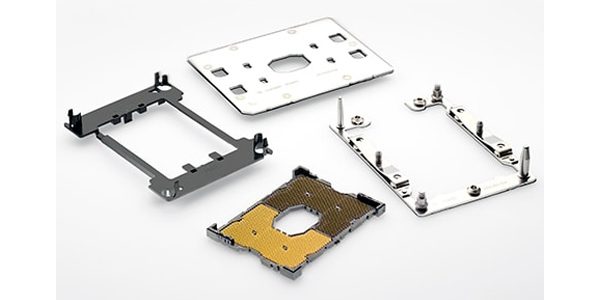
An LGA (land grid array) socket is a zero-insertion-force or low-insertion-force CPU interconnect in which the electrical contacts reside in the socket on the motherboard rather than on the processor package itself. LGA sockets are the dominant CPU interface in desktop, server, and workstation platforms. The socket format allows OEMs to design boards for multiple processor generations and gives end users a solderless path to processor upgrades. They are used by Intel across its mainstream and data-center processors and AMD adopted LGA in 2022, replacing decades of PGA (pin grid array) use.
Origin & Development
Intel introduced the LGA format with the LGA775 socket in 2004 for Pentium 4 and Core 2 processors, moving the fragile pin array from the processor package to the socket to simplify handling and eliminate bent-pin damage on CPUs. The format expanded through subsequent versions on the consumer/workstation side, and on the server side. AMD selected LGA with its AM5 socket (LGA1718) for Ryzen 7000 and subsequent desktop CPUs, marking a near-industry-wide shift to socket-side contacts.
Design Highlights
LGA sockets are chosen because placing the contacts in the socket rather than on the processor shifts wear and damage risk to the more replaceable, lower-cost board-side component. This move also allows the processor package to be a flat slab that handles more easily for manufacturing and service. The spring-loaded contact pins maintain consistent force across hundreds of contacts simultaneously, enabling very high pin counts. Current server LGA sockets exceed 4,000 positions while holding tight impedance tolerances.
LGA sockets are not cross-compatible between generations or vendors; each Intel or AMD platform defines its own pin count, pitch, geometry, and design. LGA competes with BGA (ball grid array), in which the IC is soldered directly to the board. PGA (pin grid array), LGA’s predecessor on AMD platforms, has been largely retired in favor of LGA for desktop CPUs.
Markets & Applications
LGA sockets are used in desktop PC motherboards, workstation platforms, rack-mounted servers, high-performance computing (HPC) nodes, AI/ML servers, and Test & Measurement. The format is also used in some embedded computing and rugged computing platforms, including automotive and communications applications.
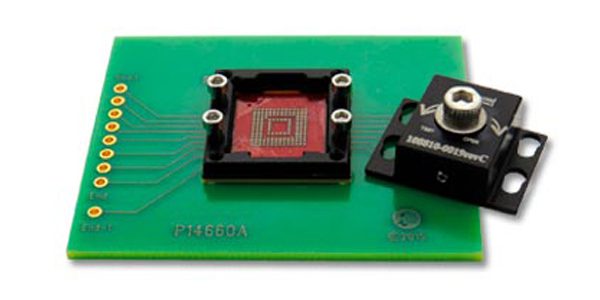
Ironwood Electronics NZGT socket is a device size or near device size footprint test socket incorporating high performance GT elastomer. This socket to work with BGA, LGA, QFN, DFN and other formats.
Technical Specifications
Values below cover the major current LGA platforms; pin count and pitch vary by specific socket generation.
| IDENTIFICATION | |
| Industry Category | IC Package Socket — Land Grid Array (LGA); PCB-mounted processor socket |
| MECHANICAL SPECIFICATIONS | |
| Shell / Housing Shape | Rectangular (square or near-square footprint matching processor package) |
| Shell Material & Finish | Reinforced plastic housing (LCP — liquid crystal polymer, or PPS); stainless steel or zinc alloy retention frame |
| Overall Dimensions | LGA1700: ~45 × 37.5 mm; LGA4677: ~76 × 56.5 mm; AM5/LGA1718: ~40 × 40 mm; SP5/LGA6096: ~75 × 58.5 mm; height varies ~5–8 mm with ILM installed |
| Mounting Type(s) | PCB surface-mount (SMT solder tails); through-hole variants exist for some embedded/server platforms |
| Receptacle Mounting Styles | SMT onto motherboard; ILM frame retention via screws or push-pin. |
| Mating Cycles (rated) | 20 insertions minimum (Intel spec); some platforms rated to 50 cycles |
| Locking Mechanism | ILM (independent loading mechanism) — screw or lever-actuated clamping plate providing controlled normal force across the full package; ZIF (zero insertion force) loading with force applied only after processor is seated |
| CONTACT SPECIFICATIONS | |
| Contact Count (range) | LGA775: 775; LGA1700: 1700; LGA4677: 4677; AM5/LGA1718: 1718; SP5/LGA6096: 6096; contact count matches socket platform designation |
| Contact Material & Plating | Phosphor bronze or beryllium copper spring pins; gold over nickel plating (15–30 μ” Au typical) on contact tip and landing zone |
| Termination Method(s) | SMT solder tails to PCB (socket side); pressure contact / land mating to processor package (no solder, no crimp) |
| Current Rating (per contact) | Varies by contact function; power delivery contacts typically rated 1–2 A per pin; total CPU power delivery managed across many parallel power pins |
| Voltage Rating | Signal contacts: typically 1.8 V–3.3 V logic; power contacts: 1.0–1.8 V core supply; platform-specific; dielectric withstanding per OEM qualification |
| SEALING & ENVIRONMENTAL | |
| Operating Temperature Range | -40 °C to +125 °C (storage); 0 °C to +85 °C operating (board ambient) |
| EMI / RFI Shielding | Unshielded; high-speed signal integrity managed via impedance-controlled PCB routing and package design rather than connector-level shielding |
| MATERIALS & COMPLIANCE | |
| Insulator Material | LCP (liquid crystal polymer) or PPS (polyphenylene sulfide); UL94 V-0 rated; ILM frame: stainless steel or zinc alloy |
| RoHS / REACH / Halogen Free | RoHS compliant on current production; REACH compliant; halogen-free housing available; verify per specific socket part number |
| ELECTRICAL PERFORMANCE | |
| Impedance (if controlled) | Controlled impedance contacts on high-speed lanes (e.g., PCIe, DDR); platform-defined; typically 85–100 Ω differential for high-speed signal pairs |
| Data Rate / Bandwidth | PCIe 5.0 (32 GT/s per lane) on LGA1700/LGA4677 current generation; DDR5 at 4800–6400 MT/s; PCIe 6.0 and CXL support on roadmap for next-generation server sockets |
SUPPLIERS
Manufacturers: TE Connectivity, Foxconn (FIT), Ironwood Electronics, Lotes, and Yamaichi are the primary socket manufacturers across Intel and AMD platforms.
Distributors: DigiKey, Mouser, TTI Inc.
RELATED PRODUCTS
BGA (Ball Grid Array)
PGA (Pin Grid Array)
DIMM Sockets
Like this article? Check out our other Meet the Connector and Connector Basics articles, our Military and Aerospace Market Page, and our 2026 Article Archives.
Subscribe to our weekly e-newsletters, follow us on LinkedIn, Twitter, and Facebook, and check out our eBook archives for more applicable, expert-informed connectivity content.

- Thermal Management Strategies with Liquid Cooling Connectors - August 11, 2026
- Rodent-Resistant Electronics - July 28, 2026
- EU Battery Regulation Prompts Design Changes for Battery Connectors - July 14, 2026