Semi-Rigid Cables are Reliable in Harsh Mil/Aero Environments
Their combination of unique characteristics offers advantages from rugged construction to signal integrity to saving space.

Military and aerospace applications often rely on uncompromised signal transmission in challenging environments, making cable selection a high priority. Semi-rigid cables have multiple features that make them an ideal choice. In addition to their solid construction and high reliability, they have the key advantage of being formable—an important consideration for high-frequency use in extreme environments, particularly where space is limited and attenuation is a main concern.
Semi-rigid cables minimize dielectric losses by pairing a solid inner conductor, typically copper, with a solid outer shield. A dielectric insulating material is encapsulated within the flexible metal tube made of braided copper or aluminum which forms a rigid outer shield. “The resulting semi-rigid structure maintains stable impedance along the entire length, reducing reflections and supporting overall system performance while protecting the inner conductor,” said Robert Grzib, Marketing Manager at CDM Inc.
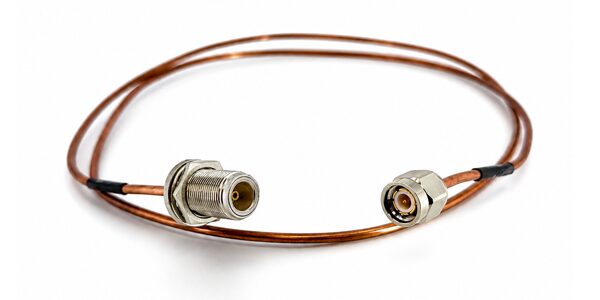
Semi-rigid cable assembly from CDM Inc.
Materials and construction
Materials and shielding are chosen for their resistance to humidity, corrosive elements, and varied environmental factors, surpassing the durability of most flexible coaxial cables. Semi-rigid cables are designed to function in temperatures from -55 °C to +125 °C with exceptional resistance against moisture and chemical exposure.
The solid outer conductor also provides superior EMI protection. Stronger shielding against electromagnetic interference is critical for protecting sensitive radar and communications systems and can minimize crosstalk to maintain transmission quality in high-density installations.
Mechanical stability is another crucial factor for ensuring signal integrity. “The rugged construction of semi-rigid cables allows them to maintain their form and electrical characteristics even when subjected to vibration, bending, or other mechanical stresses by reducing susceptibility to environmental damage,” said Grzib. “The rigid structure also allows for tighter cable bends and more compact routing, which is beneficial in space-constrained environments like aircraft, radar enclosures, or military vehicles.”
Semi-rigid cables are manufactured to exact specifications to meet the need for high-quality, repeatable, and consistent assemblies. While some flexible cables may be lighter, the use of semi-rigid cables can result in an overall weight benefit by using fewer connectors and incorporating simpler support structures.
A case study
To achieve the required level of performance, the cable and connectors must be selected together. A customer of Winchester Interconnect manufactured low insertion loss semi-rigid SMP cable assemblies in-house using purchased MIL-spec SMP right-angle solder type cable connectors with a standard bifurcated center contact, and 0.047 semi-rigid cable with 69.5 VoP solid PTFE dielectric. Despite its best efforts, the customer could not reliably meet the necessary performance criteria (SMP RA to RA; 0.047 cable diameter; 0-20 frequency range (GHz); 0.70 +/- .30 insertion loss [dB @ 20 GHz]; and 1.35:1 VSWR). The inconsistency caused critical disruptions in manufacturing.
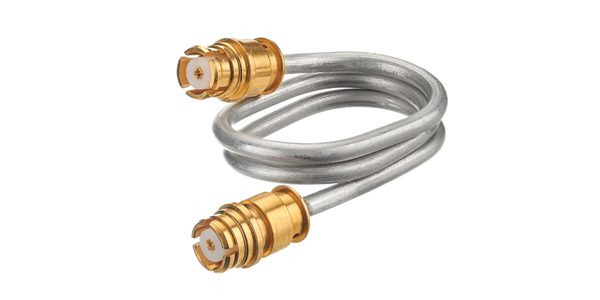
Winchester Interconnect specializes in custom-fabricated semi-rigid cable assemblies, offering superior RF interconnect solutions for demanding applications. These assemblies combine the exceptional electrical performance of semi-rigid coaxial cables with precisely terminated connectors and exact physical dimensions. Manufactured to customer-specific lengths, bent into complex shapes, and fitted with high-performance RF connectors, Winchester’s “drop-in” components deliver ultra-low loss, excellent VSWR, and superior shielding, coupled with mechanical rigidity and shape retention.
According to Winchester, coupling the connector and cable with the quality assembly work from experienced operators should have enabled the customer to meet the required performance criteria. After review, Winchester’s engineers found that the SMPs (designed to MIL-STD-348A), and the cables (intended to perform at 20 GHz), had little safety margin to meet the overall performance requirements. Despite proper assembly, connector interfaces within specification, and high-quality workmanship, the aggressive insertion loss requirement meant that the individual components needed to be optimized to work with each other. Winchester’s analysis revealed small impedance mismatches in the transition of the RF signal from the cable to the connector.
“These small mismatches occurred because, although the individual components were designed and manufactured to meet Mil-Spec dimensional standards, the connector and cable were not electrically and dimensionally optimized together to achieve the VSWR and IL performance required at the system level,” said Tony Martiniello, Director of Engineering, RF & Microwave, Winchester.
Winchester’s engineers selected the company’s swept R/A SMP connector designed to eliminate impedance mismatches and specifically developed to interface with Winchester’s Low Loss 0.047 Semi-Rigid cable. The recommended connector does not use a bifurcated contact and eliminates the associated performance compromise. The improved dimensional match optimizes the cable-to-connector RF signal transition.
To meet the specified insertion loss requirements at 20 GHz, the Winchester engineers also recommended an automated bending process using CNC programmable benders rather than manual bending, which can be inconsistent.
Winchester’s Low Loss Cable (83% velocity of propagation) assemblies resulted in the customer consistently meeting the performance requirements.
Semi-rigid cables without connectors
Semi-rigid .047 diameter cable is often used as an interconnect without connectors, according to Smiths Interconnect. The exposed center conductor and outer jacket are soldered directly to the circuits being connected. This technique, also called a direct-attach or pigtail connection, offers several potential advantages. “Depending on the application, eliminating connector transitions can reduce VSWR and improve electrical performance, and reduce space and weight,” said Tim Meehan, Product Line Manager Fiber Optics and RF Components at Smiths Interconnect. “In aerospace and military systems, it can improve vibration resistance with the use of epoxy staking and strain-relief clamps, and by bonding the cable jacket to the chassis.”
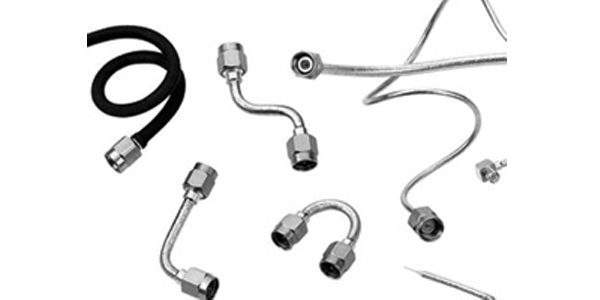
Semi-Rigid space qualified cables from Smiths Interconnect, a Molex company, are available with a copper or aluminum jacket, a selection of different platings, and four different diameters (.047”, .085”, .141”, and .250”). High-frequency RF cable assemblies are available with a wide variety of flexible and semi-rigid cable types with space orbit qualifications and are well-suited for satellite payloads (GEO/MEO and LEO constellations), deep space probes, ground antenna networks, and space robotic systems.
Specifying semi-rigid coaxial cables for military and aeronautical applications requires careful attention to frequency range, impedance, materials, environmental conditions, connector types, and compliance with industry standards. By systematically evaluating these factors, engineers and procurement professionals can select high-quality cables that meet the demanding requirements of their missions”. Tim Meehan, Product Line Manager Fiber Optics and RF Components states
Specifying semi-rigid coaxial cables for military and aeronautical applications requires careful attention to frequency range, impedance, materials, environmental conditions, connector types, and compliance with industry standards. By systematically evaluating these factors, engineers and procurement professionals can select high-quality cables that meet the demanding requirements of their missions.
To learn more about the companies mentioned in this article, visit the Preferred Supplier pages for CDM Inc., Winchester Interconnect and Smiths Interconnect, a Molex company.
Like this article? Check out our other Harsh Environment and High-Reliability articles, our Military and Aerospace Market Page and our 2026 Article Archives.
Subscribe to our weekly e-newsletters, follow us on LinkedIn, Twitter, and Facebook, and check out our eBook archives for more applicable, expert-informed connectivity content.

- Micro, Mini, and Nano Product Roundup - September 8, 2026
- September 2026 Connector Industry News - September 8, 2026
- Electronic Technology is in the Wind - September 1, 2026